Field notes
Yellow Perch: Identification, Habitat & Diet
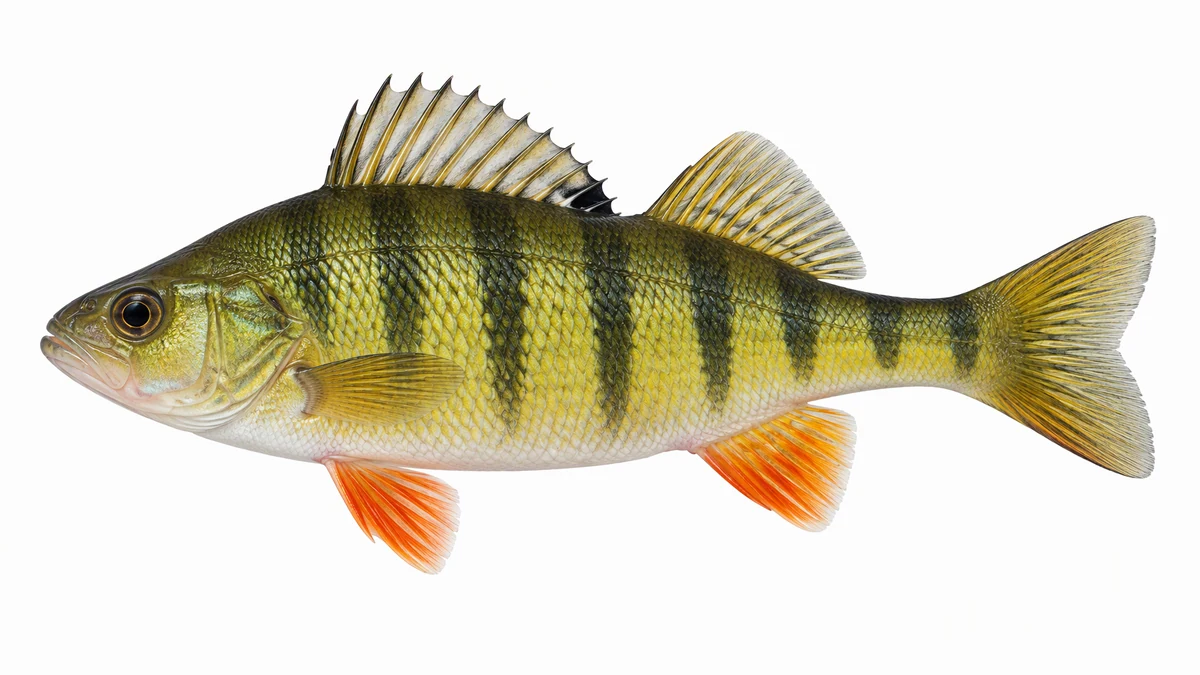
Yellow Perch: Identification, Habitat & Diet
The yellow perch is a small, striped, cold-water fish that has introduced more people to fishing than almost any other species in the northern states. It schools in lakes and slow rivers, bites through the ice, tastes good on the plate, and looks like a hand-painted lure: yellow-green sides, dark vertical bars, and orange-red lower fins. It is also a close relative of the European perch and the walleye, and it occupies a similar role in the food web. This profile covers yellow perch identification, habitat, diet, size, spawning, regulations, and how to catch them in open water and through the ice.
Quick ID Card
| Field | Details |
|---|---|
| Scientific name | Perca flavescens |
| Common names | Yellow perch, perch, lake perch, American perch, striped perch |
| Family | Percidae (perches and darters) |
| Typical size | 6–10 inches (15–25 cm), 0.3–0.75 lb |
| Jumbo size | 12–14 inches, 1–1.5 lb |
| Water type | Lakes, reservoirs, and slow rivers with weed edges and hard bottom |
| Active water temperature | 50–75°F (10–24°C) |
| Difficulty | Easy; small baits and light line |
| Best season | Ice-out through early spring; fall and winter ice fishing |
How to Identify a Yellow Perch
The pattern does most of the work. A yellow perch has a yellow-green to golden body crossed by six to eight dark vertical bars. The bars are bold and evenly spaced, running from the back down the sides. The belly is pale yellow to white. The lower fins, especially the pelvic and anal fins, are orange or red-orange, and the tail is yellowish.
The fins are arranged in a way that separates perch from sunfish. Perch have two separate dorsal fins: a spiny front fin and a soft rear fin, with a clear gap between them. Sunfish have a single dorsal fin, often with a notch. Perch also have a small mouth that reaches only to the front of the eye, and a slightly pointed snout.
The eye is yellow or amber, and the gill cover has a sharp point. Body shape is elongate and slightly humpbacked, not deep and flat like a bluegill. A big perch looks like a small walleye with stripes; a small perch looks like a bright minnow with spines.
Juveniles are paler, with fainter bars, and can be confused with young walleye or sauger. Check the bars: perch have distinct vertical stripes, while walleye are mottled and lack clear bars. The white tip on the lower lobe of a walleye's tail is absent on a perch.
Yellow Perch vs Walleye
Perch and walleye are relatives, and both are prized in the same northern lakes. Size and pattern separate them quickly.
| Feature | Yellow perch | Walleye |
|---|---|---|
| Size | 6–10 inches typical, rarely over 14 | 15–25 inches typical, often much larger |
| Pattern | Six to eight bold dark vertical bars | Mottled olive-gold, no clear bars |
| Dorsal fins | Two separate fins, spiny front | Two fins, spiny front, similar |
| Tail | Yellow, no white tip | White tip on the lower lobe |
| Eye | Yellow or amber | Glassy, silvery, light-sensitive |
| Mouth | Small, reaches front of eye | Larger, with teeth |
| Fins | Orange-red pelvic and anal fins | Pale, no bright orange |
The European perch (Perca fluviatilis) is the yellow perch's Old World counterpart. The two were once classified as the same species, and they look alike: barred sides, two dorsal fins, red lower fins. European perch tend to have a deeper body and redder fins, and they grow larger in some waters. The North American yellow perch is the fish covered here.
Is the Yellow Perch Dangerous?
No. The yellow perch is not venomous and has no teeth that can injure a person. It does have a spiny dorsal fin and a sharp gill cover, and a lively perch can poke a hand during unhooking. The spines are sharp enough to sting, but the injury is minor.
Hold the fish with wet hands, fold the spiny dorsal fin down gently, and avoid gripping the body too tightly. Small perch are easy to drop, and a fall onto ice or rocks can damage them. Use small hooks, pinch the barb if you plan to release fish, and keep handling short in freezing weather, when a fish's gills and eyes are vulnerable.
Range and Habitat
Yellow perch are native to central and eastern North America, from the Great Lakes and the St. Lawrence system through the Mississippi and Ohio drainages and south along the Atlantic coast. They have been introduced to many western states and to other parts of the world. In Canada, they are widespread across Ontario, Quebec, and the prairie provinces.
Yellow perch habitat is cool, moderately deep water with structure. Lakes and reservoirs are the core, especially where weed beds, gravel bars, and drop-offs meet. Slow rivers and backwaters hold fish too, particularly in pools and around bridge pilings. Perch avoid fast current and warm, stagnant shallows in summer.
Weed edges are a reliable pattern. Perch sit just outside the vegetation, where they can see prey and retreat into cover. Gravel and hard bottom attract insects and crayfish, and the fish often gather over these areas in fall. In summer, schools suspend over deeper flats or follow baitfish along the thermocline. In winter, they move deeper but remain active under the ice.
Water temperature in the 50s to mid-70s Fahrenheit keeps perch feeding. They are among the most cold-tolerant panfish and stay catchable when bass and sunfish slow down.
Behavior and Diet
Yellow perch are schooling fish. Young perch group tightly for protection; adults form looser schools that roam in search of food. The schools often sort by size, so a spot that produces small fish may hold larger fish nearby, slightly deeper or along a different edge. Once you find a school, you can usually catch several fish before it moves. How to catch yellow perch, then, is mostly a matter of finding the school and matching the size of the bait.
The diet is broad. Aquatic insect larvae, mayflies, caddisflies, and midges are important, especially for small fish. Adults eat minnows, shiners, small crayfish, and the young of other fish. Perch feed heavily in low light, and winter ice fishing works because the fish remain active under the ice and take small baits.
Feeding peaks in the morning and late afternoon, though schools can bite all day in overcast weather. In summer, look for perch along weed edges, over gravel, and around submerged points. In fall, they group more tightly and feed aggressively before winter. In winter, they hold near the bottom in deeper water, often in basins adjacent to shallow flats.
Spawning is an early-spring event. Yellow perch spawn shortly after ice-out, when water reaches about 45–55°F (7–13°C). Females release long, gelatinous egg strands that drape over weeds, brush, and gravel. There is no nest guarding; the strands incubate on their own. A warm spring can compress the spawn into a few days, while a cold spring stretches it out. After spawning, fish move to summer cover and feed heavily.
Perch grow slowly in crowded lakes and faster where forage is abundant. That is why some lakes produce many 6-inch fish and others regularly give up 12-inch jumbos.
Size, Records and Regulations
Most yellow perch caught by anglers are 6–10 inches and weigh under a pound. A 12-inch fish is a jumbo in most waters, and a 14-inch perch is a fish to remember. The all-tackle world record is 4 pounds 3 ounces (1.9 kg), caught in New Jersey in 1865. It is the oldest standing record in the IGFA books, which says as much about the species' growth ceiling as it does about the fish.
State records generally fall in the 2–3 pound range, with the largest fish coming from large lakes with abundant forage. Western reservoirs and some Great Lakes bays produce big perch, but a true four-pound fish is rare anywhere. Most waters are open year-round, but some lakes close or restrict harvest during the spring spawn.
Regulations vary widely. Some states have no minimum length and a daily bag of 25–50 perch; others allow unlimited harvest in certain waters, and a few impose stricter limits to protect slow-growing populations. Great Lakes states often have separate rules for different lakes and management zones. A fishing license is required, and some waters add special permits or seasonal closures.
Because perch are heavily harvested and rules change often, check the current regulation booklet or website for the state agency that manages your water before keeping fish. In the Great Lakes region, the Minnesota Department of Natural Resources (MNDNR) and the Wisconsin Department of Natural Resources (WIDNR) publish state rules; tribal and interstate rules may also apply. Last verified: November 2025.
FAQ
How big do yellow perch get? Most adults are 6–10 inches and under a pound. Jumbo perch reach 12–14 inches and 1–1.5 pounds, and the world record is 4 pounds 3 ounces.
What is the world record yellow perch? A 4-pound 3-ounce fish caught in New Jersey in 1865. It is the oldest standing IGFA all-tackle record.
How do you tell a yellow perch from a walleye? Perch have bold dark vertical bars, orange-red lower fins, and no white tip on the tail. Walleye are mottled, larger, and have a white tip on the lower tail lobe.
Where do yellow perch live? In lakes, reservoirs, and slow rivers across central and eastern North America, from the Great Lakes and St. Lawrence system through the Mississippi basin. They favor weed edges, gravel, and cool water.
What do yellow perch eat? Aquatic insects, minnows, shiners, small crayfish, and the young of other fish. Small perch eat mostly insects and zooplankton.
When do yellow perch spawn? Shortly after ice-out in early spring, when water reaches about 45–55°F (7–13°C). They release long egg strands over weeds and brush.
What is the best bait for yellow perch? Small minnows, worms, and small jigs are the standards. Tiny spoons, ice jigs, and soft plastics work in open water and through the ice.
How do you catch yellow perch through the ice? Drill over a weed edge, drop-off, or basin, use a small jig tipped with a minnow or spike, and move until you find a school. A flasher or sonar helps locate fish and keep the bait at their depth.
The yellow perch is proof that a fish does not need size to be worth chasing. Find the school, match the small bait, and the yellow perch will keep the rod bent through summer, fall, and the coldest days of winter.
Related Articles
- Smallmouth Bass — a cool-water predator that shares northern lakes and rivers.
- Pumpkinseed — a warm-water sunfish for the same light tackle.
- Longear Sunfish — a small stream native with a very different look.
- All bass and panfish profiles
Ready to catch one? Read our step-by-step guide: How to Catch Yellow Perch.
About the author and how this was tested
About the author
FishermanGuy
Bank, boat and kayak angler · fishing, crabbing and shrimping since 2021
I buy the gear, fish it for a season and write down what failed. No sponsored verdicts, no free-sample flattery. Every rig on this page has landed fish in water I can point at on a map.
How this was tested
- Every rig gets at least six trips on the same water before it is published.
- Gear is bought at retail. Free samples are labelled in the first paragraph.
- Dates show first publication and the last time the page was updated.