Field notes
Muskellunge: Identification, Habitat & Diet
Muskellunge: Identification, Habitat & Diet
The muskellunge is the largest member of the pike family and one of the most prized freshwater predators in North America. Anglers call it the fish of ten thousand casts, and the nickname is earned. A muskie may follow a lure to the boat and refuse it, then vanish for the rest of the day. It grows big, strikes hard, and lives in water that rewards patience. This profile covers muskellunge identification, habitat, diet, size, spawning, regulations, and the approach that gives you a realistic chance at one.
Quick ID Card
| Field | Details |
|---|---|
| Scientific name | Esox masquinongy |
| Common names | Muskellunge, muskie, musky, great pike, fish of ten thousand casts |
| Family | Esocidae (pikes) |
| Typical size | 30–40 inches (76–102 cm), 8–20 lb |
| Trophy size | 48+ inches (122+ cm), 30+ lb |
| Water type | Cool lakes, rivers, and reservoirs with weed, wood, or rock cover |
| Active water temperature | 59–77°F (15–25°C), best around 65–72°F (18–22°C) |
| Difficulty | High; big tackle, long hours, and a low strike-to-cast ratio |
| Best season | Late fall and early spring; low light in summer |
How to Identify a Muskellunge
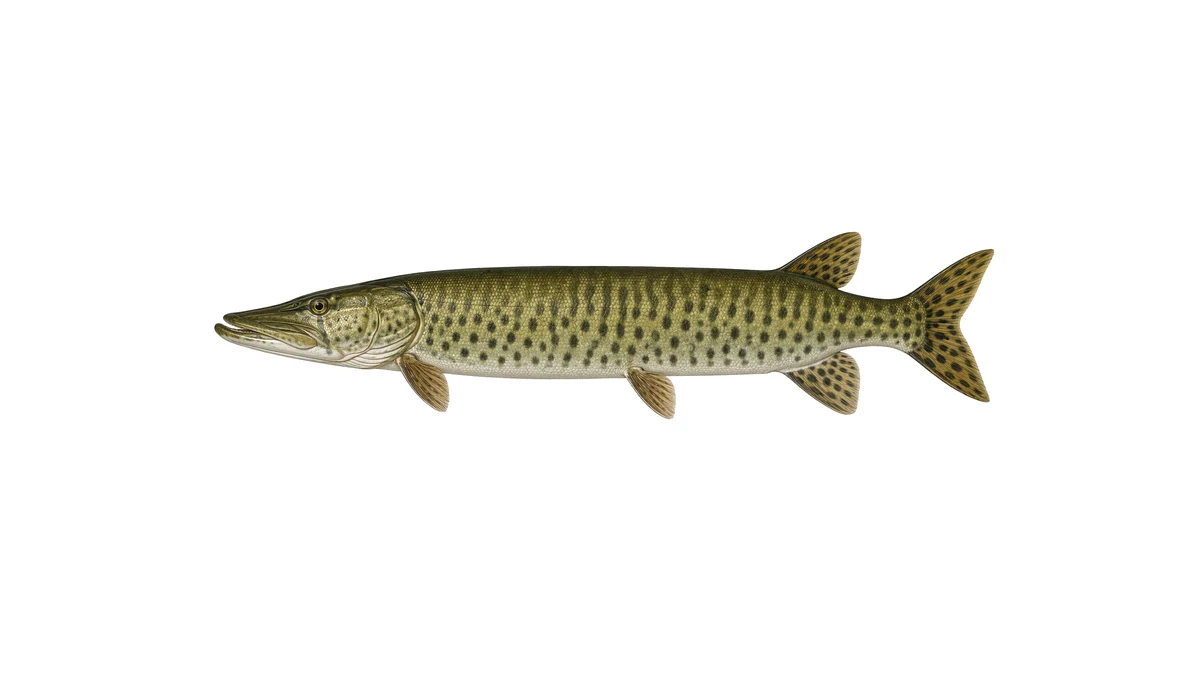
A muskellunge looks like a northern pike that went to the gym and kept the appetite. The body is long and cylindrical, built for short bursts rather than long chases. The head is large, the snout broad and duck-billed, and the lower jaw carries a row of stout, slightly inward-curving teeth. The roof of the mouth and tongue are lined with smaller teeth that point backward, a design that helps hold prey.
Coloration varies by strain and water. Great Lakes fish often show dark spots on a light green, silver, or olive background. Northern and river fish more often show dark vertical bars. The belly is pale. Fins are usually marked with dark blotches, and the tail is forked with lobes that come to a sharper point than a pike's rounded tail.
Two field marks settle the question on a fish in the net. First, look at the cheek and gill cover. On a muskellunge, scales cover only the upper half of the cheek and the upper half of the gill cover; the lower halves are bare skin. A northern pike has scales over the whole cheek and gill cover. Second, count the pores under the lower jaw. A muskie usually has six to nine pores on each side. A pike has five or fewer. The pore count is the cleanest test when the fish is alive and wet.
Juveniles are slender and heavily marked, and they can be mistaken for pike or for tiger muskies. The cheek scaling and pore count still work on small fish if you look closely.
Muskellunge vs Northern Pike
The two species share range, habitat, and a family tree, so misidentification is common. Michigan, Wisconsin, Minnesota, and Ontario all produce fish that could be either, and the answer changes the rules that apply.
| Feature | Muskellunge | Northern pike |
|---|---|---|
| Cheek and gill cover | Lower half bare of scales | Fully scaled |
| Jaw pores per side | 6–9 | 5 or fewer |
| Pattern | Dark spots or bars on a light background | Light bean-shaped spots on a dark background |
| Tail | Forked, with pointed lobes | Rounded |
| Typical size | 30–40 inches, 8–20 lb | 20–30 inches, 2–8 lb |
| Growth | Slow, late to mature | Faster, matures earlier |
The tiger muskie is a third fish to know. It is a hybrid between a female muskellunge and a male northern pike, and it is sterile. Tiger muskies usually show a mix of bars and spots, grow quickly, and are stocked in some waters to control stunted panfish. Because they cannot reproduce, they are managed differently from either parent species in many states.
Size is a useful clue but not a rule. A big pike can reach muskie length, and a young muskie can look small. Check the cheek and the pores before you decide.
Is the Muskellunge Dangerous?
The muskellunge is not venomous and does not have spiny fins. Its pike-family fins are soft-rayed. The danger is in the mouth. Those teeth can open a finger, and the gill rakers inside the gill cover are sharp enough to rake a hand. A hooked muskie that rolls at the boat can also drive a treble hook into whoever is reaching for it.
Handle muskies with a firm jaw grip behind the gill cover and support the belly with the other hand. Do not hold a big fish vertically by the jaw alone; the internal organs are not built for that load. Keep the fish in the water while you unhook it when possible, use a large rubber-mesh net, and have bolt cutters within reach for hook removal. A wet mat and a quick photo protect the fish and the angler.
Range and Habitat
The native range of the muskellunge runs through the Great Lakes and the St. Lawrence River system, the upper Mississippi River drainage, and the Ohio River basin. It reaches north into Ontario and Quebec and south into parts of the Ohio Valley. Stocking has extended it well beyond that core, including reservoirs and rivers in states where it never lived.
Muskellunge habitat comes down to cool, clean water and cover. Lakes with weed beds, drowned timber, rocky points, and deep water nearby are classic. Rivers hold fish around boulders, bridge pilings, current seams, and fallen trees. The fish likes an edge: the line where weeds meet open water, where a rock ledge drops into depth, or where current slows behind structure.
Water temperature shapes the pattern. Muskies are most active from about 59°F to 77°F (15–25°C). In summer, that often means deep weed edges and offshore structure during the day, with fish moving shallow at dawn, dusk, and after dark. In fall, cooling water pushes them onto main-lake rock and weed flats where they feed hard before winter. In spring, they move into shallow, warming bays.
Water quality matters. Muskies need oxygen and clean spawning habitat, and they are less tolerant of silt and warming than pike. Good muskie water is usually good coldwater fish water.
Behavior and Diet
A muskellunge is an ambush predator that also hunts open water. It holds near cover, waits for prey to make a mistake, and then closes with a short, violent strike. What do muskellunge eat? Mostly fish: cisco, whitefish, suckers, perch, walleye, bass, and whatever else fits in that wide mouth. Big fish also take frogs, ducks, muskrats, and small mammals. A 40-inch muskie can swallow a fish a third of its own length.
Feeding peaks in low light. Dawn, dusk, and night are prime, and many serious muskie anglers fish under moonlight or during weather changes. Cloud cover and wind help. Bright, calm, high-sky days usually push fish deep or tight to cover.
When do muskellunge spawn? Spawning happens in spring, usually from April into May, when water reaches about 48–59°F (9–15°C). Fish move into shallow bays, flooded marsh, and vegetated shorelines. There is no nest. Eggs are scattered over vegetation and debris, and adults leave without guarding them. Hatch timing depends on temperature, and early life survival is variable, which is one reason muskie populations recover slowly.
Muskies are solitary and territorial. They do not school, and a good spot rarely holds many big fish. That low density is part of why the fish is hard to catch and why regulations protect it.
Size, Records and Regulations
Most adult muskellunge run 30–40 inches and 8–20 pounds. A 48-inch fish is a trophy in most waters, and a 50-inch-plus fish over 30 pounds is the goal of a dedicated angler's season. The species can reach about 6 feet (1.8 m) and more than 30 kg, though fish that size are rare.
The IGFA all-tackle world record muskellunge is 67 pounds 8 ounces (30.6 kg), caught by Cal Johnson on Lac Vieux Desert, Wisconsin, in 1949. It has stood for more than seventy years. Wisconsin also recognizes a 69-pound 11-ounce state record taken from the Chippewa Flowage in 1949 by Louis Spray, a fish heavier than the world record but never certified as one. Both catches came from the same state in the same year, which says a lot about how rarely fish of that class appear.
Regulations are strict because muskies are slow to mature and unreliable spawners. Many waters use minimum lengths of 40 to 54 inches, bag limits of one fish, and strong catch-and-release expectations. Wisconsin uses a 40-inch minimum on most waters and 50 inches on some; Minnesota moved to a 54-inch minimum on most waters in recent years; Ontario sets zone-specific rules, with several zones using a 36-inch minimum. Stocking programs in many states depend on anglers releasing fish.
Check the current rules before you fish. The agency that manages your water is the source: Wisconsin Department of Natural Resources, Minnesota Department of Natural Resources, Ontario Ministry of Natural Resources and Forestry, or the equivalent in your state. Last verified: November 2025.
FAQ
How big do muskellunge get? Typical adults are 30–40 inches and 8–20 pounds. Fish over 48 inches and 30 pounds are trophies, and the species can reach about 6 feet and more than 30 kg. Growth is slow, especially in northern waters.
What is the world record muskellunge? A 67-pound 8-ounce fish caught by Cal Johnson on Lac Vieux Desert, Wisconsin, in 1949, according to IGFA. Wisconsin also lists a 69-pound 11-ounce state record from the Chippewa Flowage, caught the same year but not certified as a world record.
What do muskellunge eat? Mostly fish, including cisco, whitefish, suckers, perch, walleye, and bass. Large adults also eat frogs, ducks, muskrats, and other small animals. Feeding is strongest in low light.
Where do muskellunge live? Natively in the Great Lakes, St. Lawrence system, upper Mississippi drainage, and Ohio River basin, plus Ontario and Quebec. Stocking has added lakes and reservoirs in many other states. They favor cool, clean water with weed, wood, or rock cover.
What is the difference between a muskellunge and a northern pike? Check the cheek and jaw. A muskie has bare skin on the lower half of the cheek and gill cover plus six to nine jaw pores per side. A pike is fully scaled on the cheek and has five or fewer pores. Muskies also show dark markings on a light background, while pike show light spots on a dark background.
When do muskellunge spawn? In spring, usually April to May, when water reaches about 48–59°F (9–15°C). They scatter eggs in shallow, vegetated bays and do not guard them.
What is the best bait for muskellunge? Large bucktail spinners, glide baits, crankbaits, rubber swimbaits, and big topwater lures all catch fish. Live suckers are effective where legal. Use heavy line and a wire or heavy fluorocarbon leader.
How do you catch a muskellunge? Fish low-light periods around cover and edges, make long casts, and work lures with figure-8 moves at the boat. Expect follows without strikes. Big tackle, sharp hooks, and a good net matter more than any single lure.
A muskellunge is not a fish you catch by accident. It is a fish you plan for, fish hard for, and usually release. Protect the water, follow the rules, and the next cast might be the one.
Related Articles
- Bowfin — another ancient, hard-fighting predator of eastern North America.
- Alligator Gar — a giant ambush predator with a very different set of teeth.
- Spotted Gar — a smaller armored predator from the same warm backwaters.
- All species profiles
Ready to catch one? Read our step-by-step guide: How to Catch Muskellunge.
About the author and how this was tested
About the author
FishermanGuy
Bank, boat and kayak angler · fishing, crabbing and shrimping since 2021
I buy the gear, fish it for a season and write down what failed. No sponsored verdicts, no free-sample flattery. Every rig on this page has landed fish in water I can point at on a map.
How this was tested
- Every rig gets at least six trips on the same water before it is published.
- Gear is bought at retail. Free samples are labelled in the first paragraph.
- Dates show first publication and the last time the page was updated.