Field notes
Longear Sunfish: Identification, Habitat & Diet
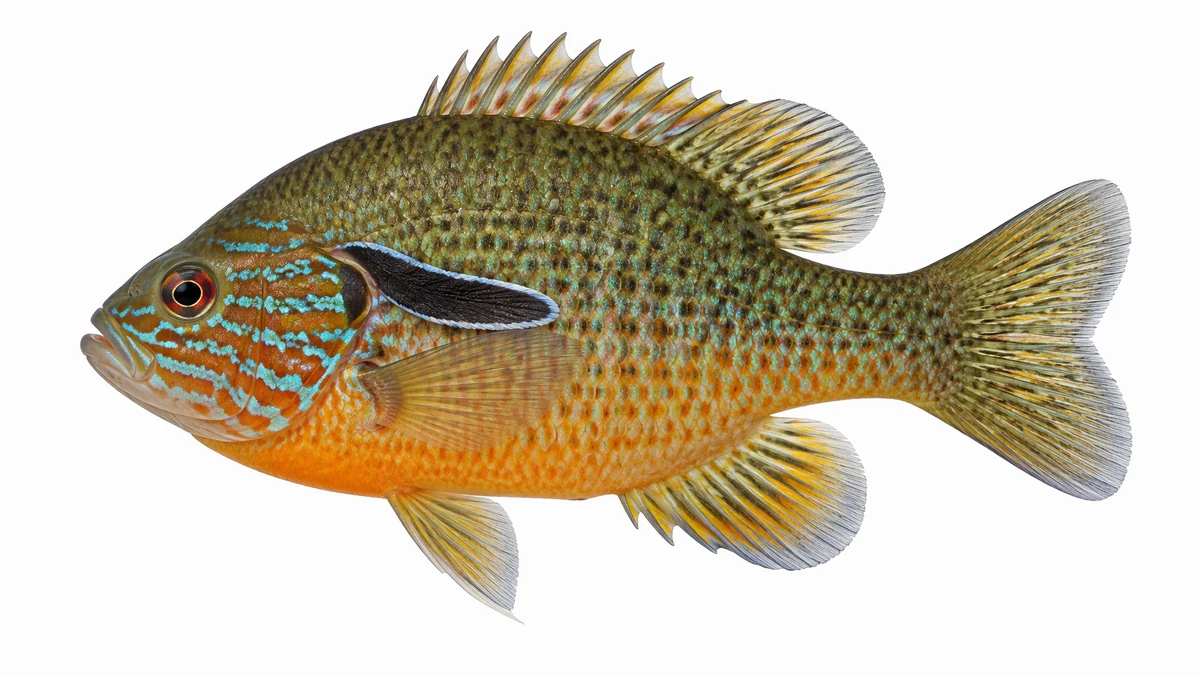
Longear Sunfish: Identification, Habitat & Diet
The longear sunfish is a small, brilliant native of clear creeks and rocky rivers, and its name comes from the one feature no other sunfish shares: an unusually long black ear flap that trails past the gill cover like a dark ribbon. In breeding condition, males turn blue, orange, and red, and a school of them over a gravel nest is one of the brightest sights in North American freshwater. The fish rarely exceeds a handspan, but it bites hard, fights in circles, and lives in some of the prettiest water in the country. This guide covers longear sunfish identification, habitat, diet, size, spawning, regulations, and how to catch them.
Quick ID Card
| Field | Details |
|---|---|
| Scientific name | Lepomis megalotis |
| Common names | Longear sunfish, long-eared sunfish, big-eared sunfish, creek sunfish |
| Family | Centrarchidae (sunfishes) |
| Typical size | 3–6 inches (8–15 cm), 0.1–0.4 lb |
| Maximum size | About 8 inches (20 cm), roughly 0.4 lb (0.2 kg) |
| Water type | Clear, warm creeks and small rivers with gravel and vegetation |
| Active water temperature | Roughly 68–82°F (20–28°C) |
| Difficulty | Easy; small hooks and light line |
| Best season | Late spring and summer, especially around spawning colonies |
How to Identify a Longear Sunfish
The ear flap is the first thing to check. On a longear, the black opercular flap is longer than the rest of the gill cover and often edged with a thin pale blue-white line. It looks like a small black ear hanging off the side of the head, and it is noticeably longer than the flap on a bluegill, pumpkinseed, or redear. The flap length alone will identify most fish.
The body is small and deep, with a small mouth and a slightly pointed face. Color varies with sex, age, and water. Non-breeding fish are olive-green above with orange or yellow bellies and blue-green speckles. Breeding males are spectacular: the back stays olive, the belly turns deep orange, the cheek and gill cover are covered in bright blue wavy lines, the eye glows red, and the long ear flap stands out against the color.
The fins are translucent with orange or yellow tint, and the pectoral fins are short and rounded. The eye is large for the head. Females and juveniles show the same long flap and wavy lines, just with less saturation. Hybrids with other sunfish occur, but the long flap usually remains visible and points to longear ancestry.
One taxonomic note: the longear is part of a species complex. Populations in the upper Midwest and Northeast are sometimes treated as a separate species, the northern sunfish (Lepomis peltastes), while true longear are recognized in the central and southern states. For anglers, the practical field mark is the same: a small sunfish with a very long black ear flap and blue wavy cheek lines.
Longear Sunfish vs Bluegill
Bluegill are larger, more widespread, and far more familiar, so most misidentifications run in that direction. The ear flap is the fastest way to separate them.
| Feature | Longear sunfish | Bluegill |
|---|---|---|
| Ear flap | Long, black, trailing past the gill cover, pale edge | Short, solid black, rounded |
| Body | Small, deep, slightly pointed face | Deeper, larger, bigger mouth |
| Color | Blue wavy lines, orange belly, red eye | Olive with dark vertical bars, dark gill spot |
| Typical size | 3–6 inches | 5–9 inches, often larger |
| Habitat | Clear creeks and small rivers | Ponds, lakes, slow water |
Longear also behave differently. They are more tied to flowing water and clean gravel than bluegill, and they rarely reach the size of a good bluegill. A small sunfish from a rocky creek, with blue lines on the cheek and a long black ear, is almost certainly a longear. A larger sunfish from a farm pond with a short black flap is a bluegill.
Is the Longear Sunfish Dangerous?
No. The longear is harmless. It has no venom, no cutting teeth, and no defensive weapon beyond the sharp spines in its dorsal, anal, and pelvic fins. Those spines can prick a hand, but the result is minor.
Handle the fish with wet hands and a light grip. Because longear are small, they are easy to over-handle or drop. Keep the fish in the water while removing the hook if possible, use small barbless hooks when you plan to release fish, and avoid squeezing the body. In warm summer water, a quick release matters more than a photo.
Range and Habitat
Longear sunfish are native to central and eastern North America, with the core of the range in the Mississippi Valley and the rivers of the Midwest and South. They occur from the Great Lakes region south through the Ohio and Mississippi drainages into Texas and the Gulf states, and east into parts of the Appalachians. The related northern sunfish replaces them in colder northern waters.
Longear sunfish habitat is moving water, not big lakes. Longear prefer clear creeks and small rivers with gravel riffles, rocky pools, undercut banks, and beds of aquatic plants. They hold in slow pockets behind rocks and logs, along shaded banks, and in the tails of pools where insects drift down. Clean gravel is important for spawning, and good water clarity helps them see food.
Longear tolerate warm summer water and low flow better than trout, but they are less tolerant of silt and pollution than bluegill. Sediment that fills gravel beds and smothers vegetation hurts longear populations, and channelization removes the pools and cover they need. Where a creek stays clean and rocky, the fish are usually abundant.
Depth is shallow. Most longear sit in 1–4 feet of water, and spawning fish may be in less than a foot. In drought, they concentrate in remaining pools; in high water, they move to the edges and behind structure.
Behavior and Diet
Longear sunfish eat aquatic insects, small crustaceans, snails, and tiny fish. They pick food from rocks, stems, and the bottom, and they rise to insects on the surface when the light is low. Their small mouth limits prey size, so they favor small items and bite them aggressively.
Feeding is strongest in the morning and evening, though fish in shaded creeks feed throughout the day. A longear's strike is quick and confident for its size. A small worm or cricket drifted under a float rarely sits long, and a tiny jig or fly cast to a shadow line usually gets a response.
Spawning begins in late spring and peaks in early summer, when water reaches about 68–75°F (20–24°C). Males clear shallow nests in gravel, often in loose colonies, and guard the eggs and fry. Breeding males are the most colorful fish in the creek and defend nests against much larger intruders. The nesting season is the best time to see longear at their brightest, and also the time to release fish quickly so nests are not abandoned.
Outside the spawn, longear stay close to cover and move little. They do not run long distances like bass or perch. If a pool holds good gravel, shade, and insects, the fish are likely to be there year after year.
Size, Records and Regulations
Longear sunfish size is small. Most adults are 3–6 inches and weigh a few ounces. A 7-inch fish is large, and the maximum is about 8 inches and 0.4 pound (0.2 kg). Growth depends on food, water quality, and crowding; overpopulated creeks produce many small fish, while clean, productive streams produce thicker fish.
State records are modest and often tracked under a combined sunfish category. Fish around 0.4–0.5 pound are exceptional. Because longear are not a major food or trophy species, record programs vary widely, and many states do not list them separately. Most states keep panfish season open year-round, though some waters have closed seasons or gear restrictions.
Regulations usually treat longear as panfish. Many states have no minimum length and a generous daily bag, while others combine all sunfish under one limit. Some populations are sensitive to habitat loss and are protected or monitored, so local rules can be stricter than the statewide panfish limit. A fishing license is required on public water in most states.
Check the current regulations for the state and water before keeping fish, and consider releasing longear even where harvest is legal. The fish is slow-growing, short-lived, and dependent on clean gravel habitat that is easy to damage. The Missouri Department of Conservation (MDC) and the Tennessee Wildlife Resources Agency (TWRA) publish rules for waters in the heart of the longear's range; use the agency for the state you fish. Last verified: November 2025.
FAQ
How big do longear sunfish get? Most adults are 3–6 inches and weigh a few ounces. Exceptional fish reach about 8 inches and 0.4 pound.
How do you identify a longear sunfish? Look for the long black ear flap edged with pale blue-white, blue wavy lines on the cheek and gill cover, an orange belly, and a red eye. The flap is longer than on a bluegill or pumpkinseed.
Where do longear sunfish live? In clear, warm creeks and small rivers with gravel, rocks, undercut banks, and aquatic plants. They are native to the central and eastern United States, mainly the Mississippi Valley, Midwest, and South.
What do longear sunfish eat? Aquatic insects, small crustaceans, snails, and tiny fish. They feed on the bottom, on vegetation, and at the surface when insects fall.
When do longear sunfish spawn? From late spring into early summer, when water reaches about 68–75°F (20–24°C). Males build shallow nests in gravel and guard them.
What is the best bait for longear sunfish? A small worm or piece of worm under a float, a cricket, or a tiny jig. Fly anglers do well with small nymphs and dry flies. Light line and small hooks make the most of the fight.
Are longear sunfish good to eat? They are edible and mild, but small. Most anglers release them and keep larger sunfish instead.
The longear sunfish is a prize of clean creeks, not big lakes. Wade quietly, cast small, and the longear will reward you with color and attitude far beyond its size.
Related Articles
- Pumpkinseed — another colorful sunfish, with a red-edged ear flap instead of a long one.
- Bluegill — the common pond sunfish that longear are often confused with.
- Yellow Perch — a cool-water species for the same light tackle.
- All bass and panfish profiles
Ready to catch one? Read our step-by-step guide: How to Catch Longear Sunfish.
About the author and how this was tested
About the author
FishermanGuy
Bank, boat and kayak angler · fishing, crabbing and shrimping since 2021
I buy the gear, fish it for a season and write down what failed. No sponsored verdicts, no free-sample flattery. Every rig on this page has landed fish in water I can point at on a map.
How this was tested
- Every rig gets at least six trips on the same water before it is published.
- Gear is bought at retail. Free samples are labelled in the first paragraph.
- Dates show first publication and the last time the page was updated.