Field notes
Bluegill: Identification, Habitat & Diet
Bluegill: Identification, Habitat & Diet
If you've ever fished a farm pond in the United States, odds are a bluegill was your first fish. It isn't glamorous. It won't peel drag or punish a rod the way a bass will. What a bluegill does is simpler and more dependable: it shows up, by the dozen, close to shore, ready to grab a worm, a cricket, or a bare hook tipped with a scrap of nightcrawler. That reliability is exactly why so many anglers call it the best beginner fish in America — and why a lot of seasoned anglers never really stop fishing for them.
Bluegill at a Glance
| Field | Details |
|---|---|
| Scientific name | Lepomis macrochirus |
| Common names | Bluegill |
| Typical size | 4–8 in and a few ounces to 1/2 lb; 8–10 in at about 1 lb is a solid fish; 10+ in and 1.5–2 lb is trophy class |
| Water | Freshwater — warm, weedy lakes, ponds, and slow river backwaters |
| Difficulty | No star rating, but widely considered the best beginner fish in America |
| Best season | Spring, when water in the mid-60s to low 70s °F pulls spawning beds into the shallows |
Bluegill Identification
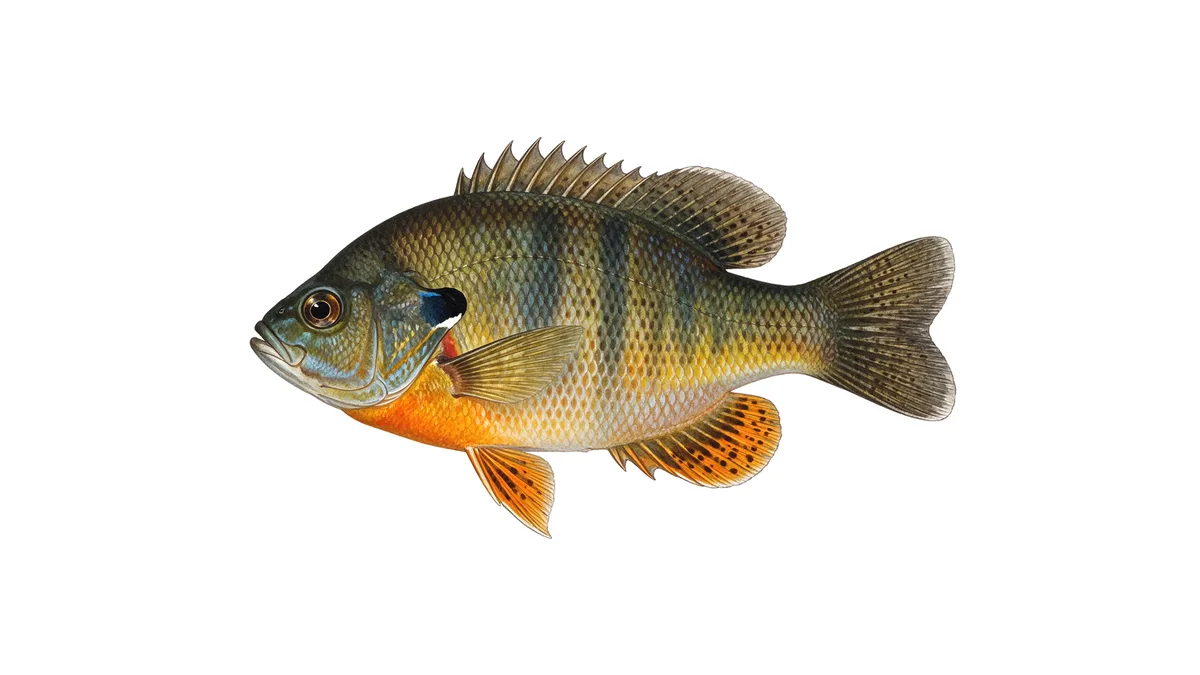
The shape is the first thing you notice. A bluegill is deep-bodied and pressed flat from the sides — an oval built to spin and dart through thick cover. The back runs olive-green, fading into a yellow-orange chest and belly. Along the flanks you'll usually make out six to eight faint, dark vertical bars.
Then find the ear flap. At the rear edge of the gill cover sits a hard, jet-black tab. That flap is the single most reliable identification mark on the fish. A dark blotch at the rear base of the soft dorsal fin backs it up.
The name comes from the cheek and gill area, which flash blue and purple when the light catches them. If the fish is already in your hand, fold the long, pointed pectoral fin forward — on a true bluegill it reaches past the eye.
Similar Species: Bluegill vs Sunfish and Other Lookalikes
Here is the confusion in one sentence: "sunfish" is a family name, not a single fish. Bluegill, redear, pumpkinseed, and crappie all belong to the sunfish family, Centrarchidae. Every bluegill is a sunfish, but the reverse is not true. When you want to tell one from another, the black ear flap and the dorsal blotch do most of the work.
| Species | Key difference |
|---|---|
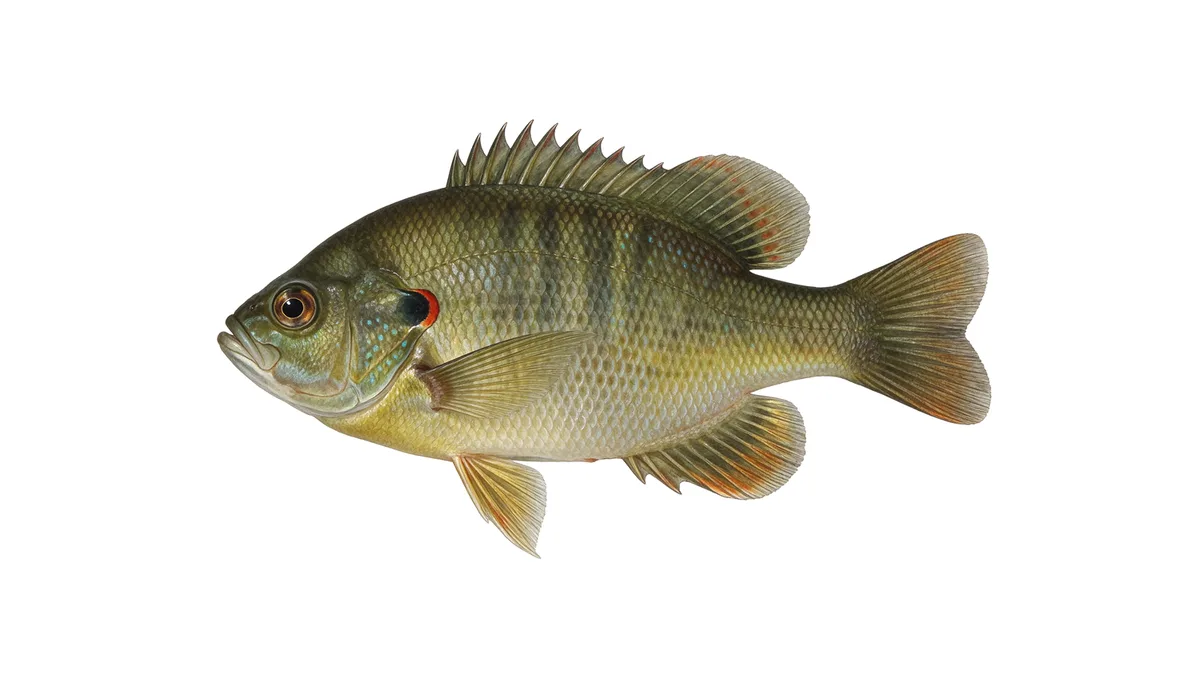
| Redear sunfish | Ear flap edged in red-orange; the bluegill's flap is solid black |
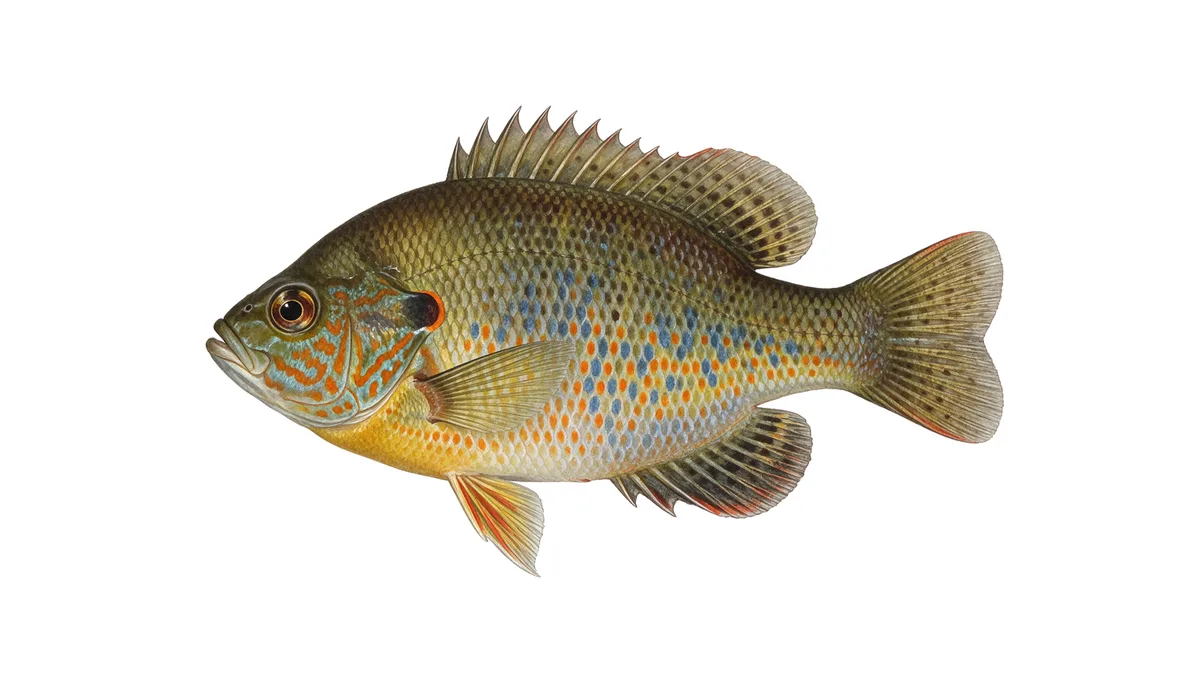
| Pumpkinseed | Wavy orange lines across the cheek and gill cover; bluegill lacks these, along with the heavy spotting |
| Crappie | Heavy speckling and mottling across the body; a bluegill has none |
| Sunfish (Centrarchidae) | The family name covering bluegill, redear, pumpkinseed, and more — not a separate species |
Bluegill Habitat and Range
Bluegill are native to the eastern and central United States and the Mississippi River basin. Decades of stocking have spread them far beyond that home range. Today they turn up in all 48 contiguous states, plus Canada, Mexico, and parts of Europe.
The ideal bluegill water is warm and vegetated. Think grass beds and weed lines, docks and boathouses with shade and structure, lily pads and floating vegetation, laydowns and brush piles, overhanging limbs, and slow river backwaters. A pond with grass beds and a dock is close to a guaranteed bluegill spot.
Most of the year they hold in 1–6 ft of water. When summer heat cooks the shallows, they slide back to the deep edge of the weed line — usually 8–15 ft down but always tight to cover. That depth range shifts by region and lake, so let the fish tell you where they are instead of trusting a number.
Where to Catch Bluegill
Start shallow and close to cover. Grass beds, docks, lily pads, and brush piles in 1–6 ft hold fish most of the year. In spring and fall, fish a bobber 1–3 ft down. In summer, move out to 3–6 ft along the deep weed edge. If a spot doesn't produce within half an hour, go deeper or shallower until you find the right level.
What Do Bluegill Eat?
Bluegill are not fussy. Aquatic insects make up a big share of the menu — mayflies, caddisflies, dragonfly nymphs, and midge larvae. Terrestrial insects fall in too: grasshoppers, crickets, ants, and beetles. Add small crustaceans like scuds, small crayfish, and freshwater shrimp, plus worms and snails. Young fish under 2 in live mostly on zooplankton, and adults will take the occasional small minnow.
They also carry a reputation as nest raiders. A bluegill that finds an unguarded largemouth bass nest will happily eat the eggs and fry.
Behavior
When Do Bluegill Spawn?
Spawning kicks off in late spring to early summer, once the water climbs into the mid-60s to low 70s °F. Males fan out dish-shaped nests in sandy or gravelly shallows, dozens of them packed side by side. Spawning males brighten — near orange and blue — and defend their beds aggressively. Drop a bait onto an active bed and it usually gets hit within seconds. Timing shifts with latitude and local conditions, so watch the water temperature on your own lake rather than the calendar.
Bluegill are daytime feeders. The bite runs strongest from mid-morning through late afternoon — one of the few fish you can reliably catch at high noon — and drops off after dark. They school loosely, usually sorted by size. Find one and there are often more nearby, though the biggest fish tend to hang alone or in small groups away from the main school.
Seasonally, expect them in 1–4 ft on the beds in spring (60–70 °F), on weed and dock edges in 3–10 ft through summer (70–85 °F, deeper at midday), back shallow and feeding hard in fall (55–70 °F), and pulled out to deeper open water, near bottom and very slow, through winter (40–50 °F).
Size and Regulations
How Big Do Bluegill Get?
A typical bluegill runs 4–8 in and weighs a few ounces to 1/2 lb. One that stretches 8–10 in and pushes a pound is a solid fish by anyone's measure. Break into the 10+ in, 1.5–2 lb class and you're holding a genuine trophy.
World Record Bluegill
The all-tackle world record bluegill is reported at 4 lb 12 oz, caught in 1950 out of Alabama's Ketona Lake. State records commonly land in the 2–3.5 lb range, so a three-pounder is a big deal almost anywhere.
Bluegill live an average of 5–6 years. In slow-growing northern lakes they can reach 10 years or more, with the longest on record around 11.
On limits, most states are generous — often 25–50 fish per day — and a few set minimum sizes to protect the biggest fish. Seasons and license requirements vary too. Regulations vary by state, always check your local rules before you keep a limit.
That liberal creel isn't an accident. Harvesting a few dozen bluegill actually helps a pond: it keeps numbers in check so the remaining fish grow. Leave them alone and competition for food can stunt the whole population into a pond full of 4–6 in fish.
As table fare, bluegill are white, firm, flaky, and mild. They fry up beautifully whole or as fillets and take a bake well. Check local consumption advisories before keeping a big batch.
Frequently Asked Questions
What's the best bait for bluegill?
Live bait wins most days: redworms, pieces of nightcrawler, crickets, and waxworms. On the artificial side, a 1/32–1/16 oz jig with a 1–2 in soft plastic, a small spinner, or a fly-rod popper all produce steadily.
Do bluegill bite at night?
They do, but nowhere near as eagerly as in daylight. Bluegill are daytime feeders, and the best window runs mid-morning to late afternoon. Summer nights under a light with worms can still produce, but the real action happens before dark.
Do bluegill eat bass eggs?
Yes. Bluegill are known nest raiders and will take eggs and fry from an unguarded largemouth bass nest.
Are bluegill good for kids and beginners?
They may be the best "first fish" in North America. They bite aggressively, hug the shore, and fight hard for their size without being impossible to land. A cane pole, a bobber, and a worm is a complete starter rig.
What size hook should you use?
A #8 hook covers most situations. Step up to a #6 for bigger baits like crickets, and down to a #10 for waxworms and small jigs. Bluegill have small mouths, so a smaller hook hooks more fish.
Do bluegill bite in the rain?
Light rain often improves the bite by washing insects into the water and adding overhead cover. The exception is a hard cold-front storm that crashes the water temperature — that shuts them down until the weather stabilizes.
Can you catch bluegill in winter?
You can, but the pace slows way down. Winter fish sit deep, near the bottom, and eat very slowly. Work a waxworm or a piece of nightcrawler on a small jig right on the bottom. Ice fishing for them is a northern tradition.
Related Articles
- How to Catch Bluegill: Bait, Rigs, and Tactics
- Crappie Species Guide
- Best Ultralight Panfish Rods and Reels
Ready to catch one? Read our step-by-step guide: How to Catch Bluegill.
About the author and how this was tested
About the author
FishermanGuy
Bank, boat and kayak angler · fishing, crabbing and shrimping since 2021
I buy the gear, fish it for a season and write down what failed. No sponsored verdicts, no free-sample flattery. Every rig on this page has landed fish in water I can point at on a map.
How this was tested
- Every rig gets at least six trips on the same water before it is published.
- Gear is bought at retail. Free samples are labelled in the first paragraph.
- Dates show first publication and the last time the page was updated.