Field notes
Crappie: Identification, Habitat & Diet
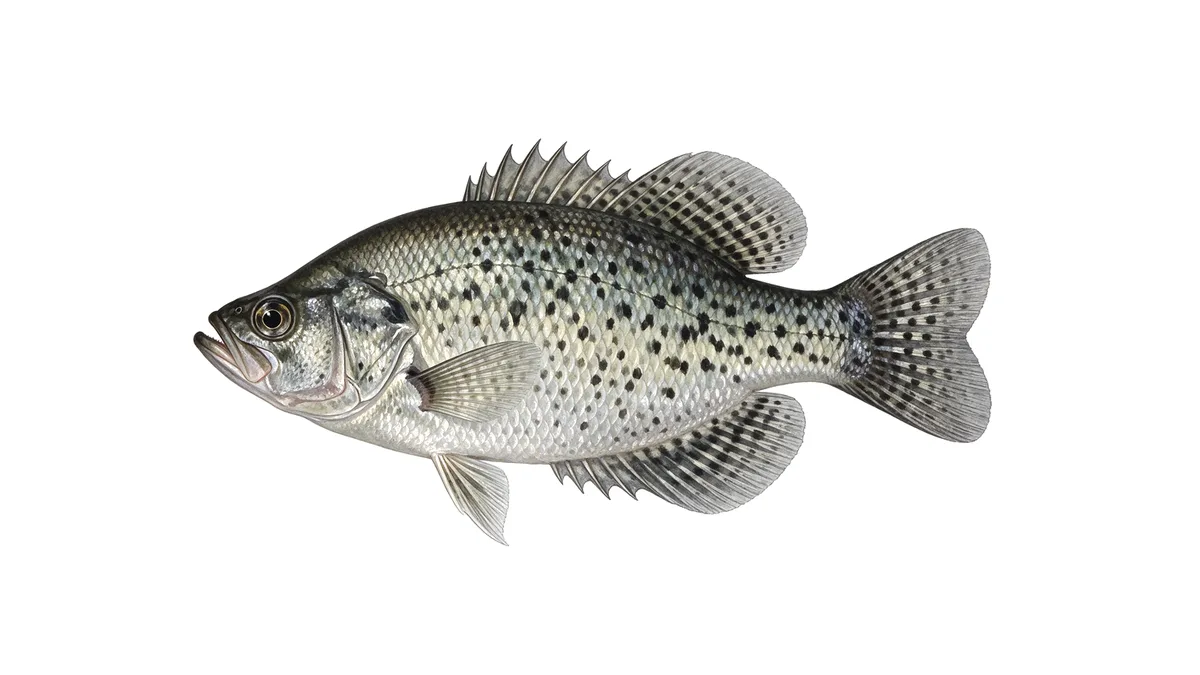
Crappie: Identification, Habitat & Diet
Ask a roomful of panfish anglers to name their favorite fish and crappie wins a lot of those votes. Part of it is the table — the white, flaky fillets are among the best in freshwater. Part of it is the numbers: crappie school up, bite small baits, and live in nearly every lake and pond around. And part of it is how cooperative they are. Light line, a small jig, and a little patience are usually all it takes. Two species — white and black — split the crappie world, and while the differences between them are subtle, they matter to how and where you fish.
Crappie at a Glance
| Field | Details |
|---|---|
| Scientific name | White crappie Pomoxis annularis; black crappie Pomoxis nigromaculatus |
| Common names | Speckled perch (Florida), strawberry bass, calico bass, sac-a-lait (Louisiana), papermouth |
| Typical size | 6–12 in and 1/4 to 1 lb; about 1 lb (12–13 in) is a solid catch; 2 lb is a trophy; 3 lb is once in a lifetime |
| Water | Freshwater — reservoirs, natural lakes, farm ponds, slow rivers |
| Difficulty | No star rating, but often called the most cooperative fish in freshwater |
| Best season | Spring spawn, when water in the mid-50s to low 60s °F pushes fish into 1–6 ft of shoreline |
How to Identify a Crappie
Crappie are deep-bodied, compressed fish with a fairly large mouth and a thin, papery membrane around the lips — the reason for the nickname "papermouth."
Both species carry dark markings on silvery sides, but the pattern differs. White crappie wear vertical bars over a silvery-gray, green-tinged body. Black crappie are mottled and speckled in irregular blotches over a silvery-olive body that often reads darker.
The fastest field check is the dorsal fin. Count the spines: six or fewer means white crappie, seven or more means black crappie. Confirm with the pattern — bars versus mottling — and you've got the ID locked. Set a crappie next to a bluegill and the crappie's larger mouth is obvious — a clue that it leans on small fish more than on insects.
White Crappie vs Black Crappie
The two species overlap across most of the country, and both are worth catching. They differ in looks, habitat preference, and tolerance for murky water.
| Species | Key difference |
|---|---|
| White crappie (Pomoxis annularis) | Dark vertical bars; 5–6 dorsal spines; tolerates turbid water better; more common in larger lakes and reservoirs |
| Black crappie (Pomoxis nigromaculatus) | Irregular dark mottling; 7–8 dorsal spines; prefers clearer water; more common in vegetated lakes |
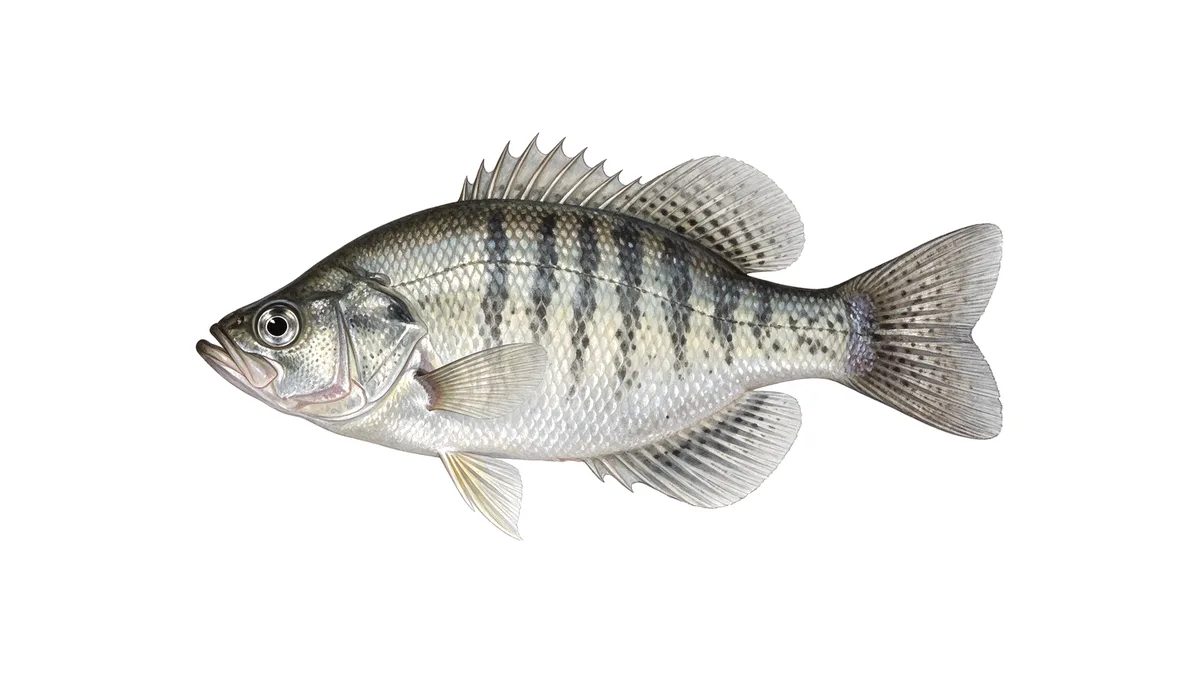
Both belong to the sunfish family (Centrarchidae), same as bluegill and largemouth bass, but the speckling sets crappie apart immediately.
Crappie Habitat and Range
Crappie are native to the eastern and central United States, from the Great Lakes and the Mississippi River basin down to the Gulf Coast states. A century of stocking has since put them in all 48 contiguous states. They thrive in reservoirs, natural lakes, farm ponds, and slow rivers.
Structure is the whole ballgame. Sunken timber and standing dead trees, brush piles and artificial reefs, grass beds and weed lines, docks and boathouses, creek channels and channel ledges — crappie pile up on all of it. Whatever the depth, they rarely stray far from cover: a bare, featureless flat is usually dead water, while a single brush pile or standing tree can hold a whole school. They also suspend in open water, holding 5–15 ft down over structure that sits 20–30 ft deep, which is exactly where a fish finder earns its keep.
Some waters are legendary for them: Alabama's Weiss Lake, self-styled "Crappie Capital of the World," Kentucky Lake and Lake Barkley on the Tennessee–Kentucky line, Mississippi's Grenada Lake, and the Santee Cooper lakes in South Carolina.
Seasonally, expect spring fish in 1–6 ft along shoreline cover, summer fish suspended over 15–30 ft of structure, fall fish at mid-depth chasing shad, and winter fish pulled deep and tight to structure. Exact depths shift by region and lake, so treat these as a starting point rather than gospel.
What Do Crappie Eat?
Small fish are the main course for reservoir crappie — shad, minnows, and young bluegill. In natural lakes and ponds, aquatic insects and larvae matter more. They'll also take small crustaceans like freshwater shrimp, scuds, and small crayfish. Young crappie under 3 in feed mostly on zooplankton.
The old rule holds: find the bait and you'll find the crappie. In spring they follow shad right into the spawning shallows.
Behavior
When Do Crappie Spawn?
Crappie spawn in spring, when the water hits the mid-50s to low 60s °F — a touch cooler than bluegill. Unlike most sunfish, dozens of males build their nests side by side over shallow sand, gravel, or hard mud near cover, and each male guards his eggs and fry for several days. This is the easiest fishing of the year, and the best time to catch crappie if you had to pick one.
Crappie are low-light feeders. Those big, sensitive eyes see well in dim conditions and get blinded by bright sun, which is why dawn, dusk, and cloudy days fish best. In summer and on clear lakes they feed after dark too.
They school by size. A school of 10-inchers rarely mixes with 6-inchers, so one spot may hand you slab after slab while the next yields only dinks.
One more detail worth building your whole approach around: crappie mostly strike on the fall. Fish a slow, controlled drop with pauses and let the bait sink past them.
Size and Regulations
How Big Do Crappie Get?
A typical crappie runs 6–12 in and 1/4 to 1 lb. A 12–13 in fish around a pound is a solid catch. Reach 2 lb and you've got a trophy. A 3 lb crappie is a once-in-a-lifetime fish.
World Record Crappie
The records split by species. The white crappie record stands at 5 lb 3 oz, caught by Fred Bright in 1957 at Mississippi's Enid Dam. The black crappie record is 5 lb 7 oz, caught by Lionel Ferguson in 2018 at Richeison Pond in Tennessee.
Growth and lifespan swing with latitude. Southern fish grow fast — hitting 10 in in 2–3 years — but die younger, most living 4–7 years. Northern fish grow slower and live longer, up to about 10 years, with the longest on record around 15.
On the regulations side, most states set a 9–10 in minimum size and a 10–30 fish daily limit. Seasons and licenses vary. Regulations vary by state, always check your local rules before you head out.
For the table, crappie fillets are white, firm, mild, and nearly boneless. They're built for a cornmeal fry or a bake, and the size is perfect for fish tacos. Check local consumption advisories before you keep a big batch.
Frequently Asked Questions
What's the best bait for crappie?
Small jigs and live minnows cover almost every situation. In shallow water (1–10 ft) throw a 1/32–1/16 oz jig; in deep summer water (15–30 ft) step up to 1/8 oz. Match 1.5–2.5 in soft plastics to the size of the baitfish they're chasing.
When is the best time to catch crappie?
Spring, full stop. When the water climbs into the mid-50s to low 60s °F and the fish move shallow to spawn, they're easier to find and catch than at any other point in the year. Within a day, dawn, dusk, and cloudy stretches fish best.
Where do crappie live?
They live tight to structure — sunken timber, brush piles, docks, grass lines, and channel ledges — and suspend over deeper structure in open water. Spring finds them in 1–6 ft near shore; summer pushes them out to 15–30 ft.
Why are crappie called papermouth?
The thin, papery membrane around their lips tears easily if you set the hook too hard. That's the whole name. Use light line and a smooth, steady hookset instead of a violent jerk.
Do crappie bite at night?
They do. Those big light-gathering eyes let them feed comfortably in the dark. Summer night fishing with glow jigs or minnows under lights is a proven tactic, especially on clear lakes.
What size crappie should you keep?
Keep the 9–12 in fish — legal in most states and the ideal eating size. Many states run a 9–10 in minimum and a 10–30 fish daily limit, so check your state rules before you start filling the cooler.
Do you need a boat to catch crappie?
No. Spring spawners sit within casting distance of shore, and docks, piers, and shoreline brush produce all season. A boat helps most in summer when the fish are over deep structure, but bank and pier anglers still catch plenty.
Do crappie bite in the rain?
Light rain often turns the bite on. Clouds stretch out the low-light feeding window, and runoff washes food into the shallows. The exception is a hard cold-front storm that crashes the water temperature — that puts the fish down until the weather stabilizes.
How long do crappie live?
Southern crappie typically live 4–7 years. Northern fish grow slower and can reach about 10 years, with the longest on record around 15. Heavy fishing pressure makes those old fish rare.
Related Articles
Ready to catch one? Read our step-by-step guide: How to Catch Crappie.
About the author and how this was tested
About the author
FishermanGuy
Bank, boat and kayak angler · fishing, crabbing and shrimping since 2021
I buy the gear, fish it for a season and write down what failed. No sponsored verdicts, no free-sample flattery. Every rig on this page has landed fish in water I can point at on a map.
How this was tested
- Every rig gets at least six trips on the same water before it is published.
- Gear is bought at retail. Free samples are labelled in the first paragraph.
- Dates show first publication and the last time the page was updated.