Field notes
Channel Catfish: Identification, Habitat & Diet
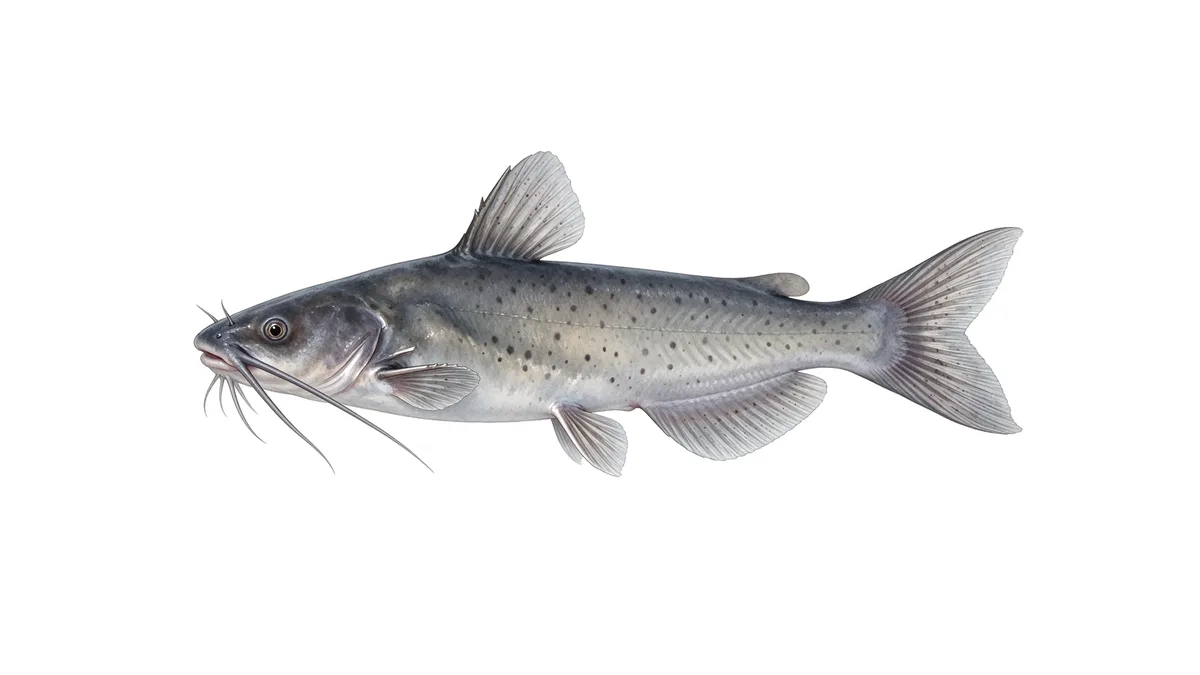
Channel Catfish: Identification, Habitat & Diet
The channel catfish (Ictalurus punctatus) is one of the easiest fish in America to catch on purpose — and one of the best eating fish in freshwater. Whether you fish a muddy river, a farm pond, or a big reservoir, channel catfish are almost always nearby, holding on the bottom and following a scent trail. This guide covers channel catfish identification, the channel catfish habitat they prefer, what do channel catfish eat, and how to load a stringer when the bite turns on.
Channel Catfish Quick Facts
| Scientific name | Ictalurus punctatus |
| Common names | Channel catfish, "channel cats" |
| Typical size | Most catches 1–5 lb, 12–24 in |
| Water | Freshwater — rivers, lakes, reservoirs, ponds; bottom-oriented |
| Difficulty | Not rated by the source; one of the easiest fish in America to catch on purpose, even for beginners |
| Best season | Water 70–85°F (roughly late spring through early fall); night is prime time |
Channel Catfish Identification: How to Tell Them Apart
A channel catfish looks like a catfish from central casting: scaleless, smooth-skinned, with a broad head and a deeply forked tail. The details matter when other catfish are swimming in the same water.
Count the barbels. A channel catfish has four pairs of whisker-like barbels around its mouth — eight in total. One long pair sits at the corners of the mouth, two short pairs line the chin, and one small pair sits near the nostrils.
Color is the next clue, especially in younger fish. Juveniles are slate-blue to olive-gray on top and covered in black spots. Those spots fade as the fish grows, and older channel catfish are often completely spotless. The belly runs white to silvery, and the whole body is scaleless.
The real field mark for identification is the anal fin. It's rounded and carries 24–29 soft rays — counting those rays separates a channel catfish from its look-alikes. And one note on the name: "channel" refers to the fish's habit of holding in deep river channels, not to anything about the tail.
Channel Catfish vs Blue Catfish (and Flathead Catfish)
Three forked-tail catfish share most American rivers, and they get mixed up constantly.
| Species | Key differences |
|---|---|
| Blue catfish | Deeply forked tail too, but blue-gray with no spots; anal fin straight-edged with 30–36 rays; lower jaw shorter than upper; commonly 5–20 lb and can grow enormous |
| Flathead catfish | Tail nearly square with only a slight notch; mottled brownish-yellow body; rounded anal fin with 24–29 rays; lower jaw projects past the upper; commonly 3–20 lb |
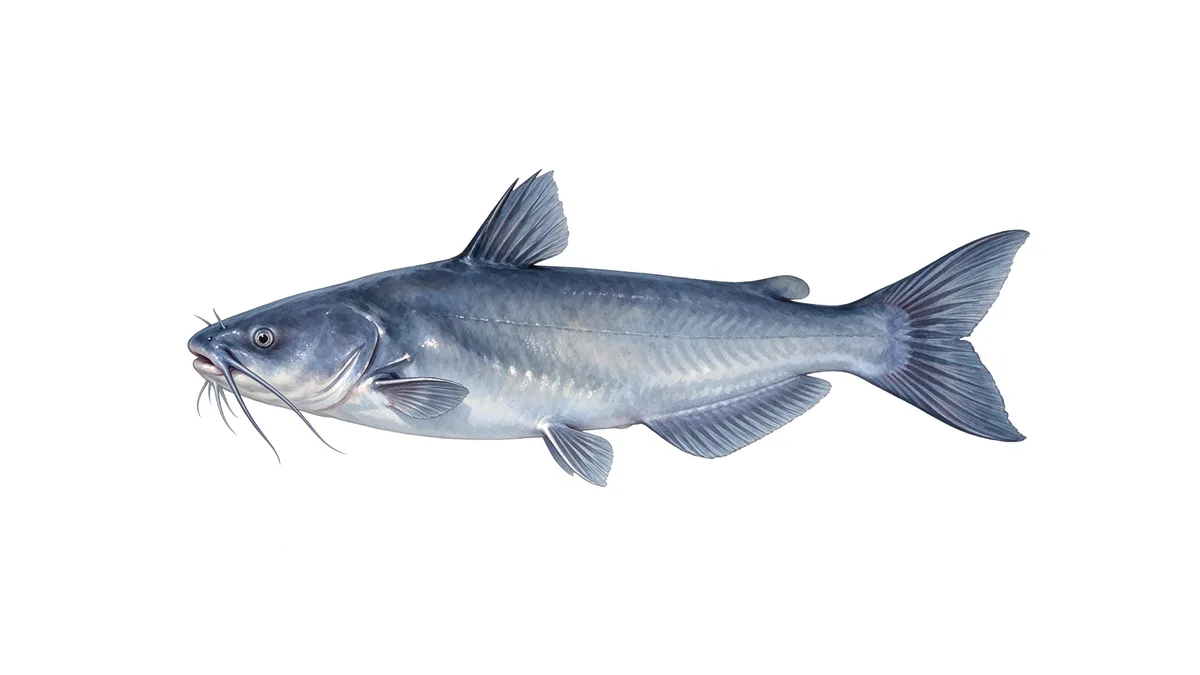
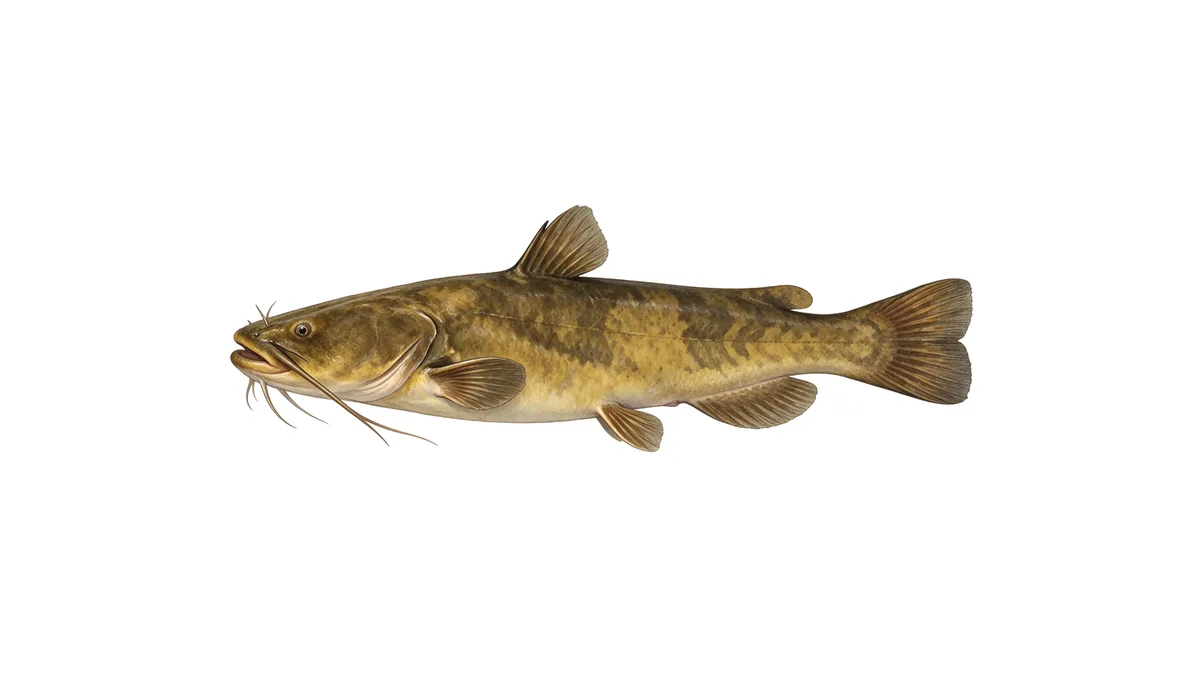
The fastest field test: a spotted fish is a channel catfish, and an unspotted blue-gray fish is a blue catfish. The anal fin settles any argument.
Where Do Channel Catfish Live? Channel Catfish Habitat
Channel catfish are native to the Mississippi River basin, the central United States, and the Gulf Coast, ranging from southern Canada down to Texas and Florida. Decades of stocking have spread them to nearly every state.
The channel catfish habitat you target depends on the water you're fishing. In rivers, they hold in deep holes — especially below riffles and gravel bars — along log jams and brush piles, under undercut banks and root wads, below dams and wing dikes, and along bends and current seams where fast water meets slow. Reservoir anglers find them at tributary mouths.
In lakes and ponds, look for the deepest old creek channels, drop-offs, and submerged timber. The depth rule that holds everywhere: deep water by day (10–30 ft of structure), then shallow flats, sandbars, and gravel bars at night (2–10 ft). General pattern — deep by day, shallow and tight to the bank after dark.
Behavior: What Do Channel Catfish Eat?
Channel catfish are nocturnal bottom-dwellers. They rest on the bottom through the day, move up onto the shallows at dusk, and feed hardest from just after sunset until midnight, with a smaller window right before dawn.
Their senses explain the whole fish. The entire skin is covered in taste buds, the barbels are packed with chemical receptors, and the eyes are tuned for low light — so a channel catfish finds food by smell and taste first, and only sees it afterward. That's why stinky bait works.
Feeding peaks when water hits 70–85°F. Below 50°F the fish slows way down but never stops feeding, which makes it a dependable winter target in the South.
What Do Channel Catfish Eat?
The diet is broad: aquatic insects and larvae, crayfish, small fish and fish eggs, worms and leeches, mollusks and freshwater mussels, plant matter, seeds, and algae, plus carrion. A channel catfish is the ultimate opportunist.
When Do Channel Catfish Spawn?
Spawning runs late spring into early summer, once the water warms into the low 70s°F. Fish nest in dark cavities — undercut banks, hollow logs, debris piles — and the male guards the eggs until they hatch. The weeks around the spawn are prime daytime fishing.
Seasonal Patterns
- Spring (60–70°F): heavy feeding around the spawn, and rivers fish well even in daylight.
- Summer (70–85°F): night fishing rules.
- Fall (60–70°F): a pre-winter feeding binge.
- Winter (below 50°F): slow, but catchable in deep holes on small baits.
One behavioral quirk sets channel catfish apart from their solitary flathead cousins: they often travel in loose small groups. Find one, and several more are usually in the same hole. Rising water after rain is a classic trigger too — the fish slide along current seams to feed on food washed in by runoff.
Size and Regulations: How Big Do Channel Catfish Get?
Most channel catfish caught weigh 1–5 lb and measure 12–24 in. A 10-lb fish runs about 28–30 in, and a 20-lb fish stretches to roughly 35 in. In most states, 10 lb counts as a trophy and 20 lb is the fish of a lifetime — but sizes like these vary by state, so check local records for what's realistic where you fish.
World Record Channel Catfish
The IGFA world record channel catfish weighed 58 lb, caught by W.H. Whaley in 1964 at the Santee-Cooper Reservoir in South Carolina. Missouri's state record is reported at over 30 lb. State records change, so check your state's current list.
How Big Do Channel Catfish Get?
Growth tracks latitude. In the South — Texas, Louisiana, Mississippi, Alabama — a channel catfish can hit 5 lb in 5–7 years. Midwest rivers produce steady numbers of 2–8 lb fish. Northern fish grow slower but live longer, and 30-in fish are possible. On lifespan: channel catfish usually live 12–14 years, many reach 20, and the wild record tops 40 years.
On the regulations side: size limits, bag limits, seasons, and licenses vary by state, always check your local rules. Most states allow 2–3 rods per person with some allowing more, though a few require a second-rod permit or cap the total. Chumming is restricted in some waters, so check before you broadcast. For the table, 1–4 lb fish from clean moving water are best; trim the dark-red fat line along the lateral line (the "mud vein") before cooking, and know that big warm-water fish are more likely to taste muddy.
Frequently Asked Questions
What's the best bait for channel catfish?
Chicken liver, fresh cut shad and other oily baitfish, stink bait (fermented dough), nightcrawlers, shrimp, and crayfish. Big rivers favor stink bait and cut bait; ponds and small lakes favor worms and liver.
How do you tell a channel catfish from a blue catfish?
The fastest field test is the spots: a spotted fish is a channel catfish, and an unspotted blue-gray fish is a blue catfish (straight-edged anal fin, 30–36 rays). Blue cats also grow far bigger — their world record tops 140 lb — while channel catfish rarely exceed 20–30 lb.
Can you catch channel catfish in the daytime?
Yes, but they're far more active at night. By day, fish deep holes, log piles, and shaded structure, and use strong-smelling baits to make up for a fish that isn't moving much.
Is a channel catfish strictly a bottom feeder?
Mostly. They hug the bottom by day and feed along it at night, but they'll also rise to chase baitfish and take bait suspended under a float in reservoirs.
When do channel catfish spawn?
Late spring into early summer, once water warms into the low 70s°F. They nest in dark cavities and the male guards the eggs; the weeks around the spawn are a good daytime bite.
Do channel catfish bite in the rain?
Usually, and rain is often a good time to be out: runoff washes in food and low light pulls fish off cover. In a flood, fish the edges of the new muddy water rather than the middle of it.
Can you catch channel catfish on lures?
Yes, more often than most anglers think. Jigs, small crankbaits, and spinnerbaits worked slowly along the bottom — especially at night and in current — will catch them, though bait is usually more efficient.
How deep do you fish for channel catfish?
At night, fish 2–10 ft flats, sandbars, and gravel bars. By day, fish the deepest available structure, 10–30 ft in rivers and reservoirs. A slip float also lets you suspend bait at mid-depth.
Related Articles
- Channel Catfish vs Blue Catfish: Full Comparison
- Best Bait for Channel Catfish
- When Do Channel Catfish Spawn?
- Flathead Catfish Species Guide
- Blue Catfish Species Guide
Ready to catch one? Read our step-by-step guide: How to Catch Channel Catfish.
About the author and how this was tested
About the author
FishermanGuy
Bank, boat and kayak angler · fishing, crabbing and shrimping since 2021
I buy the gear, fish it for a season and write down what failed. No sponsored verdicts, no free-sample flattery. Every rig on this page has landed fish in water I can point at on a map.
How this was tested
- Every rig gets at least six trips on the same water before it is published.
- Gear is bought at retail. Free samples are labelled in the first paragraph.
- Dates show first publication and the last time the page was updated.