Field notes
Crab Trap Basics: How to Set and Bait
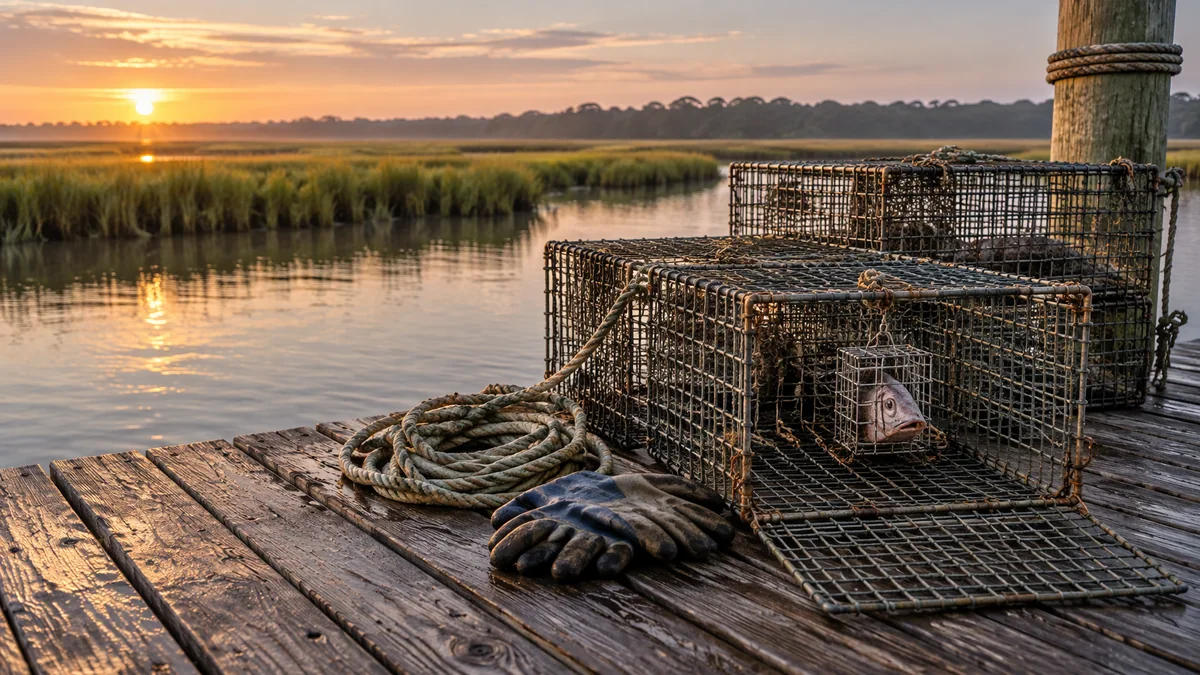
Crab Trap Basics
Crab trap basics come down to four things: the right trap for your spot, bait crabs can smell but cannot steal, a rig that stays put in the tide, and enough patience to let the trap soak. Crabbing is one of the few kinds of fishing where you can set gear, walk away, and come back to a catch, which makes it a good fit for families and for anyone who would rather manage a spread than cast all day. Get the four basics right and a single trap can produce through an entire tide. Get them wrong and you will pull up empty pots while the crabber down the bank fills a cooler.
Match the Trap Style to Your Spot
Recreational crab traps fall into a few common shapes, and the differences matter more than the brand name.
Box and cube traps are wire cages with two to four funnel entrances and a bait compartment in the middle. Crabs climb the outside, find an opening, and drop in. They are the most popular all-around trap because they are heavy enough to sit on the bottom, roomy enough to hold a mess of crabs, and easy to pull. They work from a dock, a pier, or a boat.
Pyramid traps are folding wire pyramids with entrances on each face. They open flat for storage and set up quickly, which makes them handy for kayaks and small boats. They tend to be lighter, so they need more weight in current.
Ring nets are flat hoops with netting and bait in the center, pulled up fast when a crab is feeding. They are not soak-and-leave gear; you fish them actively from a dock or boat.
For a beginner, a box trap is the simplest choice: set it, mark it, and come back. If you plan to fish from a kayak or carry traps in a small car, a pyramid trap is easier to transport.
Bait That Actually Attracts Crabs
Crabs are scavengers that hunt by smell, so fresh, oily bait outperforms everything else. Good options include menhaden (bunker), fish heads and frames, chicken necks and backs, eel, clam, and crab scraps. Fresh is better than frozen, and oily fish is better than lean.
The trap has to do two jobs with bait: attract crabs from a distance and keep them from eating it all before you return. Most traps have a bait box or wire compartment for exactly this reason. Put the bait inside and close it. If you bait loosely, crabs will pick it clean and leave.
A few practical points:
- More bait is not always better. A fist-sized chunk of oily fish in the bait box releases scent for a long soak without overfeeding.
- Refresh bait every check. Bait loses punch after a while, especially in warm water.
- Add a little variety. A fish head plus a chicken neck gives off different scents and can hold crabs longer.
- Keep bait cool on the way out. Spoiled bait still works, but fresh bait works better.
Rig the Crab Trap Line, Float, and Weight
A crab trap set is simple, but each piece has a job.
Use a strong, abrasion-resistant line — braided nylon or similar — rather than thin monofilament, because the line rubs against pilings, shells, and the trap itself. Tie the line to the trap with a secure knot, and leave enough length to reach the bottom with slack for the tide.
Attach a float at the surface. The float marks the trap, makes it easy to retrieve, and in many states must carry your name and address or a gear identification number. Use a float large enough to stay visible in chop and to support the trap's weight plus a load of crabs. Add a small weight above the trap if current drags it, but keep the trap light enough to lift.
Regulations on trap marking, float labeling, and gear numbers vary by state, and some states require specific tag colors or registration. Check the rules for your water before you set gear — crabbing and shrimping regulations covers the general categories to look up.
Choose Depth, Bottom, and Current
Crabs move with the tide and feed over sand, mud, and shell bottom near structure. Productive spots share a few traits:
- Depth of roughly 3 to 10 feet in most recreational settings, though deeper water can hold crabs in cold weather.
- Near structure — pilings, dock legs, channel edges, grass edges, creek mouths, and rock.
- Moderate current. Enough flow to carry scent and keep crabs moving, but not so much that the trap drags or tumbles.
- Clean bottom. Soft mud and sand are easier to set on than rocky, snaggy bottom that can foul the trap.
Tide matters. Crabs are most active when water is moving, so setting on a rising or falling tide usually beats dead slack. In many bays, the last of the incoming and first of the outgoing are strong windows. If you are setting overnight, position traps where they will not be exposed at low tide and not swept away at high tide.
Set, Soak, and Check
Setting is straightforward: lower the trap gently so it lands upright, let it settle, and take up slack until the float sits correctly. Mark the spot mentally or with a landmark, and set a few traps in a spread rather than one.
Soak time is the variable beginners get wrong in both directions. Too short and crabs have not found the bait; too long and the bait is gone and crabs may have escaped. A practical rhythm is to check every 20 to 30 minutes on a good tide and adjust from there. If traps are empty and bait is gone, you are soaking too long or baiting too loosely. If traps are empty and bait is untouched, move the trap.
Pull the trap straight up and steadily, keeping tension so crabs do not tumble out of the entrances. Empty the legal crabs into a cooler or bucket, re-bait, and reset. Keep a count of your traps and their locations; losing gear is both wasteful and, in some states, a violation if traps are abandoned.
Sort and Measure Before You Keep
Identifying and measuring your catch is where new crabbers get cited. The details vary by species and state, but the principles are consistent.
Measure the carapace from point to point across the widest part of the shell with a crab gauge. Minimum sizes are set by state and by species; for blue crabs they are often around 5 inches in several states, but the number changes by jurisdiction and sometimes by season, so check your state agency. Undersized crabs go back immediately.
Sex matters in many fisheries. Blue crabs are identified by the apron on the underside: a narrow, pointed apron indicates a male, while a broad, rounded apron indicates a female. Many states protect females, especially those carrying eggs (sponged crabs), and some prohibit keeping them entirely. Release egg-bearing females without exception.
Keep crabs cool and moist, not submerged in water, which kills them faster. A cooler with damp burlap or newspaper and ice packs works well; do not let melting ice drown them in fresh water.
Common Crabbing Mistakes
- Baiting loosely. Crabs strip exposed bait and leave. Use the bait box and secure it.
- Soaking too long. Empty traps with bare hooks usually mean the bait ran out hours ago. Check on a schedule.
- Setting in current that drags the trap. The trap tumbles, crabs cannot enter, and the float may go under. Add weight or move.
- Setting on foul bottom. Rocky, snaggy bottom hangs traps and makes retrieval a fight.
- Forgetting trap marking rules. Missing or incorrect float labels can cost you the gear and a fine.
- Keeping undersized or protected crabs. Measure every crab and release egg-bearing females. Ignorance is not a defense.
- Leaving traps unattended for days. Abandoned gear is illegal in many states and can kill crabs and other animals.
FAQ
What is the best bait for a crab trap? Fresh, oily fish such as menhaden, plus chicken necks or backs, works well. Use the bait box so crabs cannot steal it.
How long should a crab trap soak? Check every 20 to 30 minutes on a moving tide, and adjust. If bait is gone, shorten the soak; if it is untouched, change location.
How deep should you set a crab trap? Roughly 3 to 10 feet covers most recreational crabbing, near structure and on a moving tide. Deeper sets can work in cold weather.
Do you need a license to crab with a trap? In most states, yes, and traps often need registration or labeled floats. Rules vary, so confirm with your state agency before setting gear.
Can you keep female crabs? It depends on the state and species. Many states protect egg-bearing females, and some restrict females entirely. Learn the apron shapes and your local rules before you keep a crab.
Once the basics are in place, the rest is tuning — better spots, better bait, and knowing the tide. Start with how to catch blue crabs for the full approach, compare traps and techniques for other species in how to catch dungeness crab and how to catch mud crab, and browse the Crabbing & Shrimping category for gear and regulation guides.
About the author and how this was tested
About the author
FishermanGuy
Bank, boat and kayak angler · fishing, crabbing and shrimping since 2021
I buy the gear, fish it for a season and write down what failed. No sponsored verdicts, no free-sample flattery. Every rig on this page has landed fish in water I can point at on a map.
How this was tested
- Every rig gets at least six trips on the same water before it is published.
- Gear is bought at retail. Free samples are labelled in the first paragraph.
- Dates show first publication and the last time the page was updated.