Field notes
How to Catch Blue Crabs
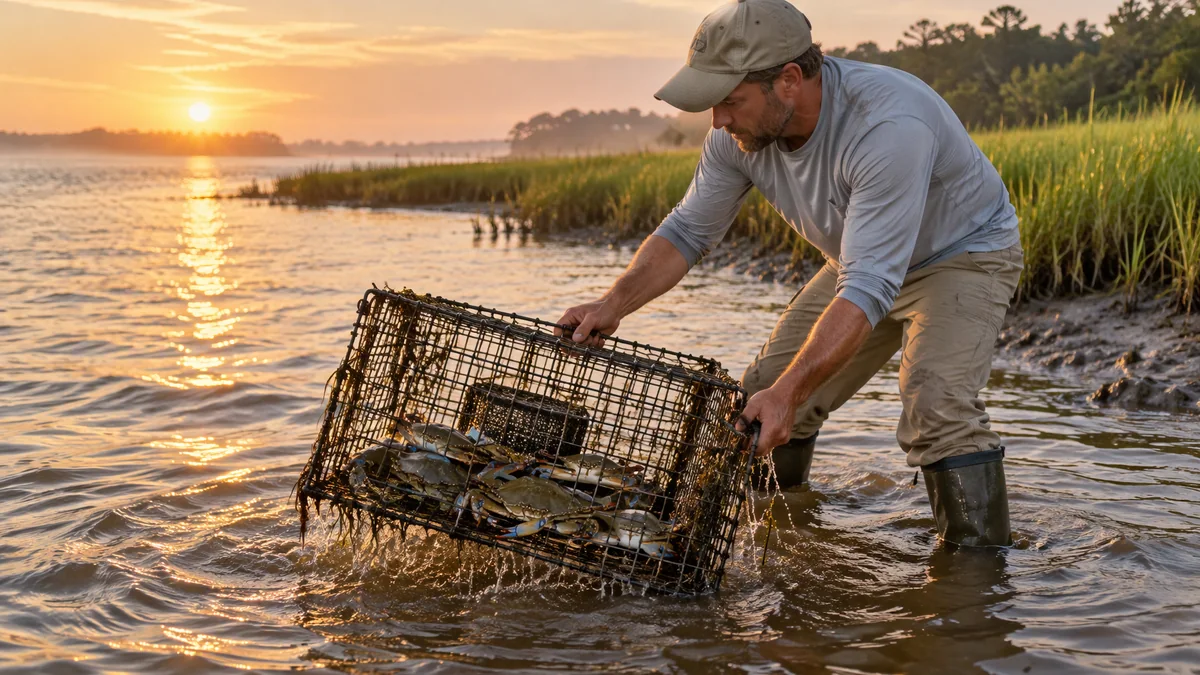
How to Catch Blue Crabs
Blue crabs are one of the most accessible seafood targets on the Atlantic and Gulf coasts. You do not need a boat, a license in every state, or expensive tackle. A length of line, a chicken neck, and a dip net can put dinner in a bucket from a public dock, and a couple of traps can turn a tidal creek into a reliable summer food source. But crabbing rewards a little knowledge: where crabs move with the tide, which bait actually attracts them, how to measure and sex a crab correctly, and which rules apply where you are fishing. This guide walks through how to catch blue crabs from scratch, from choosing a method to keeping the catch fresh.
Know the Blue Crab
The blue crab, Callinectes sapidus, is named for its blue-tinted legs and claws, though its shell is more olive or blue-green. The giveaway is the last pair of legs, which are flattened into paddles for swimming. That adaptation lets blue crabs move through the water column, not just crawl, which is why they show up around structure, in channels, and over open bottom.
Blue crabs live in brackish water and tolerate a wide range of salinity. Males, often called jimmies, tend to stay in lower-salinity upper estuaries, while mature females, called sooks, migrate toward higher salinity to spawn. A female carrying an egg mass under her apron is a sponge crab, and she should always go back. Crabs also molt to grow, and the stage just before a molt — the peeler — is prized because it produces soft-shell crabs.
The best crabbing generally coincides with warm water, from late spring through fall in most of their range, though the exact season and peak vary by latitude. Crabs are most active when water is warm and moving, which is why tides matter as much as temperature.
Choose Your Method
There are four common ways to catch blue crabs, and each suits a different budget, setting, and level of ambition.
Hand lines are the simplest. Tie a baited line to a dock, bridge, or piling, let it sit on the bottom, and wait for a crab to grab the bait. When you feel a steady pull, slowly draw the line up and scoop the crab with a dip net before it lets go. Hand lines are cheap and ideal for kids and casual dock fishing, but they are slow and catch one crab at a time.
Traps — collapsible box or cube traps — are the best all-round tool. Bait goes in the center, crabs enter through openings and cannot easily find their way out, and you lift the trap to harvest. A trap soaked for a few hours to a day can hold several crabs. Check local rules on trap size, escape gaps, and marking before you buy.
Trotlines are for volume. A long main line is anchored across a creek or flat with baits tied at intervals, and you run the line in a boat, scooping crabs with a dip net as they cling to the bait. Trotlining is productive but demands more gear, a boat, and attention to regulations.
Dip nets work best at night, when crabs move into shallow grass and around lights. A bright light and a long-handled net let you scoop crabs you spot in the shallows. This is a quiet, low-cost method that works well in summer.
If you are new to it, start with a hand line or a single trap. Our step-by-step blue crab tutorial covers the basics of the hand-line approach in more detail.
Bait and Rigging
Blue crabs are scavengers, and they are drawn by smell. The classic baits are chicken necks and backs, fish heads and racks (menhaden is a favorite), bull lips, and eel. Fresh bait releases more scent than old bait, but crabs are not fussy; the key is to keep the bait secured so it does not wash away.
For hand lines, tie the bait directly to the end of the line, or use a bait clip that holds it firmly. For traps, place bait in the trap's bait box or tie it to the center so crabs must enter to reach it. For trotlines, tie bait at regular intervals with enough slack that crabs can hold on while you scoop them.
Rigging is simple, but a few details matter. Use line that is easy on your hands, since you will be pulling it hand over hand. Keep a dip net within reach and approach the crab from behind rather than from above, so it does not see the net and let go. A long-handled net with a wide hoop makes the scoop easier.
Where and When to Set
Blue crabs follow structure and tide. Productive spots include dock pilings, bulkheads, marsh grass edges, channel edges, oyster bars, and the mouths of tidal creeks. Crabs also move along the bottom in channels, so a trap set on a channel edge can out-fish one set in a featureless flat.
Depth matters less than location, but most crabbing happens in roughly 3 to 15 feet of water, with traps set on the bottom and hand lines fished near structure. Moving water is the common thread: crabs are more active and more willing to feed when the tide is running. The hours around a tide change often produce the best action.
Time of day is flexible. Early morning and evening are comfortable and often productive, and night crabbing with lights can be excellent in shallow grass. During the heat of summer, crabs may move deeper or into shade during the day. Watch your local patterns and keep notes on tide, time, and catch.
Measure, Sex, and Keep
Regulations vary, but the essentials are the same everywhere: measure across the shell and release what you should not keep.
To measure a blue crab, close the claws and measure point to point across the carapace, from the tip of one lateral spine to the tip of the other. Minimum size limits are set by state and commonly fall somewhere between 5 and 6 inches across the shell; confirm the exact number and whether it differs for hard crabs, peelers, and soft crabs.
Sexing a blue crab is done by looking at the apron, the flap folded under the abdomen. A mature female has a broad, rounded apron; a male has a narrow, pointed one; an immature female has a triangular apron that has not yet widened. Many states protect sponge crabs, and some have rules about taking females. Learn the apron shapes before you keep anything.
Keep crabs alive and cool until you cook them. A cooler with damp burlap or seaweed and some ice works well; do not submerge crabs in fresh water, which kills them. Dead crabs deteriorate quickly, so cook them promptly or keep them alive in clean, aerated saltwater. Handle crabs from the rear, pinning the claws, to avoid a hard pinch.
Rules and Common Mistakes
Crabbing is regulated at the state level, and the details differ enough that you should read your local rules before your first trip. Expect rules on licenses, gear numbers, trap markings, escape gaps, minimum sizes, sponge crab release, and seasons. Some areas also restrict trotlines or require traps to be attended.
Common mistakes include:
- Using stale or poorly secured bait. Fresh bait and firm attachment catch more crabs.
- Setting traps in channels or navigation lanes. Gear in the channel is a hazard and may be illegal. Keep it out of the way of boats.
- Never checking gear. Traps left too long can kill crabs and attract attention from enforcement. Check at reasonable intervals and follow attendance rules.
- Keeping undersized crabs or sponge crabs. Measure every crab and release protected females immediately.
- Letting crabs die before cooking. Dead crabs spoil fast. Keep them cool and alive, and cook them the same day.
- Ignoring the forecast. Thunderstorms and strong wind make open-water crabbing unsafe. Plan around the weather.
FAQ
What is the best bait for blue crabs? Chicken necks and backs are the classic, along with fish heads and racks, bull lips, and eel. Fresh bait that stays secured on the line or in the trap works best.
Do you need a license to catch blue crabs? It depends on the state. Some require a recreational crab license or permit, and some allow limited crabbing without one. Check your state's fish and wildlife agency before you set gear.
How long should you soak a crab trap? A few hours can produce crabs, and an overnight soak often does better, but check local rules on how often traps must be checked and whether they must be attended.
Can you catch blue crabs without a boat? Yes. Hand lines and traps from docks, bridges, and bulkheads catch plenty of crabs. A boat expands your range but is not required.
How do you tell a male from a female blue crab? Look at the apron under the abdomen: broad and rounded for a mature female, narrow and pointed for a male, triangular for an immature female.
For more on the species, see the blue crab profile and the Blue Crab category. If you want to branch out, our guides to mud crabs and Dungeness crabs cover other crab fisheries, and the Crabbing & Shrimping category has the rest.
About the author and how this was tested
About the author
FishermanGuy
Bank, boat and kayak angler · fishing, crabbing and shrimping since 2021
I buy the gear, fish it for a season and write down what failed. No sponsored verdicts, no free-sample flattery. Every rig on this page has landed fish in water I can point at on a map.
How this was tested
- Every rig gets at least six trips on the same water before it is published.
- Gear is bought at retail. Free samples are labelled in the first paragraph.
- Dates show first publication and the last time the page was updated.