Field notes
Crabbing Regulations: A Plain-Language Guide for Shrimpers and Crabbers
Crabbing Regulations: A Plain-Language Guide for Shrimpers and Crabbers
Crabbing regulations and shrimping rules trip up more beginners than the catching does. There is no single national rulebook: the limits that apply to a blue crab pot in Maryland have little in common with a shrimp cast net in Texas or a Dungeness trap in Oregon. What stays consistent is the shape of the rules. Most states regulate who needs a license, how large a crab must be, how many you can keep, when the season is open, how gear must be built and marked, and what you must release. This guide explains those categories in plain English, with typical ranges rather than numbers that go stale. Use it to know which questions to ask, then confirm the exact figures with your state agency before you set gear.
Why Crabbing and Shrimping Rules Differ by State
Recreational crabbing and shrimping are managed by the states, and each one writes its own rules. Three layers usually apply at once. The state marine fisheries agency sets licenses, size limits, seasons, and gear rules, and its name varies from place to place: a department of natural resources, a fish and wildlife commission, or a marine fisheries division. Federal rules mostly govern federal waters offshore and gear that can affect protected species such as sea turtles. Local rules can close a single creek, flat, or bay to harvesting after a pollution spill, algae bloom, or oil release. When the layers overlap, the strictest rule covering the water in front of you usually wins.
The practical differences are large. Atlantic states tend to regulate blue crabs closely, with minimum sizes, sponge-crab protection, and gear limits. Some Gulf states run lighter programs but still protect egg-bearing females. Pacific states measure Dungeness differently and add hard-shell and sex rules. Shrimping swings even wider: one state treats it as part of a saltwater license, another sells a separate permit and caps net size and season length. None of this is guessable, and limits do get adjusted. Look them up every year.
Licenses, Permits, and Tags
Almost everywhere, recreational crabbing and shrimping start with a license, though not always the one you expect. Some states fold both activities into a standard saltwater fishing license. Others require a dedicated crab license, a pot tag, or a separate shrimp permit on top of it. A boat may carry its own license that covers everyone aboard, or each person may need an individual one.
Licenses come with conditions worth reading. Traps often have to display the license or permit number, and some states tie the number of traps you may fish to the type of license you buy. Exemptions exist for young anglers, seniors, disabled residents, and sometimes for people crabbing from their own waterfront property, but the details differ enough that you should not assume you qualify. If you are new to the paperwork, start with our guide to whether you need a fishing license, then read the crabbing or shrimping page on your state agency's site. Buying the wrong license is a common and avoidable citation.
Size Limits, Sex Rules, and Daily Possession
This is where most tickets get written, so slow down here.
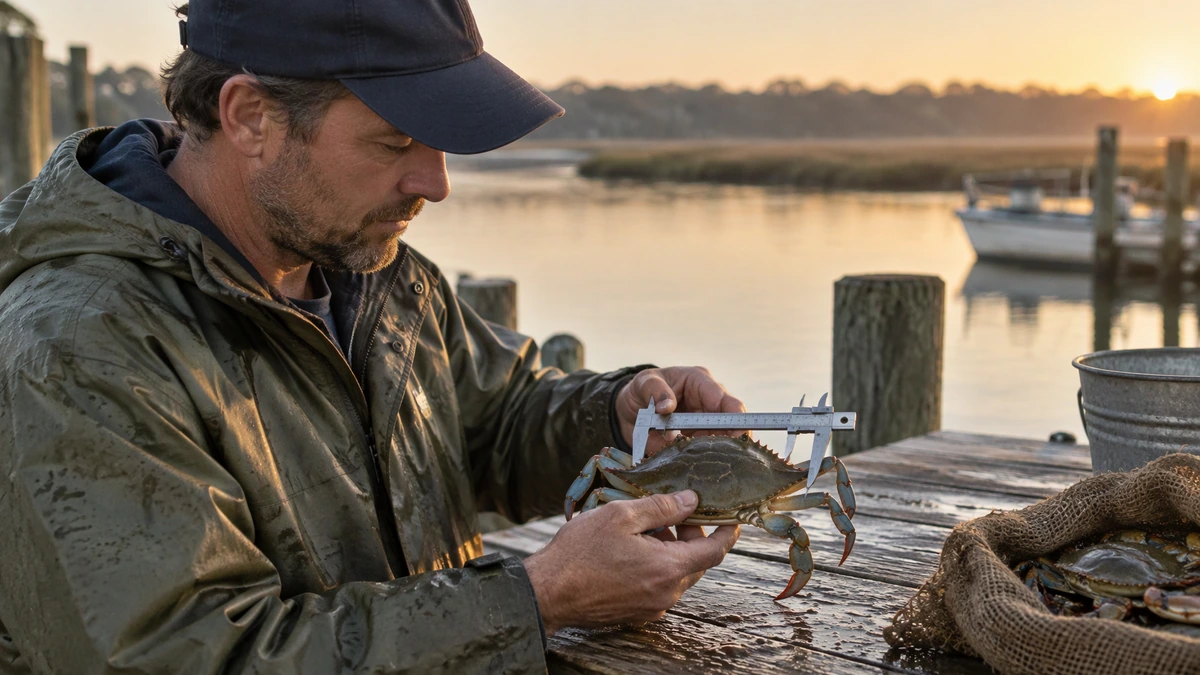
Minimum size. Blue crabs are measured point to point, spike tip to spike tip, across the widest part of the shell. Many Atlantic states set the minimum near five inches, but the exact figure and the measuring points vary, and some Gulf states set no minimum at all while relying on other protections. Pacific Dungeness crab are measured differently, across the back, with minimums in the range of six inches across much of the Northwest. Do not stretch a crab to make it fit the gauge. A soft or freshly molted crab is not a legal keeper in most fisheries anyway.
Sex and egg-bearing females. A female crab carrying an egg mass under her apron is called a sponge crab, and in most states she must go back immediately, whatever her size. Learn to read the apron: a mature female's is broad and rounded, while a male's is narrow and pointed. Some Pacific fisheries also require releasing female Dungeness. Put protected crabs back gently and quickly, because a crab held out of the water while you debate the rules is a crab more likely to die.
Daily possession. Limits are usually per person per day, and possession can include what is in your cooler, your vehicle, and sometimes your freezer at home. Several states count picked or processed meat toward the same limit, so cleaning your catch early does not reset it. Boat limits may cap the total for everyone aboard. Keep count as you go rather than guessing at the ramp. For a closer look at the species themselves, see our blue crab and Dungeness crab profiles.
Seasons, Closures, and Protected Catch
Open seasons matter as much as size limits, and they are rarely the same from one state to the next. Blue crab seasons may run year-round in warm states and close during winter or spawning periods farther north. Peeler and soft-shell fisheries sometimes have their own windows and handling rules. Shrimp seasons follow the runs, and states often announce openings by region on short notice rather than publishing one fixed date.
Closures fall into a few types. Spawning sanctuaries protect females at the worst possible time to harvest them. Pollution and shellfish closures shut specific waters after heavy rain, spills, or blooms, and they can lift at a different time than the season does. Gear closures may ban pots where diamondback terrapins or other protected animals live, which is why many crab pots must carry turtle excluder openings.
The catch you must release is broader than undersized crabs. Expect rules on sponge crabs, soft-shell crabs in some fisheries, egg-bearing shrimp in a few places, and bycatch such as horseshoe crabs and terrapins. If you cannot identify an animal confidently, put it back. A released crab costs you dinner. A kept protected one can cost you a fine.
Gear Rules: Trap Limits, Escape Rings, and Marking
Gear rules exist to limit effort and to stop lost traps from catching animals forever, and they are written tightly.
Trap limits and marking. Most states cap how many pots or traps one person may fish and require a visible float marked with your name and license or permit number. Buoys must be readable, not a faded scrap of foam. Some areas also cap trap size or the number of entrances.
Escape rings and degradable parts. Many states require escape or cull rings so small crabs can get out, plus a degradable panel, hinge, or rot cord so an abandoned trap falls apart instead of ghost-fishing. Removing or blocking these parts is illegal and easy for a warden to spot on a pulled pot.
Trotlines, nets, and attendance. Trotline length may be capped, lines often must be attended while fishing, and cast nets face limits on mesh size and sometimes radius. Night shrimping with lights is allowed in many places but not everywhere, and some waters restrict it outright.
Shrimp-specific gear. Recreational trawling is heavily restricted where it is legal at all, and trawls frequently require turtle excluder devices. Cast nets and seines have their own mesh and size rules.
If you are new to pots, our crab trap basics covers how to rig a trap legally, and the shrimp-catching guide walks through net rules in practice.
Common Mistakes That Draw Citations
Most violations are careless rather than deliberate. These are the ones to watch.
- Measuring the wrong points, or stretching the crab. Use the gauge your state specifies, and measure before the crab has sat in a bucket.
- Keeping a sponge crab by accident. Check the apron before the crab goes in the cooler, not after.
- Fishing unmarked or too many traps. A missing or illegible float is a citation even if the trap is otherwise legal.
- Ignoring local closures. The state season can be open while your creek is closed for pollution or a sanctuary.
- Mishandling live catch and bait. Shorts held too long die, and moving live crawfish or certain bait across state lines is illegal in some places. Our crawfishing basics explains why live transport rules are stricter than most people expect.
- Assuming last year's rules still apply. Limits, seasons, and gear requirements get revised, sometimes annually.
FAQ
Do you need a license to go crabbing or shrimping? In most states, yes, though what you need varies. Some fold it into a saltwater fishing license, while others require a separate crab license, pot tag, or shrimp permit. Age, residency, and disability exemptions exist, but the terms differ, so check your state agency rather than assuming.
What is the minimum size for blue crabs? It depends on the state. Many Atlantic states set the minimum near five inches across the shell, measured spike tip to spike tip. Some Gulf states set no minimum but still protect egg-bearing females. Use the official gauge and the measuring points your state lists.
Can you keep a crab with eggs? Generally no. A sponge crab carrying an egg mass should be returned immediately in most states, regardless of size. Check the apron before the crab goes into your cooler.
How many crab traps can you set? Usually a small number per person, tied to your license or permit. Traps must be marked with your name and number, and many must include escape rings and a degradable panel. The cap and marking rules are set by your state.
Are shrimping rules different from crabbing rules? Often yes. Shrimping may need its own permit, and it usually has separate seasons, bag limits measured in gallons or pounds, mesh and net-size caps, and gear restrictions such as turtle excluder devices on trawls. Read both sets of rules if you do both.
Rules are the least exciting part of crabbing and shrimping and the easiest part to get wrong. Learn your state's license, size, season, and gear requirements before the first set, measure every crab before it goes in the cooler, and leave the egg-bearing females in the water. From there, browse the Crabbing & Shrimping category and read how to catch blue crabs for the techniques these rules are built around.
About the author and how this was tested
About the author
FishermanGuy
Bank, boat and kayak angler · fishing, crabbing and shrimping since 2021
I buy the gear, fish it for a season and write down what failed. No sponsored verdicts, no free-sample flattery. Every rig on this page has landed fish in water I can point at on a map.
How this was tested
- Every rig gets at least six trips on the same water before it is published.
- Gear is bought at retail. Free samples are labelled in the first paragraph.
- Dates show first publication and the last time the page was updated.