Field notes
How to Fillet a Fish: Step-by-Step Guide
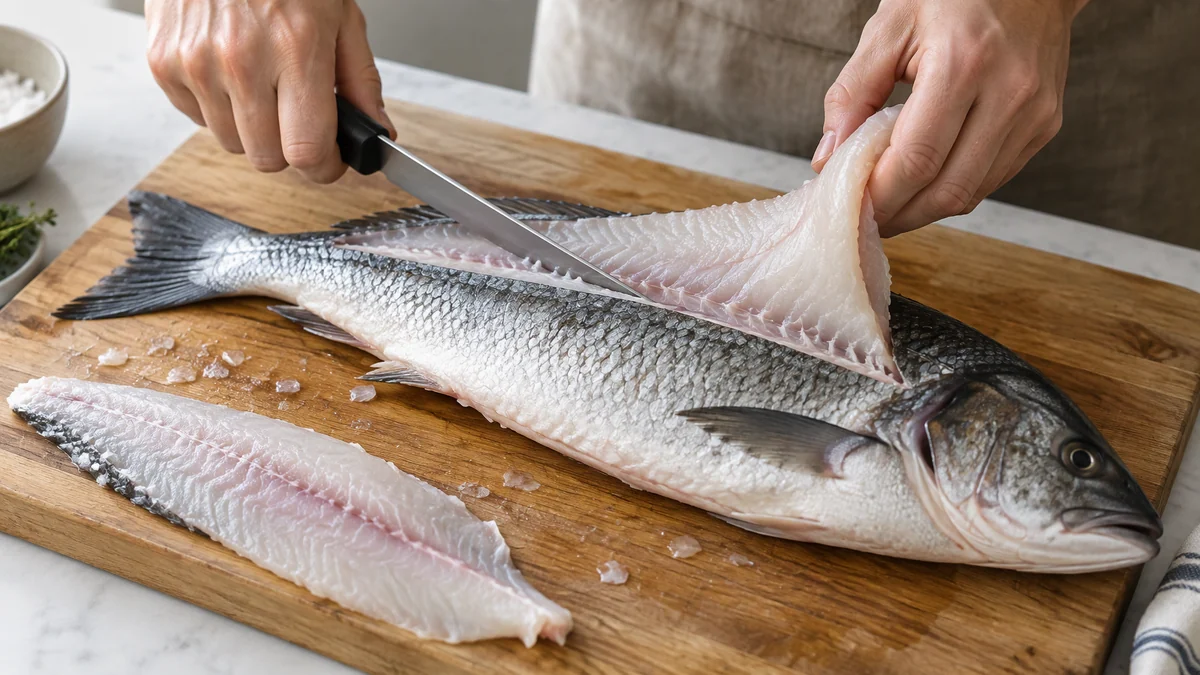
Learning how to fillet a fish means learning to take the flesh off both sides of the backbone as boneless slabs, which is a different job from gutting the fish. Round-bodied fish and flatfish are cut differently, so the steps below split into three parts: the round-fish method, the flatfish method and skinning a finished fillet. Every step is the one the source gives, in the order it gives it.
For flatfish such as flounder, the species background is in summer flounder and how to catch summer flounder; for round fish, see how to catch bluegill or how to catch red snapper.
What You Need
- A fish scaler, or the back of a spoon, for scaling
- A thin, sharp fillet knife for every cut
- Cold running water for the final rinse
Step-by-Step
Round-Body Fish
- Scale the fish. Work the scaler or the back of a spoon along the body and take the scales off .
- Make the first cut. At the pectoral fin, just behind the head, cut into the flesh at a 45-degree angle toward the head until the knife reaches the backbone . The equivalent cut is made behind the gills and the pectoral fin, going only as deep as the rib cage .
- Follow the backbone to the tail. Turn the knife and run it along the backbone toward the tail, keeping the blade against the bone . Turning the blade toward the tail and cutting along the top of the ribs, using the backbone as a guide, frees the fillet .
- Turn the fish over and repeat the same cuts on the second side .
- Take off the rib section. Slide the blade close to the rib bones and slice the whole rib section away from each fillet .
- Rinse the fillets well under cold, running water .
Flatfish
- Scale the fish .
- Cut down to the backbone at a 45-degree angle just behind the head .
- Free each fillet. Make a cut from the nape to the tail along each side of the backbone, then slide the knife along the backbone to loosen the fillet .
- Turn the fish over and repeat on the other side .
- Decide the portion. Leave the fish as two fillets, or cut each one in half lengthwise to make four .
- Rinse well under cold, running water .
Skinning a Fillet
- Lay the fillet skin side down .
- Hold the tail end of the fillet .
- Slide the knife between skin and flesh, keeping the blade almost horizontal .
- Pull the skin taut while drawing the blade toward the thick end of the fillet .
- Cut against the skin, not through it. Use light pressure and a sawing motion to separate the fillet from the skin .
Safety & Hygiene
- Keep the knife sharp and cut away from your body; a dull blade needs pressure and slips.
- Wash hands with soap and warm water for at least 20 seconds after handling raw seafood.
- Clean utensils, cutting boards and countertops with hot, soapy water, and sanitize surfaces with a bleach solution of 1 tablespoon of unscented liquid bleach per gallon of water.
- Bleed and chill fish as soon as they are caught. Prompt bleeding and rapid chilling slow spoilage and prevent blood clots from forming in the flesh.
Storage
- Refrigerate raw fish at 40°F (4.4°C) or colder and use it within 3 days.
- Fillets can be frozen, but quality depends on handling before the freezer: bleed, chill and gut the fish properly first.
- If freezing is delayed, keep the cleaned fish on ice in the meantime.
FAQ
Do I have to scale a fish before filleting it? Yes in both methods here: scaling is the first step for round fish and for flatfish .
How deep is the first cut? On a round fish, cut at 45 degrees toward the head until the knife touches the backbone, or only as deep as the rib cage on the second description . On a flatfish, cut at 45 degrees down to the backbone just behind the head .
Should the knife go through the skin when skinning? No. The blade runs between skin and flesh, almost horizontal, and the cut is made against the skin rather than through it.
How many fillets does a flatfish give? Two, or four if each fillet is split lengthwise .
Recipes and serving ideas: recipes.
About the author and how this was tested
About the author
FishermanGuy
Bank, boat and kayak angler · fishing, crabbing and shrimping since 2021
I buy the gear, fish it for a season and write down what failed. No sponsored verdicts, no free-sample flattery. Every rig on this page has landed fish in water I can point at on a map.
How this was tested
- Every rig gets at least six trips on the same water before it is published.
- Gear is bought at retail. Free samples are labelled in the first paragraph.
- Dates show first publication and the last time the page was updated.