Field notes
How to Find Fish in a Lake
How to Find Fish in a Lake
Most lake fishing problems are location problems. The lure is fine, the knot holds, the cast lands where you aimed, and nothing bites — because there are no fish within casting distance of the bait. Knowing how to find fish in a lake is the skill that makes everything else work. A lake is big, but fish do not spread across it evenly. They gather on structure, follow bait, and shift with the season, the light, and the wind. Find those places and the fishing gets dramatically easier. This guide covers how to read a lake before you leave home, how to confirm what you see once you are on the water, and how to cut a large body of water down to the few spots worth fishing.
Start With the Map, Then Confirm It on the Water
Before you touch a rod, learn the shape of the lake. A contour map, a lake map from the state fisheries agency, or a mapping app on your phone shows you the bottom in a way your eyes cannot. Look for depth changes at close intervals — five- and ten-foot contour lines packed together mark a drop-off — plus points that reach into deep water, humps that rise off the bottom, creek channels, and the old roadbeds and bridges that reservoirs hide.
Mark a handful of spots that fit the season and the species you want, then check them in order rather than wandering. The map is a hypothesis; the water is the test. When you arrive, confirm the map with your eyes and your electronics. A point on the map should show up as a point in the water. A weedline on the map should match the weedline you can see. When the map and the water disagree, trust the water; maps go stale as lakes silt in and vegetation shifts.
This is the biggest time-saver in lake fishing: fish structure you chose in advance instead of structure you stumbled onto.
Learn the Edges Fish Actually Use
Fish are not evenly distributed, and they are rarely in the middle of nowhere. They hold where two things meet, because an edge gives them both food and a way to retreat. Learn to see these edges and you can find fish on any lake.
- Points that run from the bank into deeper water. Fish use the tip and the sides to move up to feed and down to safety.
- Weedlines and weed holes. Weeds hold insects, baitfish, and shade. Fish patrol the outer edge and sit in the holes inside a bed.
- Drop-offs. A sharp change from shallow to deep is a highway for fish moving between feeding and resting water.
- Creek channels. In reservoirs, the flooded creek channel is the main street. Bends and intersections concentrate bait.
- Humps and rock piles. Isolated hard cover in a soft bottom attracts fish like a magnet.
- Inflows and culverts. Moving water brings oxygen and food, especially after rain.
- Docks, timber, and bridges. Shade and hard structure in one package.
The mistake is fishing the feature itself and ignoring the edge around it. A point is not just a shallow pile of rocks; it is the break where that rock meets deeper water. Fish the transition, not only the object.
Follow the Fish Through the Seasons
Fish do not stay in one spot all year, and a pattern that worked in May can be empty in August. Water temperature and bait drive the movement, and the seasons give you a reliable outline.
Spring pushes fish shallow. As the water warms, bass stage on points beside spawning coves, then move onto flats to spawn. Panfish move into warm shallows and dock shadows. Fish slowly and shallow, and expect the most sun-exposed, wind-sheltered banks to warm first.
Summer splits the lake in two. Early and late, fish push shallow to feed in low light. In the middle of the day, many fish pull back to deeper structure, weed shade, or the edge of the thermocline — the layer where warm surface water meets cooler deep water. In lakes that stratify, oxygen below the thermocline can drop, so fish often sit above it rather than on the bottom.
Fall is a moving pattern. Baitfish school up, the water turns over and mixes, and predators follow the bait into creeks, flats, and the backs of bays. Fishing gets more aggressive and more spread out, so covering water helps.
Winter slows everything. Fish group tightly on deep structure, channel bends, and the deepest weed edges, and they want small, slow presentations. On lakes that freeze, the search moves under the ice, which is its own discipline covered in ice fishing basics.
Tie the season to the day as well. Dawn and dusk are the strongest windows in most lakes, and an overcast day can fish like a long dawn. Best time of day to fish explains how light and weather fronts change the bite.
Let the Bait Tell You Where the Fish Are
Predators go where the food is, so finding bait is often faster than finding fish directly. Watch for these signs:
- Birds. Diving gulls and terns mark bait pushed to the surface, and gamefish are usually underneath. Loons working an area mean the same thing.
- Surface activity. Baitfish flicking or bass busting the surface tells you fish are feeding now.
- Sonar marks. A cloud of small marks mid-depth is usually bait. Larger arches below or beside it are the fish you want.
- Boat clusters. A group of boats can mean a community spot holding fish, or it can mean pressure. Check it, but do not assume.
Once you find bait, slow down and fish around it, especially the edges where bait meets structure. A school of shad over a deep point is a better bet than a perfect-looking point with nothing on it.
Use Sonar to Narrow the Water
Electronics turn guesswork into aim. Even a basic depth finder helps, and side-imaging or down-imaging units show structure and fish in detail.
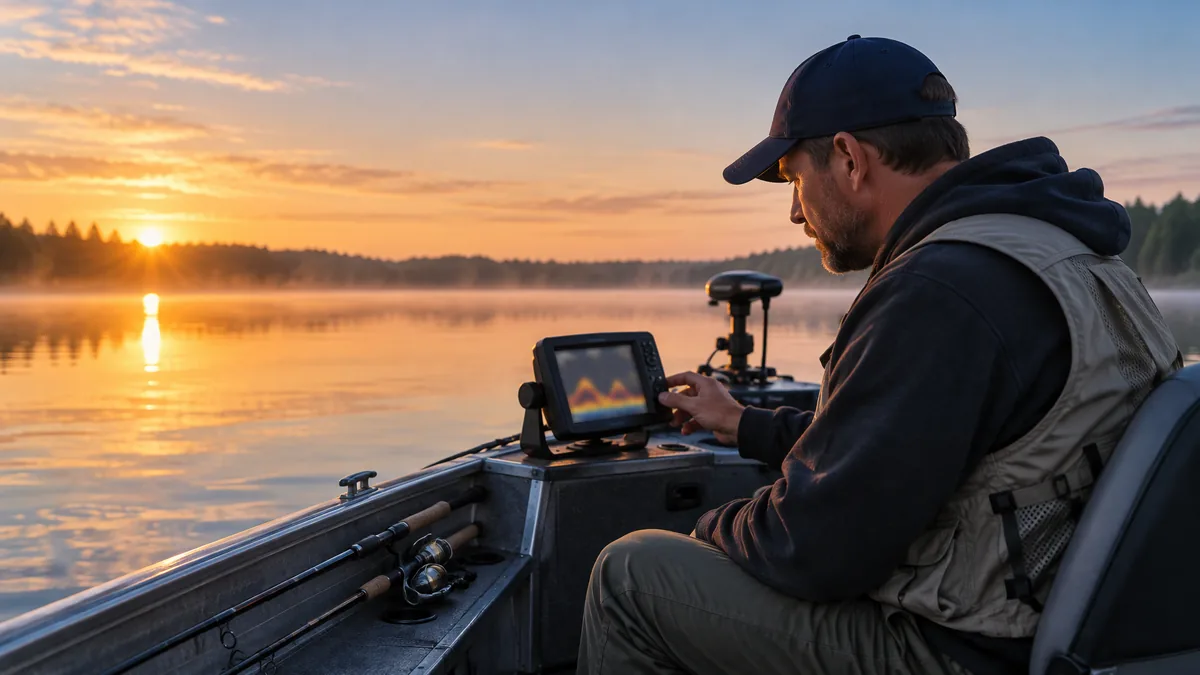
Use sonar to do three jobs. First, confirm depth and find the break you marked on the map. Second, find bait and the fish around it. Third, mark fish-holding cover — a brush pile, a rock, a weed clump — so you can fish it precisely and return later. Drop a waypoint whenever you mark fish, then work that spot thoroughly instead of drifting off it.
A fish finder shows what is under the boat, not what is a cast away, so combine it with casting. When you mark fish, position upwind so you can cast back over the mark. If you do not have electronics, fish the visible edges carefully and use a slip bobber or a countdown method to put a bait at depth. How to read water covers reading the surface and shoreline for the same clues.
Find Fish From Shore
Shore anglers do not need to find the whole lake — only the water they can reach. Choose access with structure: a point, a dock, a bridge, a culvert, a weed edge, or a drop-off close to the bank. These places put deep water within casting range.
Fan your casts across the available water, starting close and working outward, and cover the whole arc before moving. If fish hold deeper than you can cast, a slip bobber set to the right depth lets you fish straight down from the bank. At night, lights on docks and bridges attract bait and fish. When a spot has no structure and no bait, do not force it; walk to the next access.
Common Mistakes That Make a Lake Look Empty
- Fishing yesterday's spot. Fish move with bait and conditions. Check the season and the day before you commit.
- Casting randomly. Pick a piece of structure and fish it thoroughly, then move with a reason.
- Ignoring the depth. The right lure at the wrong depth catches nothing. Confirm where fish sit.
- Staying too long. If a spot gives no feedback after a solid pass, move. Lakes reward coverage.
- Fishing only visible cover. Offshore points, humps, and channels hold fish that never see a dock.
- Skipping local information. A tackle shop or a lake forum knows the current pattern better than any map.
- Forgetting the rules. Size and bag limits, and rules on bait and keeping fish, vary by lake. Check them before you keep anything.
FAQ
How do you find fish in a lake without a fish finder? Fish the visible edges: points, weedlines, inflows, docks, and drop-offs near shore. Watch for birds and surface activity, and use a slip bobber to probe depth. A contour map plus careful observation covers a lot of water.
What depth do fish hold at in a lake? It changes with the season. Spring fish are often shallow; summer and winter fish are often deeper, near structure or the thermocline. Start at the edge of the weeds or the top of a drop-off and adjust until you find fish.
Do fish stay in the same spot in a lake? Some fish hold tight to a piece of structure for a while, especially in summer and winter, but most move with bait, temperature, and light. Treat a good spot as a starting point, not a permanent address.
How do you find fish from shore? Pick access with structure and deep water within casting range, fish the whole arc of water you can reach, and use wind and bait activity to pick the bank. Move when a spot is clearly empty.
How long should you fish a spot before moving? Long enough to cover it properly with a search bait and then a slower presentation, and no longer if you get no marks or bites. On a new lake, plan to move often until you find active fish.
Finding fish is a process of elimination. Choose structure off the map, confirm it on the water, match it to the season, and let bait and sonar narrow the rest. From there, the lake fishing guide covers presentations in depth, and the species guides for largemouth bass, crappie, bluegill, and walleye put the patterns to work. Browse more in the Lakes & Ponds category.
About the author and how this was tested
About the author
FishermanGuy
Bank, boat and kayak angler · fishing, crabbing and shrimping since 2021
I buy the gear, fish it for a season and write down what failed. No sponsored verdicts, no free-sample flattery. Every rig on this page has landed fish in water I can point at on a map.
How this was tested
- Every rig gets at least six trips on the same water before it is published.
- Gear is bought at retail. Free samples are labelled in the first paragraph.
- Dates show first publication and the last time the page was updated.