Field notes
How to Read Water: Find Fish Anywhere
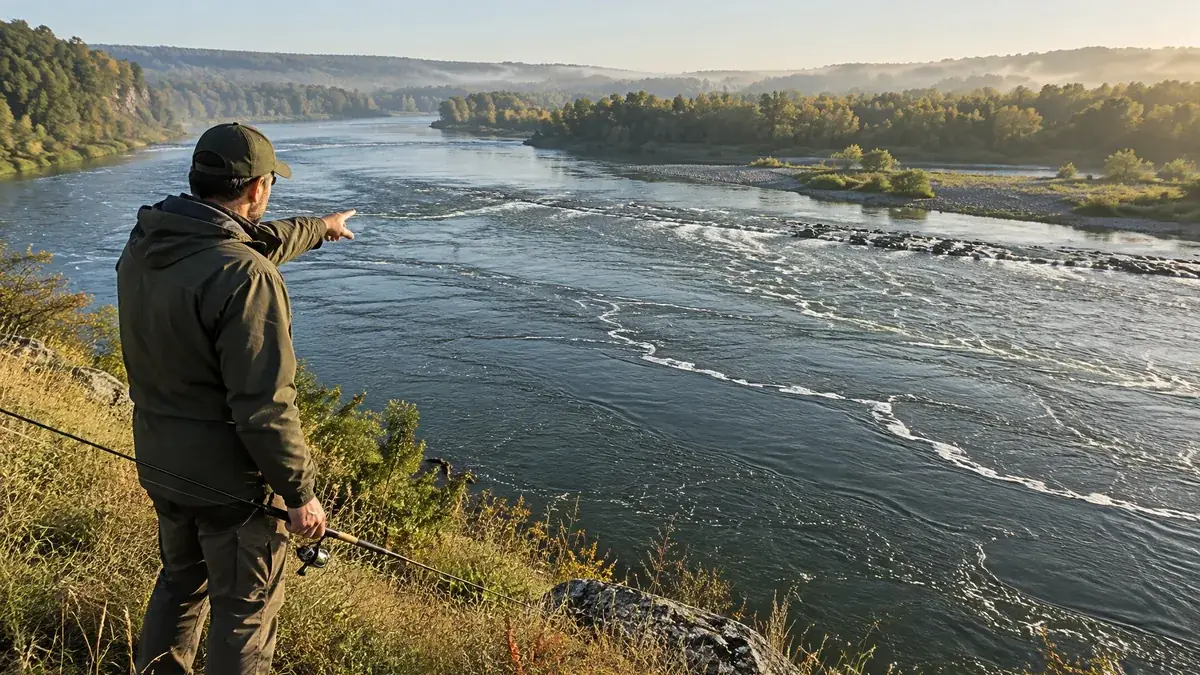
How to Read Water: Find Fish Anywhere
Most beginners walk to the bank, tie on a lure, and cast at the middle of the lake. The middle is usually the emptiest part of the water. Fish are not spread evenly; they gather where food, oxygen, and safety overlap, and those places leave clues on the surface and along the shore. Learning how to read water means slowing down for five minutes, looking at the whole scene, and choosing a few spots that make sense before the first cast. This guide explains the terms, shows what to look for on lakes and rivers, and gives you a simple scan you can repeat on any new water.
Start on the Bank: A Five-Minute Scan
Before you rig up, stop and look. A short scan from a high point, a bridge, or a dock is worth more than an hour of random casting.
- Wind. Note which way it blows. Wind pushes plankton and baitfish downwind, and predators follow. The windy bank is often the feeding bank if you can fish it safely.
- Sun and shade. Look for shade lines along docks, trees, bridge pilings, and steep banks. On bright days, fish sit in the dark edges.
- Water color and clarity. Clear water pushes fish deeper; stained water lets them feed shallower. A color change often marks a depth change or an inflow.
- Bait and birds. Dimples, fleeing minnows, and diving birds mean bait is present, and bait means predators are nearby.
- Current. On a river, find where the flow speeds up, slows down, or breaks around an object.
- Other anglers. See where they are set up, but do not crowd them. Their spots tell you where access is easy, not necessarily where fish are.
Pick three spots you want to fish and rank them. That ranking is your plan, and it keeps you moving instead of standing in one place all morning.
Structure, Cover, and Edges
Two words explain most fish location.
Structure is the shape of the bottom and shoreline: points, drop-offs, humps, channels, ledges, and flats. Structure is permanent. A point that juts into the lake, a creek channel that swings near the bank, or a sharp drop from shallow to deep all count.
Cover is what sits on or above the structure: weeds, lily pads, submerged trees, rocks, docks, bridge pilings, and overhanging brush. Cover can be temporary or move with the seasons.
Fish use both, but the best spots are where the two meet. A weed edge along a drop-off, a dock next to a channel, or a rock pile on a point combines food, safety, and a quick escape to deep water. That overlap is what anglers mean by an edge.
Edges come in several forms:
- Weedlines, where open water meets vegetation.
- Drop-offs, where shallow water falls into deeper water.
- Points, where land pushes into the lake and fish can move from deep to shallow.
- Shade lines, where sunlight ends and shadow begins.
- Color changes, where clear water meets stained water or an inflow.
When you find an edge, fish along it rather than through the middle of the feature. Most strikes come from the edge, not the center of a weed bed.
Read the Current in Rivers and Tidal Water
Flowing water compresses fish into predictable places. The basic river sequence is riffle, run, and pool: shallow fast water over rocks (riffle), a smoother moving stretch (run), and a deeper, slower section (pool). Fish use all three, often holding at the transitions.
The most important feature is the eddy, a pocket of slower or reverse-flowing water behind a rock, bridge piling, or bank point. Fish sit in eddies because the current brings food past them without forcing them to fight it. The line where fast water meets slow water is called a seam, and fish often hold right on it, facing upstream.
Other places to look:
- Behind boulders. The slack water directly behind a rock is a classic holding spot.
- Foam lines. A line of bubbles on the surface marks a current seam with food trapped in it.
- Tailouts. The shallow, slowing water at the bottom of a pool concentrates bait and feeding fish.
- Undercut banks. Current carves hollows under the bank, and fish tuck into them.
In tidal water, the same logic applies with the tide as the engine. Fish hold on the down-current side of points, bridge pilings, and channel edges, and they feed when the water is moving. Fish the slack side of structure during a moving tide, and expect the bite to slow near slack water. Our guide to the best time of day to fish explains how tides fit the daily schedule.
Read the Surface
The surface is a report on what is happening below it. You do not need electronics to read it; you need to watch.
- Dimples and rings. Small, repeated rises usually mean fish feeding on insects or small bait at the surface.
- Nervous water. A patch of water that ripples or dimples without a clear source often means baitfish are being pushed from below.
- Wakes and boils. A sudden boil or a V-shaped wake can be a predator chasing bait.
- Birds. Diving terns or gulls mark baitfish schools, and game fish are often under them.
- Slicks. A smooth, oily patch on the surface can be a sign of feeding fish below, especially in saltwater.
- Floating debris lines. Scum lines and foam lines collect bait and mark current edges.
Surface clues tell you where fish are right now. Take them seriously, even if the spot is not on your original plan.
Adjust for Season and Weather
The same water reads differently through the year. In spring, fish move shallow to feed and spawn, so flats, weed edges, and warm banks matter. In summer, heat pushes fish to deeper structure, shade, and current, except at dawn and dusk. In fall, fish follow bait into creeks and onto flats. In winter, deep holes and slow, stable water hold the most fish.
Weather shifts the read day by day. A cold front sends fish deeper and tighter to cover; a warm rain pushes them toward inflows and runoff. A steady wind stacks bait on one bank. Bright, calm days make shade and depth more important; overcast days let fish roam shallower.
If you are new to a water, ask locally which species are present and what the lake or river is known for. Then match your read to the fish you are chasing. A largemouth bass angler looks for weed edges and wood; a trout angler looks for current seams and cold inflows. Our guides to how to catch largemouth bass, how to catch bluegill, and how to catch rainbow trout each explain the spots that species prefers.
Common Mistakes
- Casting before looking. Five minutes of observation saves an hour of blind casting.
- Fishing the middle of a featureless lake. Fish relate to edges; find one before you fan-cast.
- Standing on the skyline. A silhouette above the bank spooks fish in clear, shallow water. Keep low and use cover.
- Ignoring the sun. Trout and bass often sit in shade during bright hours. Fish the shade line, not the glare.
- Only fishing comfortable spots. The easy-to-reach bank is usually the most pressured. Walk a little farther.
- Staying too long in one spot. If a spot has no bait, no cover, and no current, move. Fish the plan, not the hope.
- Making noise. Footsteps, dropped tackle, and banging boat hulls travel through water. Quiet banks catch more fish.
FAQ
What is the difference between structure and cover?
Structure is the permanent shape of the bottom and shoreline, such as points and drop-offs. Cover is the stuff fish hide in or around, such as weeds, rocks, and docks. The best spots combine both.
Where do fish sit in a river?
They sit where the current is broken: behind rocks, in eddies, on seams, under undercut banks, and in the tailouts of pools. They usually face upstream and let the current bring food to them.
How do I find a drop-off from shore?
Cast a heavy lure or a weight, count how long it takes to hit bottom, and repeat at different distances. A sudden change in count time means the depth changed. A contour map on a fishing app can also show drop-offs before you arrive.
Do fish use the same spots all year?
No. Fish shift with water temperature, oxygen, bait, and spawning cycles. A summer weed edge may be empty in winter, and a winter deep hole may hold nothing in spring.
What if the water has no obvious features?
Look for windblown banks, weed edges, inflows, shade, or color changes. If none exist, fish deeper or find the transition where shallow flats drop into the main basin.
How long should I fish a spot before moving?
Give a spot fifteen to twenty minutes with a few different presentations. If nothing happens, move to your next ranked spot. Finding fish is a search, and the pattern usually shows up after a few stops.
Ready to put it to use? Learn the best time of day to fish, review catch and release so every fish goes back healthy, and start with how to start fishing and the Getting Started guides for gear and casting basics.
About the author and how this was tested
About the author
FishermanGuy
Bank, boat and kayak angler · fishing, crabbing and shrimping since 2021
I buy the gear, fish it for a season and write down what failed. No sponsored verdicts, no free-sample flattery. Every rig on this page has landed fish in water I can point at on a map.
How this was tested
- Every rig gets at least six trips on the same water before it is published.
- Gear is bought at retail. Free samples are labelled in the first paragraph.
- Dates show first publication and the last time the page was updated.