Field notes
Snell Knot: How to Snell a Hook
Snell Knot: How to Snell a Hook
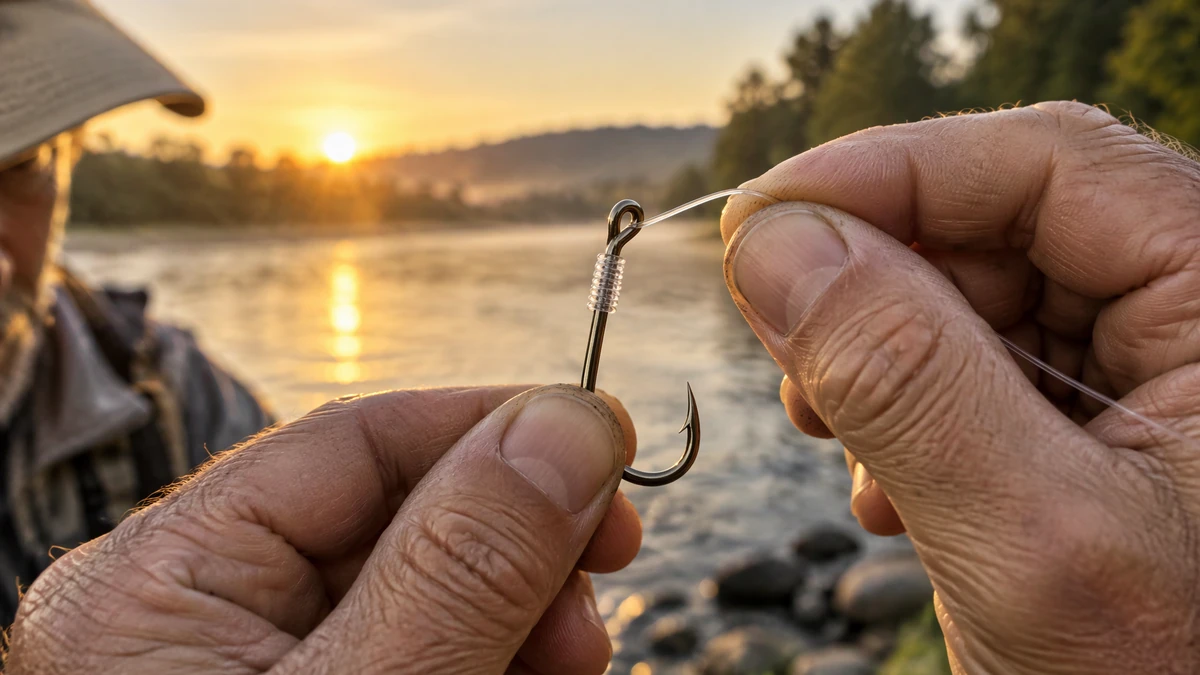
The snell knot attaches the line to a hook by wrapping it around the shank as well as through the eye, so the pull comes straight along the shank rather than pulling sideways at the eye. That geometry is why snelled hooks are used with offset worm hooks, live bait hooks, and other patterns where the hook needs to hang straight and drive home cleanly. Snelling takes a few more seconds than an eye knot, but the result is a hook that sits true and a connection that holds up to repeated hooksets. This guide covers what the snell knot is used for, how strong it is, the steps, the hooks and lines it suits, and the mistakes that weaken it.
What the Snell Knot Is Used For
The snell knot ties line to a hook that has an eye. Instead of a knot that simply seats against the eye, the snell wraps the shank and passes the tag through the eye, so the standing line leaves the hook along the shank rather than at an angle.
That matters most with offset worm hooks for soft plastics. A snelled offset hook sits in line with the bait, and when a fish takes and the angler sets the hook, the pull travels down the shank and rotates the point into the jaw. It is a standard setup for Texas rigs and other soft-plastic presentations, including flipping and pitching.
The snell is also used with live bait hooks for bait fishing, and with patterns where a straight pull along the shank is wanted.
The knot needs a hook with an eye large enough to pass the line and a shank long enough to take the wraps. It is not used for lures with treble hooks, and it does not suit hooks with very short shanks.
How Strong the Snell Knot Is
The snell is commonly cited as retaining roughly 85 to 95 percent of line strength, depending on the line, the wrap count, and how cleanly it seats. Its reputation rests less on raw breaking strength than on geometry: the pull runs along the shank, the hook stays aligned with the line, and the point is driven in a straight line.
The knot's grip comes from the coils compressing against the shank and against the standing line as it exits the eye. More wraps give more grip and a longer, flatter knot; fewer wraps are tidier on short-shank hooks.
The main weakness is slip when the knot is poorly formed. Crossed wraps, a loose barrel, or an eye too small for the line to pass cleanly all reduce holding power. In braid the coils need a little more attention than in mono, because the line is slick.
How to Snell a Hook Step by Step
- Pass about six inches of tag end through the hook eye and pull it through, so the tag can run back along the shank.
- Lay the tag along the shank toward the bend, then double it back toward the eye to form a loop beside the shank, and pinch the loop against the shank.
- Wrap the tag around the shank and the loop five to seven times, keeping the coils side by side and working from the bend end of the loop toward the eye.
- Wet the wraps with saliva or water.
- Pull the tag end steadily to close the loop and clamp the coils onto the shank. Hold the hook, not the wraps, while you pull.
- Pull the standing line to seat the knot tight against the eye, check that the coils are even, and trim the tag close.
The finished knot wraps the shank just behind the eye, with the standing line leaving along the shank. If the coils sit loose or the loop has not closed, cut the knot off and start again; a snell that has not clamped will slide.
Best Hooks and Line Types
Hooks. Offset worm hooks, straight-shank worm hooks, extra-wide-gap hooks, and live bait hooks with a straight shank and an eye large enough to pass the line. The hook should have enough shank length to hold five to seven wraps.
Monofilament. The easiest line to snell. It grips the shank well and the wraps seat smoothly. Five or six wraps is typical.
Fluorocarbon. Works with thorough wetting. Stiff fluoro needs steady pressure to seat the coils cleanly, and heavy fluoro can make the knot bulky.
Braid. The snell can be tied in braid, but the slick line needs more wraps, usually six to eight, and a firm final seating. Check the knot with a hard pull before fishing it.
The snell is a hook knot. For lures, swivels, and snaps, a Palomar or an improved clinch is the simpler choice.
Snell Knot vs Other Hook Knots
Against the Palomar. The Palomar is faster, holds the hook tight against the eye, and tests among the highest of the terminal knots. It pulls through the eye, though, so the hook can sit at a slight angle. The snell trades some speed for a straight pull along the shank.
Against the improved clinch. The improved clinch is quick and works well in mono, but it seats at the eye and does not wrap the shank. On offset worm hooks, the hook can hang off line with the clinch; the snell keeps it aligned.
Against the San Diego Jam. The San Diego Jam is a strong terminal knot for heavy line and fluoro, again seating at the eye. It suits lures and conventional hooks rather than the soft-plastic presentations that call for a snell.
For drop shot hooks, the drop shot knot serves a different purpose and is not a substitute for a snell.
Common Mistakes
- Crossed wraps. The coils must lie side by side around the shank. A crossed wrap creates a high spot and a loose knot.
- Too few wraps. Five is a working minimum in mono and fluoro. Fewer wraps give less grip, especially in braid.
- Pulling the standing line first. Close the loop with the tag before you seat the knot at the eye. Pulling the standing line first can trap loose coils.
- A hook eye that is too small. If the line cannot pass cleanly through the eye, the knot will not seat. Match the hook to the line.
- Tightening dry. Wet the wraps so the coils slide into place without friction damage.
- Snelling a treble-hooked lure. The snell is for hooks with a shank. Lures attach with a terminal knot at the line tie.
FAQ
What is a snell knot used for? It attaches line to a hook while wrapping the shank, so the pull runs along the shank. It is common on offset worm hooks for soft plastics, on live bait hooks, and anywhere the hook needs to hang straight.
Can you snell a hook with braid? Yes, with more wraps (six to eight) and a firm final seating. Braid is slick, so test the knot with a hard pull before fishing it.
Is a snell knot stronger than a Palomar? Published figures put both in a similar range, with the Palomar often cited slightly higher. The snell's advantage is hook alignment and a straight pull along the shank, not raw strength.
Do you need a special hook to snell? No special hook is required, but the hook needs an eye large enough to pass the line and a shank long enough for five to seven wraps. Offset and straight-shank worm hooks are common choices.
How many wraps should a snell have? Five to seven for mono and fluoro, six to eight for braid. Heavier line takes fewer wraps to keep the knot from becoming bulky.
For more hook and terminal options, compare the Palomar knot and the San Diego Jam, match hook size with the fishing hook sizes guide, or browse the Fishing Knots category.
About the author and how this was tested
About the author
FishermanGuy
Bank, boat and kayak angler · fishing, crabbing and shrimping since 2021
I buy the gear, fish it for a season and write down what failed. No sponsored verdicts, no free-sample flattery. Every rig on this page has landed fish in water I can point at on a map.
How this was tested
- Every rig gets at least six trips on the same water before it is published.
- Gear is bought at retail. Free samples are labelled in the first paragraph.
- Dates show first publication and the last time the page was updated.