Field notes
Fishing Hook Sizes Explained
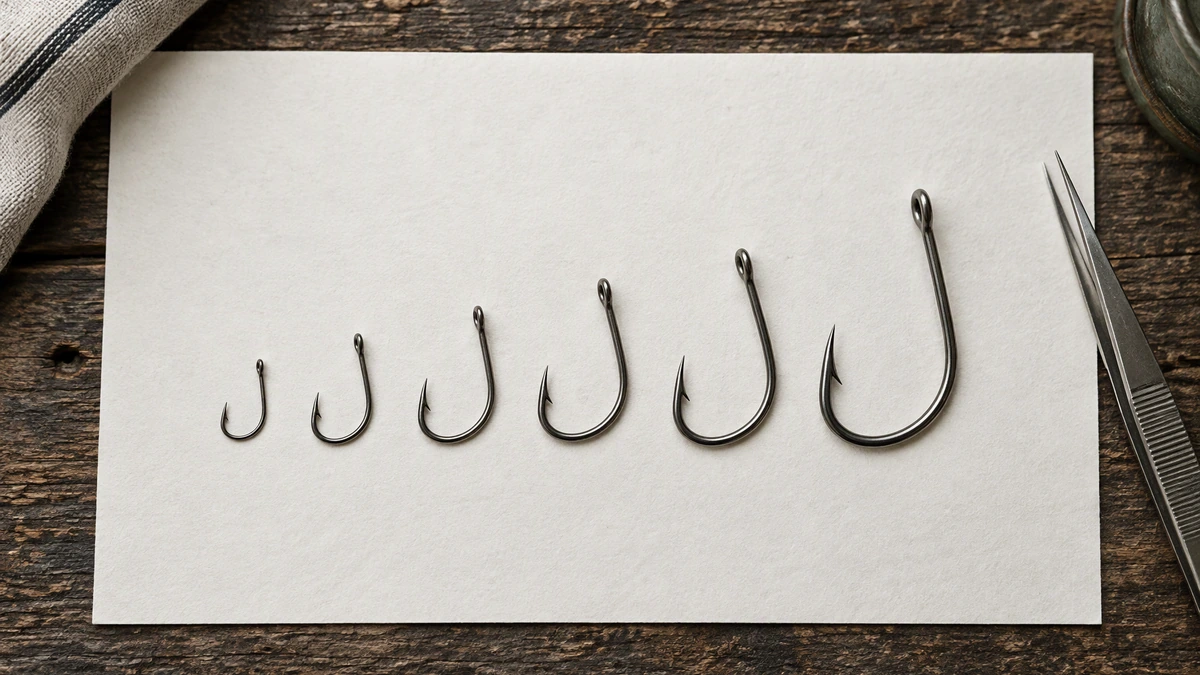
Fishing Hook Sizes Explained
Fishing hook sizes confuse almost everyone at first because the numbering runs backward from what people expect. A size 1 hook is bigger than a size 8, and a 1/0 is bigger than a 1. Once you understand the scale and the few things that matter more than the number, choosing a hook becomes a simple decision instead of a guess. Hook size affects whether a bait looks natural, whether a fish gets hooked in the jaw, and whether the hook straightens or holds. This guide explains the scale, the difference between size and type, how to match hooks to bait and fish, and why gape and wire often matter more than the number stamped on the box.
How the Hook Size Scale Works
Hook sizes come in two ranges, and the scale flips in the middle.
The small range runs from size 1 down to size 32, and the bigger the number, the smaller the hook. A size 1 is the largest in this range, a size 8 is smaller, and a size 32 is tiny, the kind used for small panfish or tying flies. When you see a pack of size 6 hooks, you are holding small hooks.
The large range uses aught sizes, written with a slash: 1/0, 2/0, 3/0, and up. Here the bigger the number before the slash, the bigger the hook. A 1/0 is larger than a size 1, a 3/0 is larger than a 1/0, and offshore hooks can run to 10/0 or larger. The zero is spoken as "aught," so 1/0 is "one aught."
Put together, the full order runs from smallest to largest like this: 32, 30, 28, and on up through 10, 8, 6, 4, 2, 1, then 1/0, 2/0, 3/0, and so on. That single sequence explains most of the confusion.
Hook Size Is Not Hook Type
Two hooks with the same number can behave completely differently because size and style are separate. A 1/0 circle hook, a 1/0 octopus hook, and a 1/0 offset worm hook share a number but not a shape, and each is built for a different job.
Common styles include the standard J-hook, the circle hook with its point turned back toward the shank, the octopus hook with a short shank and a wide bend, the extra-wide-gap worm hook for soft plastics, the offset worm hook for Texas rigs, treble hooks for lures, and siwash hooks for spoons and spinners. Bait holder hooks have barbs on the shank to grip soft bait, and Aberdeen hooks use a light wire and wide gap for live bait.
Choosing a hook means choosing a style first, then a size within that style. A circle hook in the right size still will not work like a worm hook, and a worm hook will not give you the jaw-hooking benefits of a circle.
Match the Hook to the Bait
The bait sets the working range for hook size. The hook has to be big enough to hold the bait and small enough that the point and gap stay clear.
For small baits like worms, dough, and small minnows, use small hooks: size 8 to size 2 for panfish and trout, and size 4 to 1/0 for bass and walleye. For cut bait and larger live bait, step up: 2/0 to 5/0 covers most freshwater catfish and bass applications, while saltwater cut bait often calls for 5/0 to 8/0 circle hooks.
The test is simple. Hook the bait and look at it from the side. If the bait covers the point or fills the gap so a fish cannot get hooked, the hook is too big or the bait is too big for it. If the hook looks lost in the bait, it is too small to hold.
For soft plastics, the hook style matters as much as the size. A Texas rig needs an offset worm hook with enough gap to clear the plastic body, usually 2/0 to 5/0 for standard worms and larger for big swimbaits. The Texas rig and Carolina rig guides show how hook size fits those presentations.
Match the Hook to the Fish
Fish size and mouth shape set the upper end of hook size. A big hook in a small fish's mouth blocks the point; a small hook in a big fish's jaw can pull out or straighten.
Panfish and trout take small hooks, roughly size 10 to size 4, because their mouths are small and their baits are small. Largemouth and smallmouth bass cover a wide range depending on bait, from size 1 for finesse worms to 5/0 for big soft plastics and punching setups. Catfish and carp take larger hooks, 2/0 to 8/0, matched to the bait.
In saltwater, redfish and striped bass on cut bait commonly use circle hooks in the 5/0 to 8/0 range. Surf and pier anglers chasing whiting and croaker drop to 1/0 to 3/0. Offshore, hook sizes climb with the fish: 7/0 to 10/0 or larger for tuna and billfish, depending on the bait and the rig.
Mouth shape matters too. A fish with a soft, fleshy mouth, like a catfish, needs a wider gap to get around the jaw. A fish with a hard, bony mouth needs a sharp, strong point and enough gap to reach past the lip.
Gape, Wire, and Shank Matter as Much as the Number
Two hooks of the same size can fish differently because of gape, wire, and shank length.
Gape is the distance between the point and the shank. A wide gap gives more room for the hook to rotate into the jaw and holds soft plastics better. A narrow gap suits small baits and light wire.
Wire gauge sets strength and weight. Light wire hooks penetrate easily and suit finesse fishing and small fish. Heavy wire hooks are stronger but harder to drive, and they suit big fish and heavy cover. Forged hooks are stronger than plain wire for their size.
Shank length changes the leverage. A long shank protects the knot from teeth and makes unhooking easier; a short shank keeps the hook compact and is common on circle and octopus hooks. Offset hooks bend at the shank to make soft plastics track straight.
The point and barb matter most of all. A dull point costs fish, and a barb that is too large tears flesh. Check the point on your thumbnail before every trip; if it drags instead of biting, sharpen or replace it.
Common Hook Size Mistakes
- Assuming every brand's size is the same. Hook sizes are not standardized across manufacturers. A 1/0 from one brand can differ from another. Compare hooks side by side.
- Choosing by number instead of by bait. A hook that buries the bait or leaves no gap will miss fish no matter how correct the number looks.
- Going too big for pressured fish. Big hooks catch big fish, but small finesse hooks catch more fish in clear, pressured water.
- Ignoring the gap. A hook can be the right length and still have too narrow a gap for the bait or the fish's mouth.
- Using freshwater hooks in saltwater. Saltwater hooks need corrosion resistance and often heavier wire. A freshwater hook will rust and may straighten.
- Fishing a dull hook. Replace or sharpen points often, especially after contact with rocks, teeth, or a fish.
- Using trebles where a single is better. For release-focused fishing, single hooks and circle hooks reduce injury and are easier to remove.
FAQ
What is the smallest hook size? Sizes run down to 32 in common freshwater ranges, and smaller hooks exist for fly tying. In practice, size 10 to size 6 covers most panfish and trout fishing.
What does 1/0 mean on a hook? The slash sizes are aught sizes. 1/0 is the smallest aught size and is larger than a size 1. The bigger the number before the slash, the bigger the hook.
What size hook should I use for bass? It depends on the bait. Finesse worms and small plastics often use size 1 to 2/0; standard Texas rigs and creature baits use 2/0 to 4/0; big swimbaits and flipping baits use 4/0 to 6/0.
Do hook sizes vary by brand? Yes. There is no universal standard, so a size from one maker can differ from the same size in another. Compare gape and length, not just the number.
Are circle hooks better for catch and release? Circle hooks usually hook fish in the jaw rather than deep in the throat, which improves survival and makes release easier. Some fisheries require them for bait fishing, so check local rules.
Hook size is one piece of a working rig. Pair it with the right knot from the fishing knots category, and see how it fits surf setups in best surf fishing rigs. For species-specific choices, largemouth bass and redfish cover the most common hook questions, and catch and release explains why hook style matters for fish survival. The Rigs & Terminal Tackle category has the rest.
About the author and how this was tested
About the author
FishermanGuy
Bank, boat and kayak angler · fishing, crabbing and shrimping since 2021
I buy the gear, fish it for a season and write down what failed. No sponsored verdicts, no free-sample flattery. Every rig on this page has landed fish in water I can point at on a map.
How this was tested
- Every rig gets at least six trips on the same water before it is published.
- Gear is bought at retail. Free samples are labelled in the first paragraph.
- Dates show first publication and the last time the page was updated.