Field notes
Best Surf Fishing Rigs
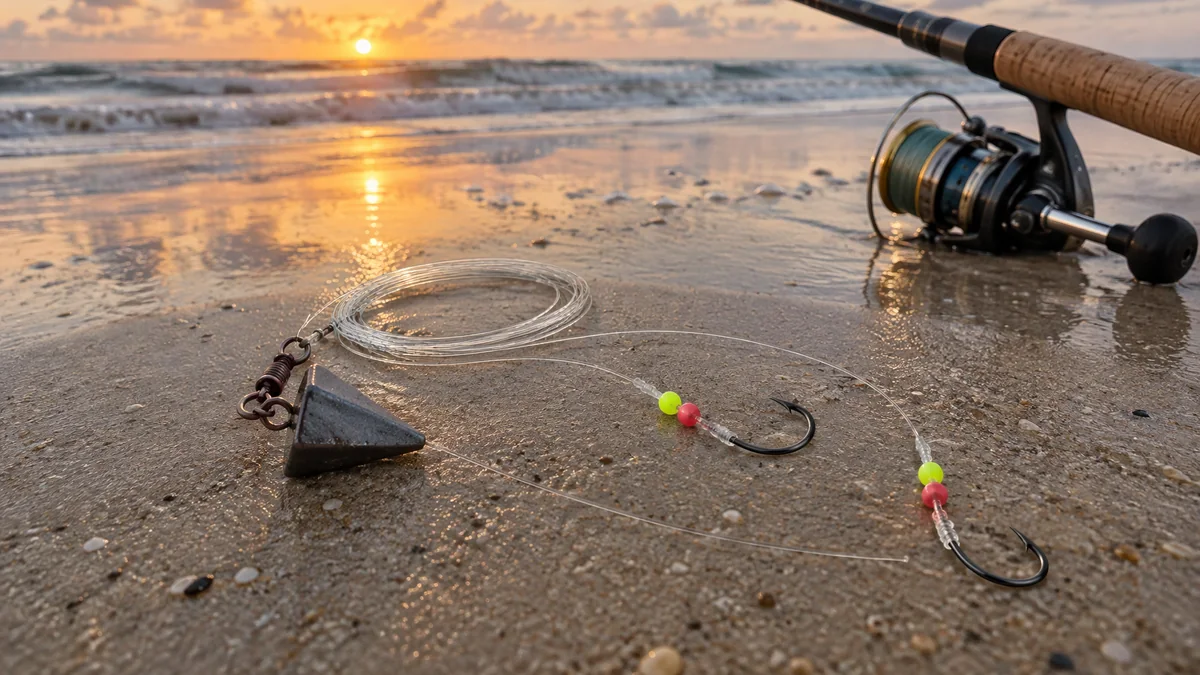
Best Surf Fishing Rigs
The right surf fishing rigs solve three problems at once: reaching past the shorebreak, holding bottom where the water is moving, and presenting bait so a fish can eat it without feeling the weight. Every rig in this guide does those jobs differently, and the best choice depends on the beach in front of you, the fish you are after, and how much current you have to beat. A calm trough on a falling tide calls for a different setup than a ripping cut on a rising tide. What follows are the four rigs that cover most surf situations, the line and hook sizes that make each one work, and the mistakes that turn a good rig into tangles and missed fish.
What a Surf Rig Has to Do
A surf rig is a delivery system. It has to cast a bait far enough to reach the fish, keep that bait where you put it, and let a fish pick it up without feeling resistance. Those three demands pull against each other. More weight casts farther and holds better but makes the bait look less natural. Less weight presents better but rolls in the wash. The rigs below balance the trade-off in different ways.
The other job is handling. Surf fishing usually means braid main line, a long shock leader, and a bait that has to survive repeated casts. A rig that tangles on every cast is useless no matter how well it fishes, so simple line flow matters as much as fish appeal.
The Fish Finder Rig: The All-Around Bottom Rig
The fish finder rig is the first rig most surf anglers learn, and for good reason. It handles big baits, heavy weights, and rough water, and it lets a fish run without feeling the sinker.
The setup is simple. Thread a sliding sinker onto your main line, add a bead, tie on a swivel, and attach a leader of 30 to 50-pound mono or fluorocarbon with a circle hook at the end. The sinker slides freely between your rod and the swivel, so when a fish picks up the bait, it can move off with the leader while the weight stays put. That freedom is what makes the rig so effective on wary fish in clear water.
Use a Sputnik or storm sinker when current is strong, because the wire legs dig in and hold. In calmer water a bank sinker or an egg sinker rolls less than you might expect. Leader length is a tuning tool: a short leader keeps the bait close to the weight and casts clean, while a longer leader lets the bait move more naturally but tangles more easily. Start around 18 to 24 inches and adjust.
Hook size depends on the bait and the fish. For striped bass and redfish on cut bait, circle hooks in the 5/0 to 8/0 range are a common starting point. Match the hook gap to the bait so the point is not buried.
The High-Low Rig: Two Baits, One Cast
The high-low rig, also called a top-and-bottom rig, puts two hooks above a sinker so you cover two depths on every cast. It is the standard for whiting, croaker, pompano, and other small-to-medium surf species, and it is hard to beat when fish are scattered through the water column.
You can build it with a three-way swivel or with dropper loops tied into a single leader. The three-way version is easier to visualize: main line to the swivel, a short leader down to the sinker, and two hook leaders off the other eyes at different heights. The dropper-loop version is tidier in the wind because the hooks stand out from the main line instead of dangling from swivels.
Keep the hook leaders short, around 4 to 8 inches, so they do not wrap around the main line on the cast. Small hooks are the point of this rig: 1/0 to 3/0 for whiting and croaker, and smaller for pompano. A pyramid or Sputnik sinker holds the rig in place while the baits flutter above the bottom.
The high-low rig shines on sand beaches with moderate current. In heavy current the upper hook can tangle, and on very snaggy bottom both hooks find structure. It is a numbers rig, not a trophy rig, though big fish do eat small baits.
The Carolina Rig: Finesse in the Wash
The Carolina rig moves the weight away from the hook with a longer leader, which makes it a better choice for clear water and pressured fish. It is the surf version of a freshwater staple.
Slide an egg sinker onto the main line, add a bead to protect the knot, tie on a swivel, and run a leader of 18 to 36 inches to the hook. The sinker stays above the swivel and the bait trails behind on a lighter leader. That long, light section lets a bait like a live shrimp, sand flea, or small piece of cut bait move naturally in the wash.
The Carolina rig is at its best in calm-to-moderate surf, over sand, when fish are finicky. It casts well because the weight is concentrated, and it sinks quickly. The trade-off is that the long leader can wrap on the cast, so keep the bait compact and use a smooth, lobbing cast rather than a hard snap.
Fluorocarbon leaders make sense here because the rig is built for visibility-shy fish. Downsize the hook to match the bait, often 1/0 to 3/0, and let the current do the work.
The Pompano Rig: Small Hooks and Floating Beads
The pompano rig is a specialized high-low that targets pompano, whiting, and other small surf feeders. It uses small hooks, short leaders, and often small floats or beads above the hooks to lift the bait off the bottom.
The floats are the key. A small foam float or a cluster of beads above each hook keeps the bait just off the sand, where pompano cruise. Sand fleas, small pieces of shrimp, and scented strips are standard baits. Hooks run small, often 1 to 2/0, with a pyramid sinker at the bottom to hold in the wash.
This rig will not win a trophy fight, but it is deadly on the species that make up most surf catches on Gulf and Southeast beaches. It also tangles less than a plain high-low because the floats keep the hooks separated.
Matching the Rig to the Beach
Rig choice starts with reading the beach. Look for troughs, the deeper water between the sandbar and the shore, and cuts, the channels where water drains off the beach. Fish use both, especially on a moving tide.
A fish finder rig with a heavy Sputnik suits a cut with current ripping through it. A high-low rig suits a broad, flat trough where fish are spread out. A Carolina rig suits clear, calm water where fish are spooky. The pompano rig suits the shallow, sandy stretches where small fish feed.
Tide matters too. On a rising tide, fish often push shallow to feed, so shorter casts and lighter weight can be better. On a falling tide, they pull back into the troughs and cuts, and distance and holding power matter more. Walk the beach at low tide and note the bars, holes, and cuts while you can see them; that map is gold when the water comes back.
Common Surf Rig Mistakes
- Using heavy mono as main line. Mono's stretch and memory cost distance and create tangles. Braid main line with a mono shock leader casts farther and lasts longer.
- Skipping the shock leader. A heavy bait on a light main line will snap on the cast. A common starting rule is a leader rated at roughly ten pounds per ounce of weight.
- Hooks too big for the bait. A hook that buries the bait or leaves no gap for the point will miss fish. Match the hook to the bait, not to the fish you hope to catch.
- Too much weight. A sinker that holds is better than one that casts far and rolls. Pick weight for the current, not for the horizon.
- Long leaders on a high-low rig. Long droppers wrap around the main line. Keep them short and the rig casts clean.
- Not checking knots after a fish. Surf knots take a beating in the wash. Retie the leader after every good fish or snag.
FAQ
What is the best surf fishing rig for beginners? The fish finder rig. It is simple, handles big baits and heavy weights, and lets fish run without feeling the sinker. Learn it first, then add the high-low for smaller species.
Do you need a shock leader for surf fishing? In most cases, yes. A shock leader absorbs the load of the cast and keeps a heavy sinker from breaking the main line. Ten pounds of leader rating per ounce of weight is a common starting point.
What size hook should I use for surf fishing? It depends on the bait and species. Circle hooks in the 5/0 to 8/0 range suit striped bass and redfish on cut bait; 1/0 to 3/0 suits whiting, croaker, and pompano.
How heavy a sinker do I need in the surf? Use enough to hold bottom without dragging. Two to four ounces works in calm surf, while four to six ounces or more is common in strong current. Let the water decide.
Should I use one hook or two in the surf? Two hooks catch more fish but tangle more and complicate release. One hook is simpler and safer for big fish; two hooks are fine for small species on a high-low rig.
If you are just starting, read surf fishing for beginners before you pick a rig, and compare notes with pier fishing basics if you fish structure. Hook size choice gets its own breakdown in fishing hook sizes, and the Surf & Pier category has more beach-specific guides. Target species matter too: redfish and whiting are the classic surf targets, while striped bass reward the same rigs on the right coast.
About the author and how this was tested
About the author
FishermanGuy
Bank, boat and kayak angler · fishing, crabbing and shrimping since 2021
I buy the gear, fish it for a season and write down what failed. No sponsored verdicts, no free-sample flattery. Every rig on this page has landed fish in water I can point at on a map.
How this was tested
- Every rig gets at least six trips on the same water before it is published.
- Gear is bought at retail. Free samples are labelled in the first paragraph.
- Dates show first publication and the last time the page was updated.