Field notes
How to Read Current in a River
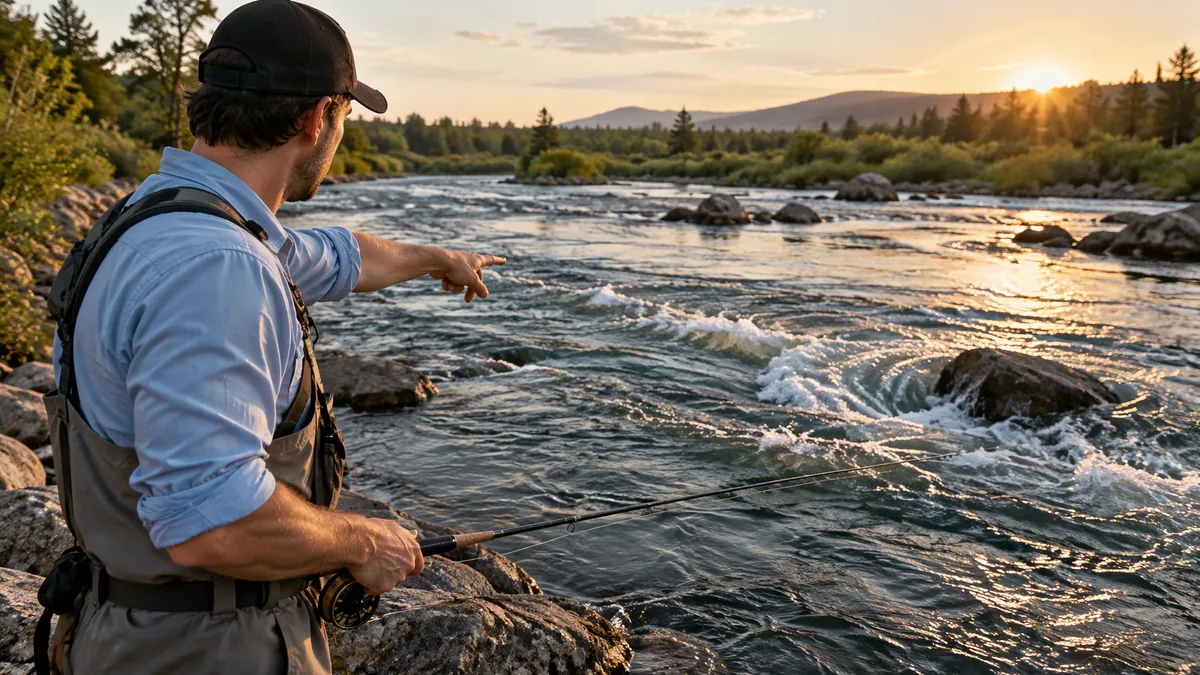
How to Read Current in a River
Learning how to read current is the fastest way to stop fishing empty water. A river is not one speed from bank to bank; every boulder, log, drop-off, and bend rearranges the flow, and fish arrange themselves around those changes. Current carries food, delivers oxygen, and costs energy, so a trout, bass, walleye, or salmon holds only where the trade is worth it. That means the slow lane beside a fast tongue, the pocket behind a rock, the deep water under a foam line. You can find those places by looking, without electronics, once you know what the surface is telling you. This guide covers the features that repeat in almost every river and how to turn each one into a cast.
What the Surface Tells You Before You Cast
Stand on the bank and watch for thirty seconds before you rig up. The surface reads like a map if you know the symbols.
A riffle is shallow, broken water over rock or gravel. It is fast and oxygen-rich, and fish feed at its edges but rarely sit in the middle. A run is the steady stretch where the surface is smooth and moving at one speed. A pool is the deep, slow water below a riffle, where fish rest and feed out of the main push. Most rivers repeat riffle, run, pool in sequence, so the pattern you learn in one bend applies in the next.
Watch for standing waves. A line of waves that stays in one place is water piling over something hard and shallow underneath, usually a rock ledge or a gravel bar. Boils and upwelling bubbles mark a sudden drop into deeper water. A smooth, dark patch beside riffled water is either depth or a different speed, and both are worth investigating. These are the first clues to the shape of the bottom.
Seams: The Edges That Hold Fish
If you learn one feature, make it the seam. A seam is the line where fast water meets slow water, visible as a glassy band, a foam line, or a streak of color beside a riffle. Food gets swept along the fast side, and predators hold just inside the slow side, facing upstream, picking off whatever crosses. The seam is the dinner table.
Seams form anywhere the flow changes speed: beside a riffle, below a boulder, along the edge of a weed bed, under a bridge. The stronger the contrast, the better the seam. On big rivers you can often see several seams braiding down one stretch, each one a potential holding line. Fish the slow side of the seam, not the middle of the fast water. A cast that lands a foot too far into the current drags your bait out of the zone within seconds.
Foam lines are the most reliable seam markers. Foam collects where two currents meet and where water slows, so a long foam line usually means a long, stable edge. Follow it with your eyes and note where it bends; the bend is often where the bottom changes and fish stack up.
Eddies and Current Breaks
Any object in the flow pushes water around it and leaves a pocket of calmer water downstream. That pocket is an eddy, and fish use it as a rest stop. Boulders, bridge pilings, fallen trees, and even the outside of a bend all create them.
An eddy has two useful edges. The front edge, where the main current wraps around the object, is where food gets delivered. The back edge, where the water curls, is where fish sit. Work the seam at the edge of the eddy rather than its dead center, and cast tight to the object so your bait slips into the slack before the current grabs it.
Large eddies can be surprisingly big. Below a bridge piling or a big rock, the calm zone may extend several feet downstream, and big fish will hold in the middle of it where the current is almost still. Those spots are easy to overlook because the surface looks flat. A flat, smooth patch behind structure on a fast river is almost always worth a cast.
Read Structure, Not Just the Surface
The surface is the beginning, not the whole story. Underneath, the same objects that make eddies also scour holes, create ledges, and stack rocks into ridges. Predators use those changes the same way they use a seam.
Undercut banks are a good example. Where the current has carved soil out from under the bank, fish hide in the shadow and dash out for food. The surface often shows a slick, smooth line tight to the bank, and the strike zone is inches from dry land. Cast parallel to the bank and let the bait drift along it.
Points, bridge pilings, and rock gardens all deflect current and create a chain of features downstream: a scour hole, a slack pocket, a secondary seam. Read the whole chain rather than one spot. In a rock garden, the water between two rocks forms a chute, and fish hold at the tail of the chute where it dumps into slower water. In a bend, the outside edge is fast and deep, the inside is shallow and slow, and the seam between them is where fish travel.
Judge Depth and Speed From Surface Signs
You cannot see the bottom in most rivers, but the surface gives you a decent read. Standing waves mean shallow structure. A smooth bulge with no waves usually means deep water pushing up. Color changes can mean depth, bottom type, or a tributary coming in. A dark patch beside a bright riffle is often a hole.
Speed is easier. Riffles are fast, runs are medium, pools are slow. The steeper the wave, the faster and shallower the water. If you are wading, test depth with a staff or your feet before committing, and remember that a smooth surface can hide a strong undercurrent. The calmest-looking water in a river is often the most dangerous to wade, because it is deep and pushing hard underneath.
Adjust the Read to Water Level and Clarity
A river's features move with the water level. In high, dirty water, the main current is too strong and too dirty to feed in, and fish push tight to the bank and into eddies. The seams get bigger and closer to shore, and the strike zone shrinks to a narrow strip along the edge. Fish dark, bulky baits and cast short.
In low, clear water, the current lines are sharper but the fish are spookier. Fish slide into deeper pools, shaded pocket water, and the heads of riffles where oxygen is high. You need longer casts, lighter line, and a quieter approach. The same seam that held fish at normal flow may now be too shallow, while the deeper tailout below the pool becomes the new target.
Cold water slows fish down, so they hold in slower water and feed less aggressively. Warm water pushes them toward riffles and current for oxygen. Either way, the seam is still the anchor; what changes is how deep and how far you fish it. For a wider look at how flow and season interact, see river fishing techniques.
Common Mistakes When Reading Current
- Casting into the middle of the fast water. The center of a riffle is the least likely place a fish is sitting. Work the edges first.
- Fishing the seam from the wrong side. Fish face upstream on the slow side. A cast that lands on the fast side drags the bait away from them.
- Reading one spot and stopping. Walk the bank and read the whole stretch. The best feature is often fifty yards away.
- Ignoring flat water behind structure. The calm pocket behind a rock looks boring, but it is often where the biggest fish in the run are resting.
- Standing where you should fish. Wading straight into a pool sends fish scattering. Fish the near water first, then move upstream.
- Assuming the surface shows everything. A smooth surface can hide a deep hole or a strong undercurrent. Probe before you wade.
FAQ
How do you find the seam in a river? Look for a visible line where fast water meets slow water: a foam line, a glassy band, or a color change. The seam usually runs beside a riffle, below a boulder, or along a bank. Fish the slow side.
What does a foam line mean in a river? Foam collects where currents converge and where water slows. A long foam line marks a stable edge between fast and slow water, which is a natural feeding lane for fish.
Do fish sit in fast current? Some do, briefly, to feed, but most hold in slower water beside the fast lane and dart out to grab food. The seam, not the riffle center, is where they spend their time.
How does rising water change where fish hold? Rising, dirty water pushes fish toward the bank and into eddies, away from the main current. Falling, clearing water pulls them back toward deeper pools and sharper seams.
How can I practice reading current? Pick a short stretch you can see well and map the features out loud: riffle, run, pool, seam, eddy. Then fish each one and note where the bites come from. The feedback teaches faster than any diagram.
If you are new to moving water, start with how to fish a river for the fundamentals, then use how to read water to sharpen your eye on still water too. Trout anglers will get more from this skill than anyone, so pair it with how to catch brown trout or rainbow trout. The Rivers & Streams category collects the rest of the river guides.
About the author and how this was tested
About the author
FishermanGuy
Bank, boat and kayak angler · fishing, crabbing and shrimping since 2021
I buy the gear, fish it for a season and write down what failed. No sponsored verdicts, no free-sample flattery. Every rig on this page has landed fish in water I can point at on a map.
How this was tested
- Every rig gets at least six trips on the same water before it is published.
- Gear is bought at retail. Free samples are labelled in the first paragraph.
- Dates show first publication and the last time the page was updated.