Field notes
How to Spool a Reel Correctly
How to Spool a Reel Correctly
Knowing how to spool a reel correctly saves line, saves casts, and saves fish. A reel filled the wrong way twists, backlashes, and loses distance; a reel filled the right way casts smooth from the first cast and holds enough line to fight a fish that runs. The job is not complicated, but the details matter: which way the line comes off the filler spool, how much tension you apply, how much backing goes under braid, and how close to the lip you fill. This guide walks through spooling both spinning and baitcasting reels, how to choose line and how much of it, and the mistakes that show up as wind knots and loose coils on the first trip.
Why Spooling Technique Matters
Line goes onto a reel under tension, and it remembers how it was put there. If it goes on loose, it sits in loose coils that dig in and cause tangles. If it goes on with twist, every cast adds more twist until the line curls off the spool in loops. If the spool is overfilled, line spills off the lip; if it is underfilled, distance suffers and the line rubs the lip on the way out.
Spooling also sets up your drag and line capacity. A reel filled to the right level with the right line diameter performs close to its rating. A reel filled with the wrong line, or with too little of it, cannot. Getting this right at the start is easier than fixing it on the water.
Pick the Line and the Right Amount
Line choice starts with the reel and the job. Monofilament is forgiving, stretchy, and inexpensive, which makes it a good backing and a fine choice for many freshwater setups. Fluorocarbon is denser and sinks, with better abrasion resistance and less visibility, which suits leaders and some bottom presentations. Braid has almost no stretch, casts far, and lasts for years, but it is slippery on a bare spool and needs either backing or tape to grip.
Capacity is printed on the reel, usually as a few line-test and yardage combinations. Those numbers assume a specific line diameter, so a reel rated for a given yardage of mono holds much more braid at the same test because braid is thinner. Fill by diameter and by the reel's intended use, not by the number on the box alone.
For braid, add a base of mono backing first. The backing gives the braid something to bite into and saves expensive braid. Fill roughly a third of the spool with backing, then top with braid to the fill line. A strip of electrical tape on the bare arbor works as a shortcut, but backing is more reliable.
Spool a Spinning Reel Step by Step
A spinning reel spools line in loops, so the direction the line comes off the filler spool matters. If the filler spool is oriented the wrong way, every loop adds twist.
- Open the bail and run the line through the rod guides and onto the reel.
- Tie the line to the spool arbor with an arbor knot, or tie the backing on first if you are using braid.
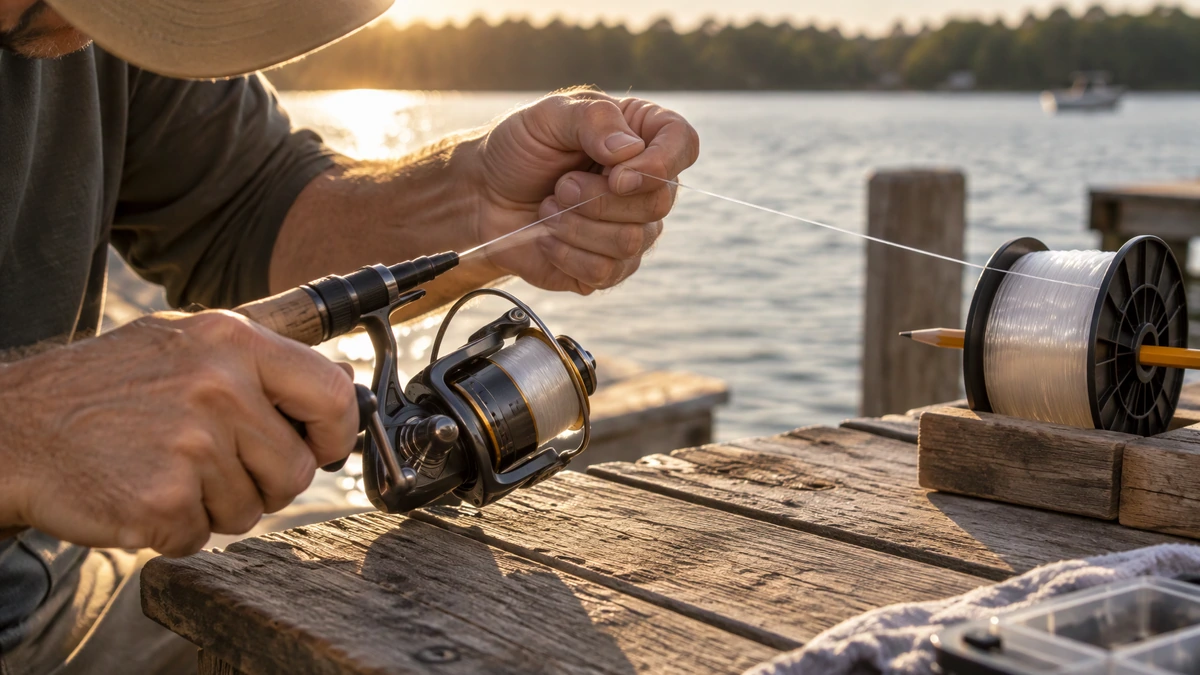
- Lay the filler spool on the floor with the label facing up, or hold it on a pencil so it can rotate. The line should come off the filler spool in the same direction the reel turns.
- Close the bail and crank slowly, keeping tension on the line with the fingers of your free hand.
- After 20 or 30 turns, stop and look at the line on the spool. If it looks twisted or the line curls when you slack it, flip the filler spool over and continue.
- Fill to about an eighth of an inch below the spool lip.
That flip test is the whole trick. There is no universal "label up" or "label down" answer, because it depends on how the reel and the filler spool interact. Watch the line, not the label.
Spool a Baitcasting Reel Step by Step
Baitcasters wind line onto a rotating spool through a levelwind, so the filler spool can sit on a pencil and rotate freely. Tension still matters, but the direction issue is less of a factor.
- Run the line through the levelwind and tie it to the spool arbor.
- Hold the filler spool on a pencil or a line spooler, with the line coming off cleanly.
- Crank slowly while thumbing the line across the spool to keep even tension.
- Guide the line back and forth with the levelwind so it lays evenly.
- Fill to about an eighth of an inch below the spool flange, leaving room for the line to move without rubbing.
Baitcasters are less tolerant of overfilling than spinning reels. A full-to-the-edge spool makes the line rub the frame and causes backlashes. Leave a little room.
Set the Fill Level Right
Fill level is where most spooling problems start. On a spinning reel, the line should sit just below the lip, about an eighth of an inch down. Too much and the line spills off in loops; too little and the lip creates friction that costs distance.
On a baitcaster, fill to just below the spool flange and the levelwind opening. The line needs clearance to come off the spool without touching the frame.
Check the fill level by looking at the spool from the side, not from above. A spool that looks full from the top can still be low on one side if the line went on unevenly. Even tension and an even lay matter as much as the final height.
Deal With Line Twist and Memory
Even a good spool job picks up some twist, especially with monofilament. Twist shows up as loops that jump off the spool, wind knots on a spinning reel, and backlashes on a baitcaster. It gets worse every cast if you do not fix it.
The easiest fix is to let the line out behind a moving boat, with nothing attached, and reel it back in under light tension. The water drag removes twist. If you are not on the water, walk the line out across a lawn or driveway and reel it back through your fingers. A line conditioner helps monofilament and fluorocarbon lay smoother and hold less memory.
Also check that the line is not spooled against the drag. Cranking while the drag slips puts twist into the line. Set the drag before you fill, and reel with the drag tight enough that the spool turns with the handle.
Common Spooling Mistakes
- No backing under braid. Braid slips on a bare spool. Add mono backing or tape first.
- Overfilling the spool. Line that spills off the lip causes wind knots and backlashes. Leave an eighth of an inch.
- Wrong filler spool orientation on a spinning reel. If the line twists after a few turns, flip the spool.
- Too little tension. Loose coils dig in and cause tangles. Keep steady pressure with your fingers.
- Spooling against a slipping drag. That adds twist with every turn. Tighten the drag first.
- Using old or mismatched line. Line that has sat on a shelf for years, or that is far heavier than the rod is rated for, will not perform.
- Forgetting the drag setting. After spooling, set the drag to roughly a quarter to a third of the line's breaking strength as a starting point.
FAQ
Do you need backing for braid? Yes, on most reels. Braid is slippery and will spin on a bare spool under load. A base of mono backing, or a strip of tape on the arbor, gives it grip and saves braid.
Which way should line come off the filler spool? There is no single answer. Spool a few turns, then check for twist. If the line curls, flip the filler spool and continue. The line tells you which way is right.
How much line should be on a spinning reel? Fill to about an eighth of an inch below the spool lip. That is enough for distance without spilling line off the edge.
Can you spool a reel by yourself? Yes. Lay the filler spool on the floor or hold it on a pencil, keep tension with your fingers, and crank slowly. A second person makes it faster but is not required.
How often should you replace line? Monofilament degrades with sun and age, so replace it at least once a season if you fish often. Braid lasts for years but should be inspected and trimmed back when it gets fuzzy or loses color.
Spooling pairs with the rest of your setup. If you are still deciding on gear, how to choose a fishing rod and spinning vs baitcasting cover the bigger picture, and how to rig a rod and reel takes you from a fresh spool to a fishable rig. New anglers can start with fishing gear for beginners, and the Rods & Reels category has more. The arbor knot itself is worth learning properly; the fishing knots category covers it.
About the author and how this was tested
About the author
FishermanGuy
Bank, boat and kayak angler · fishing, crabbing and shrimping since 2021
I buy the gear, fish it for a season and write down what failed. No sponsored verdicts, no free-sample flattery. Every rig on this page has landed fish in water I can point at on a map.
How this was tested
- Every rig gets at least six trips on the same water before it is published.
- Gear is bought at retail. Free samples are labelled in the first paragraph.
- Dates show first publication and the last time the page was updated.