Field notes
San Diego Jam Knot
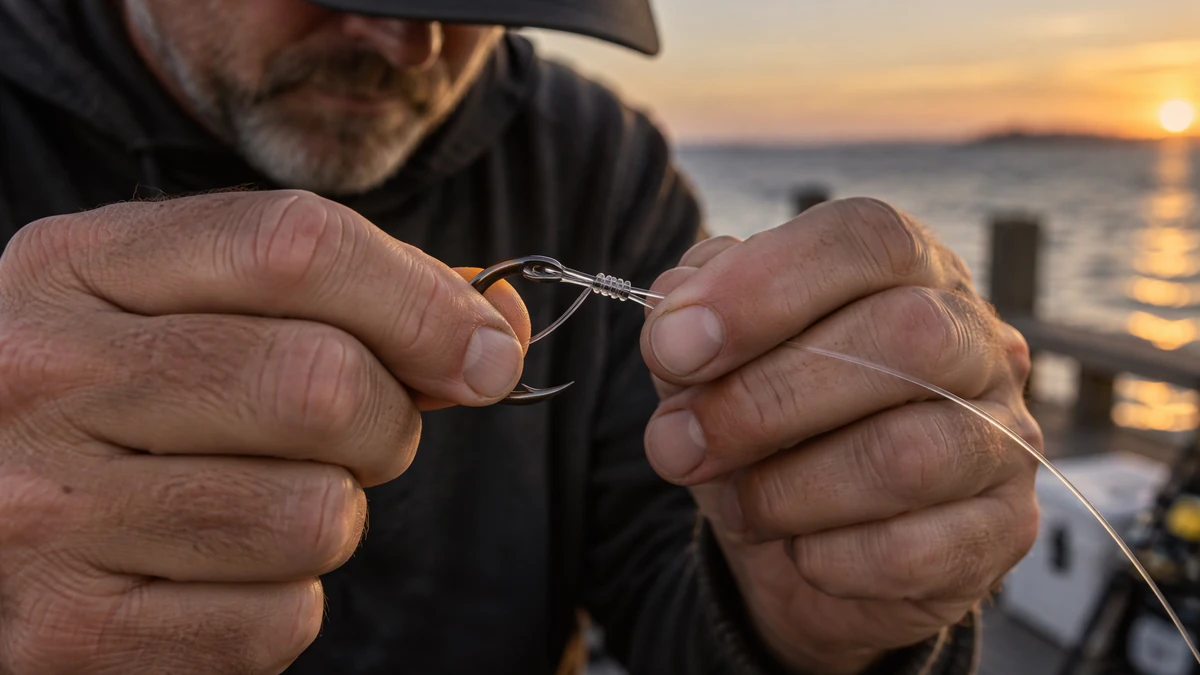
San Diego Jam Knot
The San Diego Jam knot is a cinch-style terminal knot built for slippery, stiff line. It threads the tag end through the eye, lays it back alongside the standing line, and wraps around both strands before tucking the tag through the loop at the eye. That doubled wrap gives the coils more surface to grip, which is why the knot is used with fluorocarbon and other hard leader materials. It seats close to the hook eye and holds with fewer wraps than some clinch-style knots. This guide covers what the San Diego Jam is used for, how it performs, the tying steps, why it suits fluorocarbon, and the mistakes that weaken it.
What the San Diego Jam Knot Is Used For
The San Diego Jam attaches line to hooks, swivels, and lures. It came out of Southern California saltwater fishing, where anglers needed a compact, reliable knot for stiff fluorocarbon leaders and heavier line, but it works anywhere a terminal knot is needed.
It is often tied to live-bait hooks, jigheads, and swivels, and it suits line diameters from light freshwater leaders up to the heavy fluoro used offshore. Because the finished knot sits tight against the eye, it also works where a low profile matters, such as fishing through grass or around structure.
It is a terminal knot. It does not join two lines, and it does not form a loop. For line-to-line work, the double uni and FG knot are the relevant tools.
How Strong the San Diego Jam Is
The San Diego Jam is commonly cited as retaining around 90 to 95 percent of line strength when tied well, with results that hold up in fluorocarbon, the material it was designed around. The doubled wraps are the reason: load passes through two strands at the eye and through coils that bear on both, which spreads stress better than a single-line clinch.
Like every knot, the number depends on the tie. Wraps that do not encircle both strands, a dry tighten, or a tag tucked through the wrong loop will all lower it. The knot is also sensitive to wrap count: too few in heavy or slick line and the coils can creep.
Compared with the improved clinch, the San Diego Jam is generally bulkier but gives the coils more contact area. In light monofilament the difference is small; in stiff fluorocarbon it is more noticeable.
How to Tie the San Diego Jam Knot
- Pass six to eight inches of tag end through the hook eye.
- Bring the tag end back alongside the standing line, so the two run parallel and a narrow loop forms at the eye.
- Wrap the tag end around both strands, working toward the hook eye, five to seven times. Keep the wraps side by side.
- Pass the tag end through the narrow loop at the eye, entering from the hook side.
- Wet the knot with saliva or water.
- Pull the standing line steadily to seat the coils against the eye, then pull the tag to lock the knot, and trim.
The critical detail is step 3: the tag wraps around the standing line and its own length together. If you wrap around the standing line only, you have tied a clinch variant, not a San Diego Jam, and the extra grip that makes the knot useful in fluoro disappears.
Why It Suits Fluorocarbon
Fluorocarbon is stiffer and slicker than monofilament and less tolerant of friction heat. Those traits make some knots fussy. A clinch that bends a single diameter sharply can seat unevenly in stiff fluoro, and slick surfaces give coils less to bite.
The San Diego Jam addresses both issues. Wrapping around a doubled line means each coil presses on two strands instead of one, increasing friction and contact. The final pass through the eye loop traps the tag under the coils, so the knot jams rather than relying on friction alone. And because the finished knot sits close to the eye with a short barrel, there is less bulk to seat unevenly.
For heavy fluorocarbon leaders, that combination is why the knot is common. It is not the only option: the Palomar also holds well in fluoro, and the uni is a versatile alternative, but the San Diego Jam is the more targeted choice when the line is stiff.
Line Types That Suit the San Diego Jam
Fluorocarbon. The knot's strongest case. Use five to seven wraps depending on diameter, wet thoroughly, and tighten smoothly.
Monofilament. It works well in mono, with four or five wraps usually enough. Mono's stretch and friction make the knot easy to seat.
Braid. The San Diego Jam can be tied in braid, but braid is so slippery that the wrap count matters more, and the knot is bulkier than needed. The Palomar and uni are simpler braid choices. Where braid meets a fluoro leader, the join knot, not the terminal knot, is usually the important one.
Heavy monofilament in the 30-pound-and-up range also suits the knot, since the doubled wraps handle the stiffness better than a thin clinch.
San Diego Jam vs. the Improved Clinch
The two knots look similar and tie at a similar speed, but they are not the same. The improved clinch wraps the tag around the standing line, passes it through the loop at the eye, then tucks it through the large loop created by that pass. The San Diego Jam wraps around both strands and finishes by passing the tag through the eye loop, with no large second loop.
The practical result is more friction and contact in the San Diego Jam, at the cost of a slightly bulkier barrel and one more strand to manage while wrapping. In monofilament, either knot is fine. In fluorocarbon, especially heavier leader, the San Diego Jam gives the coils more to grip. The improved clinch remains quicker for light mono and small hooks.
Common Mistakes
- Wrapping only the standing line. The tag must encircle both strands. A single-strand wrap removes the knot's main advantage and turns it into a weaker clinch.
- Too few wraps. Four wraps may hold in light mono, but heavy or slick fluoro wants five to seven. Under-wrapped coils creep under load.
- Tucking through the wrong loop. The tag goes through the narrow loop at the eye, not through a loop formed by the wraps. Check the path before tightening.
- Tightening dry. Fluorocarbon is sensitive to friction damage. Wet the knot and pull smoothly.
- Crossed coils. Wraps that overlap create a high spot that fails first. Keep them side by side as you wrap.
- Yanking the tag to seat the knot. Pull the standing line to bring the coils down, then lock with the tag. A hard tag pull can trap a loose wrap.
FAQ
Is the San Diego Jam knot good for fluorocarbon? Yes. It is one of the knots most associated with fluoro because the doubled wraps give the coils more grip on stiff, slick line. Wet it well and use five to seven wraps.
How many wraps does a San Diego Jam need? Four to seven, depending on line. Light monofilament needs fewer, heavy fluorocarbon needs more. Keep the wraps side by side.
What is the difference between the San Diego Jam and the improved clinch? The San Diego Jam wraps the tag around both strands and finishes through the eye loop. The improved clinch wraps only the standing line and adds a second tuck through a large loop. The San Diego Jam is bulkier and grips slick line better.
Can you tie a San Diego Jam with braid? It can be tied in braid, but the knot is bulkier than necessary and braid's slipperiness rewards knots built for it, such as the Palomar or uni.
Does the San Diego Jam work for heavy leaders? Yes. It handles heavy monofilament and fluorocarbon well because the doubled wraps spread load and seat against the eye without a sharp single-line bend.
For more terminal options, compare the Palomar and improved clinch, match your hook with the fishing hook sizes guide, and browse the Fishing Knots category.
About the author and how this was tested
About the author
FishermanGuy
Bank, boat and kayak angler · fishing, crabbing and shrimping since 2021
I buy the gear, fish it for a season and write down what failed. No sponsored verdicts, no free-sample flattery. Every rig on this page has landed fish in water I can point at on a map.
How this was tested
- Every rig gets at least six trips on the same water before it is published.
- Gear is bought at retail. Free samples are labelled in the first paragraph.
- Dates show first publication and the last time the page was updated.