Field notes
Giant Snakehead: Identification, Habitat & Diet
Giant Snakehead: Identification, Habitat & Diet
The giant snakehead is the biggest and most feared member of a family already known for teeth, aggression, and a talent for surviving where other fish cannot. In Malaysia and Singapore it is called toman, and it is the ultimate target for frog-lure anglers who fish matted vegetation and blackwater canals. The fish is an obligate air breather, a devoted parent, and an ambush predator capable of taking prey a third of its own length. It is also an invasive species in several parts of the world, which makes its legal status as important as its fishing tactics. This profile covers giant snakehead identification, habitat, diet, size, the difference between giant and northern snakehead, and how to catch toman.
Quick ID Card
| Field | Details |
|---|---|
| Scientific name | Channa micropeltes |
| Common names | Giant snakehead, toman, red snakehead, giant mudfish |
| Family | Channidae (snakeheads) |
| Typical size | 40–70 cm (16–28 in); 1–5 kg (2–11 lb) |
| Maximum size | About 1.3 m (4.3 ft) and 20 kg (44 lb); larger reports are unverified |
| Water type | Slow rivers, lakes, swamps, canals and reservoirs |
| Active water temperature | Roughly 24–32°C (75–90°F) |
| Difficulty | Hard; violent strikes, heavy cover, and sharp teeth |
| Best season | Warm months and the rainy season, when fish are active and nesting |
How to Identify a Giant Snakehead
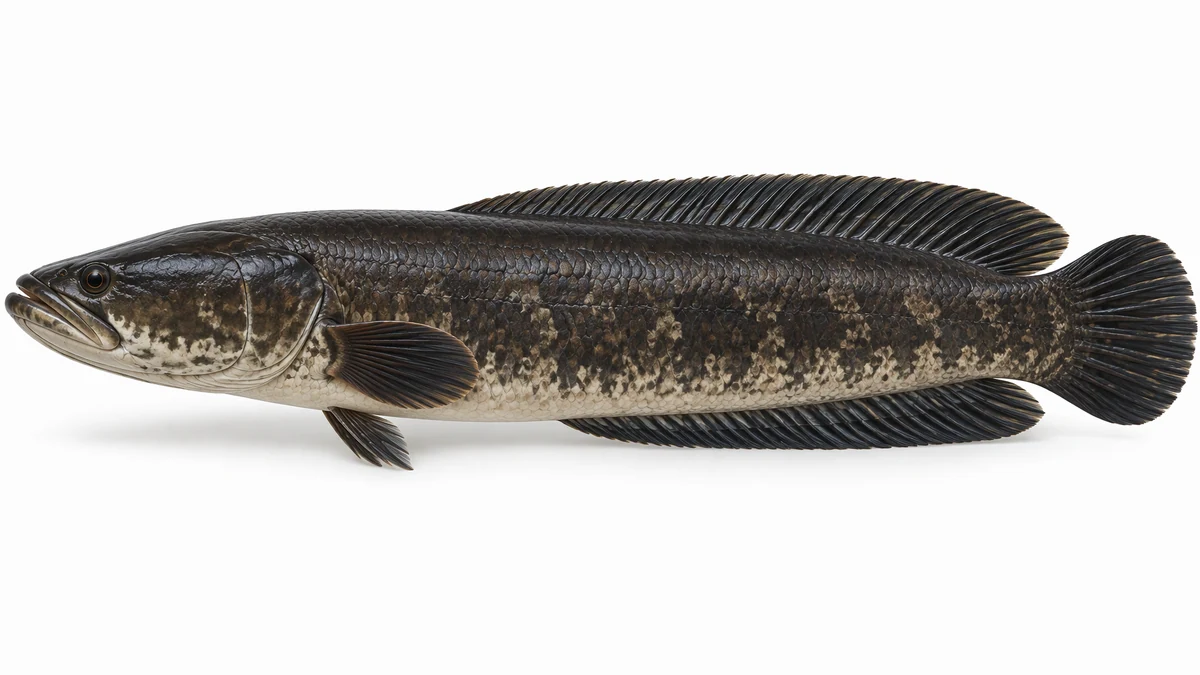
Giant snakehead identification begins with the outline. The body is long, cylindrical, and powerful, with a large, flattened, snake-like head and a mouth that extends well back behind the eye. The dorsal and anal fins are long and run along the rear half of the body, and the tail is rounded rather than forked. Adults are dark brown to almost black, with faint lighter mottling and a pale belly. They look like a piece of dark timber with a bad temper.
Juveniles are completely different, and this is where the name "red snakehead" comes from. Young fish have two bright red-orange stripes running along the body, separated by a dark band. The stripes are striking, and they are the reason so many juvenile giant snakeheads were sold in the aquarium trade. The red fades as the fish grows, and large adults show little or none of it.
The other key feature is the way the fish sits in the water. Giant snakeheads are air breathers, and they regularly come to the surface to gulp air. On a still morning, a series of slow, deliberate rises along a weed edge is a good sign that snakeheads are present.
Giant Snakehead vs Northern Snakehead
Giant snakehead vs northern snakehead is the identification question that matters most outside Southeast Asia, because the northern snakehead is the species established in parts of the United States. The giant snakehead is much larger, reaching about 1.3 m and 20 kg, while the northern snakehead generally tops out around 85–100 cm. Adult giant snakeheads are dark and relatively plain; adult northern snakeheads have a blotchy, snake-like pattern of dark saddles and spots.
Juveniles are also different. A young giant snakehead has two red-orange stripes. A young northern snakehead has a dark lateral band and a more mottled body. Both species have long dorsal and anal fins, a snake-like head, and the ability to breathe air, so the family resemblance is strong. If you catch a snakehead in North America, assume it is a regulated species and do not move it alive.
Other snakeheads, such as the striped snakehead (Channa striata) and the bullseye snakehead (Channa marulius), add to the confusion in Asia. The giant snakehead is the largest and the one most associated with the name toman.
Is the Giant Snakehead Dangerous?
Giant snakehead are not venomous, but they are one of the few freshwater fish that will actively come at a person. The danger comes from two things: teeth and parental defence. A big toman has a mouth full of sharp, backward-pointing teeth and a bite that can crush a frog lure and open a hand. It also has a habit of attacking anything that comes near its fry.
Both parents guard the eggs and the young, and the fry travel in a tight, swirling ball near the surface while the adults circle below. Approach that ball and the parents may strike the water, the boat, or a lure with real aggression. There are documented cases of snakeheads biting people who waded too close to a brood. It is not a fish to swim with or to handle casually.
For anglers, the practical rules are simple. Use heavy line, a strong leader, and a rod that can handle a violent strike in thick cover. Keep your fingers away from the mouth, use long-nosed pliers or a jaw spreader, and hold the fish with a wet towel or a firm grip behind the head. Never put a hand into the mouth to remove a hook.
The environment is the other hazard. Toman fishing happens in swamps, canals, and weed-choked lakes, often at dawn or after dark, and often from a small boat. Watch for stability, wear a life jacket, and keep clear of the water when a fish is thrashing.
Where Do Giant Snakehead Live?
Giant snakehead habitat is warm, slow, and vegetated. The species is native to Southeast Asia, including the Mekong, Chao Phraya and Mae Klong basins, the Malay Peninsula, Sumatra, Borneo, and Java. It lives in rivers, lakes, swamps, canals, flooded forest, and reservoirs, and it is most at home in still or slow-moving water with plenty of cover.
The fish's air-breathing ability lets it use water that would suffocate most predators. It can survive in stagnant, low-oxygen canals and in shallow, warm swamps, and it can remain alive out of water for several days if it stays moist. That is one reason the species is such a successful colonist, and one reason it is so hard to control once it establishes.
Outside its native range, giant snakeheads have been introduced through the food trade, aquaculture, and aquarium releases. They are established in several Asian countries and have been recorded in other tropical and subtropical waters. In North America, the family is treated as a serious invasive threat, and the legal response has been strict.
Habits and Diet: What Do Giant Snakehead Eat?
What do giant snakehead eat? Almost anything they can fit in their mouths. The diet includes fish, frogs, crustaceans, insects, birds, and small mammals. Big adults are ambush predators that hold in cover and explode outward when prey comes close. They are also known to take prey from the surface, and a toman smashing a frog lure in a weed pocket is one of the most exciting strikes in freshwater fishing.
Giant snakeheads are obligate air breathers. They have a suprabranchial organ that lets them take oxygen from the air, and they must surface regularly to breathe. That habit makes them visible, and it also lets them survive in water with very low dissolved oxygen. They are sedentary ambush hunters rather than long-distance chasers, and they use cover, shade, and structure to get within striking range.
When do giant snakehead spawn? Spawning is tied to the rainy season and warm water. The fish build nests in vegetation or shallow water, and both parents guard the eggs and the fry. A female can release thousands of eggs, and the young form a dense ball that the parents herd and protect. The parental care is intense, and it is the reason nesting fish are so aggressive. Growth is fast, and the fish can live for many years.
Invasive Status and North American Rules
The giant snakehead is not established in the United States, but it is closely regulated because of the risk it poses. Since 2007, all snakehead species have been listed as injurious wildlife under the Lacey Act, which makes it illegal to import them into the United States or transport them across state lines without a federal permit. Several states go further and ban possession outright.
In Canada, several provinces, including British Columbia and Ontario, prohibit possession of snakeheads, and the live food and aquarium trades are restricted. The concern is well founded. Snakeheads are air breathers, tolerate poor water, eat a wide range of native fish and wildlife, and can spread over land in wet conditions. A breeding population would be extremely difficult to remove.
For anglers, the rules are clear. Never release a live snakehead into a waterway, never move one between waters, and never keep one alive without checking the law. If you catch a snakehead where it should not be, kill it humanely if the local rules require it, photograph it, and report the capture to the state or provincial fisheries agency. In native range countries, catch-and-release is encouraged and snakeheads are important food fish, but the same principle applies: do not move live fish between waters.
Size, Records and Regulations
How big do giant snakehead get? Most fish caught by anglers are 40–70 cm and 1–5 kg. A fish over a metre is a trophy, and the largest verified fish are around 1.3 m and 20 kg. There are larger reports, but they are hard to verify. The species is not a typical record-chasing fish, and the biggest ones are usually released.
The best bait for giant snakehead is a live frog, a fish, or a large prawn fished near cover. On the artificial side, hollow-body frogs, poppers, buzzbaits, and walk-the-dog lures are the classics. Toman are ambush predators, so cast tight to weed edges, lily pads, submerged timber, and shade, then work the lure slowly and deliberately. The strike is often a violent surface explosion, and the fish will immediately try to bury itself in cover.
How to catch giant snakehead: use heavy gear. A rod with a strong backbone, 50–80 lb braid, a 60–100 lb leader, and a drag that is locked down enough to turn a fish away from weeds are the basics. Fish the warm months, fish early and late, and fish the fry balls if you want the biggest fish, but be ready for the parents. Keep the rod tip low and apply maximum pressure from the first second. Land the fish quickly, unhook it with pliers, and release it if the rules allow.
Regulations vary by country. In Malaysia, Singapore, Thailand, Indonesia and the wider region, snakeheads are managed as food and sport fish, with local bag limits, closed areas, and catch-and-release practices. In the United States and Canada, the emphasis is on prevention: the fish is a prohibited or injurious species, and live possession and transport are illegal without a permit. As of 2025, check with the relevant national, state, or provincial agency before you fish or keep one. Last verified: November 2025.
FAQ
How big do giant snakehead get? Most are 40–70 cm and 1–5 kg. The largest verified fish are around 1.3 m and 20 kg, with unverified reports of larger fish.
Giant snakehead vs northern snakehead: how do you tell them apart? Giant snakeheads grow much larger, reach about 1.3 m, and adults are dark and plain. Northern snakeheads are smaller and have a blotchy, snake-like pattern.
Where do giant snakehead live? In slow, vegetated rivers, lakes, swamps, canals, and reservoirs across Southeast Asia. They have been introduced elsewhere and are tightly regulated in North America.
What do giant snakehead eat? Fish, frogs, crustaceans, insects, birds, and small mammals. They are ambush predators with a very broad diet.
When do giant snakehead spawn? In the rainy season and warm water. Both parents guard the eggs and the fry, which form a dense ball near the surface.
What is the best bait for giant snakehead? A live frog or fish near cover. Hollow-body frogs, poppers, and buzzbaits are the classic artificial choices.
How do you catch giant snakehead? Fish heavy cover with heavy braid and a strong leader, cast tight to vegetation, and apply maximum pressure from the strike.
Are giant snakehead illegal in the US? Yes. All snakeheads are listed as injurious wildlife under the Lacey Act, and import or interstate transport requires a federal permit. Many states ban possession.
Related Articles
- Bowfin — a North American air-breathing predator with a similar body plan and attitude.
- Alligator Gar — another armoured freshwater predator that can breathe air.
- Arapaima — a giant air-breathing fish of the Amazon, and another species under heavy fishing pressure.
- All species profiles
The giant snakehead is a fish of weed edges, dark water, and violent surface strikes. Learn the long fins and the snake-like head, fish heavy gear, and keep your hands away from the mouth. In Asia, it is a magnificent sportfish. In North America, it is a species to report, not to release.
Ready to catch one? Read our step-by-step guide: How to Catch Giant Snakehead.
About the author and how this was tested
About the author
FishermanGuy
Bank, boat and kayak angler · fishing, crabbing and shrimping since 2021
I buy the gear, fish it for a season and write down what failed. No sponsored verdicts, no free-sample flattery. Every rig on this page has landed fish in water I can point at on a map.
How this was tested
- Every rig gets at least six trips on the same water before it is published.
- Gear is bought at retail. Free samples are labelled in the first paragraph.
- Dates show first publication and the last time the page was updated.