Field notes
Blood Knot
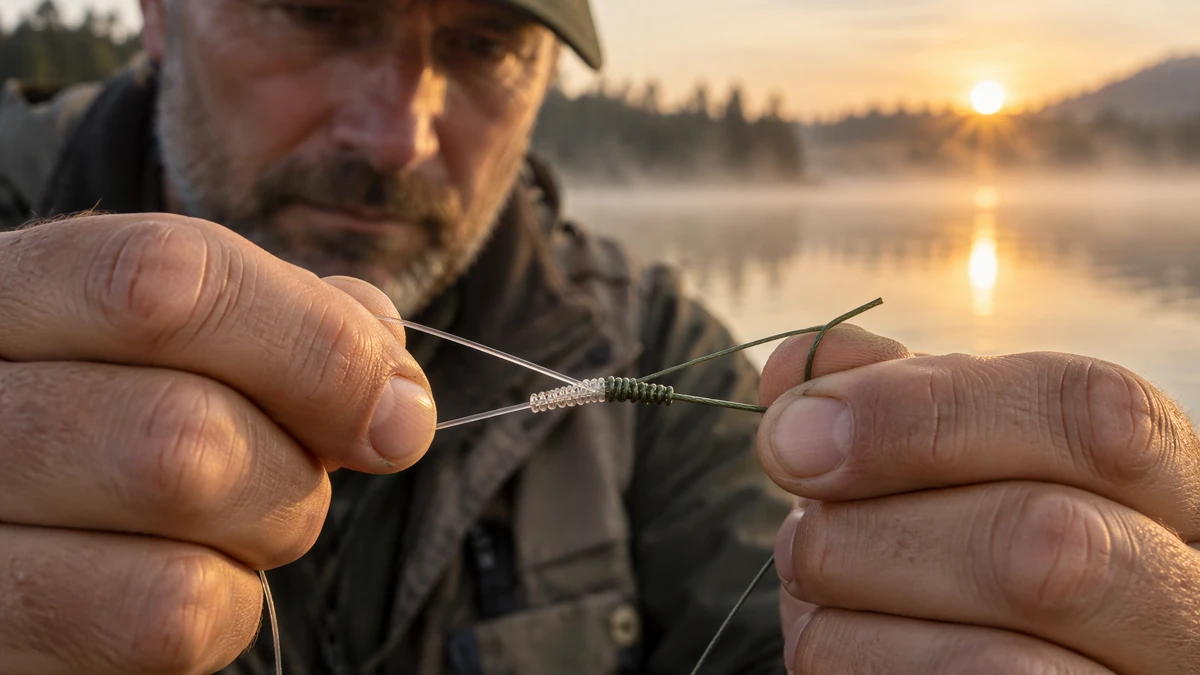
Blood Knot
The blood knot is a line-to-line join built for two lines of similar diameter. Each line wraps around the other, and the two sets of coils pull together into a compact barrel that sits almost straight in the line. It has been used for generations to build tapered fly leaders and to join monofilament and fluorocarbon sections, and it remains one of the slimmest joins available when the two lines match in size. This guide covers what the blood knot is used for, how strong it is, the exact steps, the line types it suits, and why it is a poor choice for braid.
What the Blood Knot Is Used For
The blood knot joins two lines end to end. It is most at home in fly fishing, where leaders are built from sections of monofilament that step down in diameter, and each section is joined to the next with a blood knot. The join is slim and symmetrical, so it runs through the rod guides without a bump.
Outside fly fishing, it is used to join a mono or fluorocarbon leader to a main line of similar size, to repair a broken main line, and to connect tippet sections. It is a line join only; it does not attach line to a hook, lure, or swivel.
The knot has one hard requirement: the two lines should be close in diameter. A blood knot between lines that differ greatly in size will not seat evenly, and the thinner line can pull through the coils. A join for mismatched lines, such as the double uni knot, is the tool for that job.
How Strong the Blood Knot Is
When tied cleanly in matched monofilament or fluorocarbon, the blood knot is commonly cited as retaining roughly 80 to 90 percent of line strength. The figure depends on the line brand, the diameter, and the wrap count, and stiff fluorocarbon can test differently from soft mono.
The knot's shape is part of its appeal. The two coils meet in the middle, load is transferred through the wraps rather than one sharp bend, and the finished join lies nearly straight. A straight join spreads stress well and passes through guides smoothly.
The weak points are predictable. A blood knot tied with crossed coils, too few wraps, or dry tightening will fail early. And in braid the knot has a structural problem: braid is slick, and the coils rely on friction, so a blood knot in braid tends to slip. That is why braid-to-leader work uses other joins.
How to Tie a Blood Knot Step by Step
- Overlap the two lines by about six inches, with the tag ends pointing in opposite directions.
- Wrap the first tag end around the standing part of the second line five times, working back toward the middle of the overlap.
- Bring that tag end back to the center and pass it through the opening between the two lines, so it exits on the opposite side of the knot.
- Wrap the second tag end around the standing part of the first line five times in the opposite direction.
- Pass that tag end through the same central opening from the other side, so the two tag ends finish on opposite sides of the knot, pointing in opposite directions.
- Wet the knot, pull the two standing lines steadily apart until the coils gather into two barrels that butt in the middle, then trim the tags.
The direction of the second set of wraps is what makes the knot symmetrical. If both halves are wrapped the same way, the coils will not lock against each other and the join will look lopsided.
Best Line Types for the Blood Knot
Monofilament. The classic use. Mono grips well and the knot ties neatly in matched sizes. This is the material the knot was designed around.
Fluorocarbon. Works when both lines are fluoro, or mono to similar-diameter fluoro. Stiff fluoro needs thorough wetting, and very heavy fluoro in large diameters can be hard to draw tight.
Braid. Not a good match. Braid is slippery and the blood knot's grip depends on friction between coils. A blood knot in braid is likely to slip, and it is not a join to trust with a fish on.
Diameter matching. Keep the two lines within about two sizes of each other. A 20-pound and 30-pound mono pair is reasonable; 10-pound and 30-pound is not. When the sizes differ, the double uni or another mismatched-line join is the safer option.
For terminal connections the blood knot has no role. Use a Palomar, an improved clinch, or a San Diego Jam at the hook or lure.
Blood Knot vs the Double Uni
The two knots solve the same problem with different trade-offs.
The blood knot is slimmer and lies straighter, which matters for fly leaders and for any join that has to pass through guides repeatedly. In matched mono or fluoro it is compact and neat.
The double uni is bulkier but works across materials and handles a wider diameter spread. It is also reliable in braid, where the blood knot is not. In braid-to-leader work, neither is the slimmest option; that is the FG knot.
A practical split for most setups: matched mono or fluoro, tippet sections, and fly leaders point to the blood knot; mixed materials or braid point to the double uni; braid to a hard leader, where a slim join matters, points to the FG knot.
Common Mistakes
- Mismatched diameters. The most common reason a blood knot fails. Keep the lines close in size, or choose a different join.
- Crossed coils. Wraps must lie side by side. A coil that crosses another creates a high spot and a weak point.
- Too few wraps. Four is a working minimum and five is typical. Fewer wraps in slick or stiff line will creep.
- Pulling too fast. Draw the standing lines apart slowly and evenly so the coils gather straight. A hard yank can jam the coils unevenly.
- Tightening dry. Wet the knot so the coils slide into place. Dry fluorocarbon can be damaged by friction heat.
- Using it in braid. Braid slips. Use a join designed for braid.
FAQ
Can you tie a blood knot with braid? It is a poor match. Braid is slippery and the blood knot relies on friction between coils, so the join can slip under load. Use a double uni or FG knot for braid.
How many wraps does a blood knot need? Four to six wraps per side, with five typical. Heavier line takes fewer wraps; light tippet can take more.
What is the difference between a blood knot and a double uni? Both join two lines. The blood knot is slimmer and suits matched mono or fluoro. The double uni is bulkier, works across materials, and handles braid.
Can a blood knot join lines of different sizes? Only within a narrow range. When the diameters differ substantially, the coils do not seat evenly. Use a join built for mismatched lines instead.
Is the blood knot good for fly leaders? Yes. It is a standard way to join sections of a tapered leader, and its slim profile passes through guides cleanly.
For related line joins, see the double uni knot, the FG knot, and the surgeon's knot, or browse the Fishing Knots category.
About the author and how this was tested
About the author
FishermanGuy
Bank, boat and kayak angler · fishing, crabbing and shrimping since 2021
I buy the gear, fish it for a season and write down what failed. No sponsored verdicts, no free-sample flattery. Every rig on this page has landed fish in water I can point at on a map.
How this was tested
- Every rig gets at least six trips on the same water before it is published.
- Gear is bought at retail. Free samples are labelled in the first paragraph.
- Dates show first publication and the last time the page was updated.