Field notes
Surgeon's Knot: Fast Line Joiner
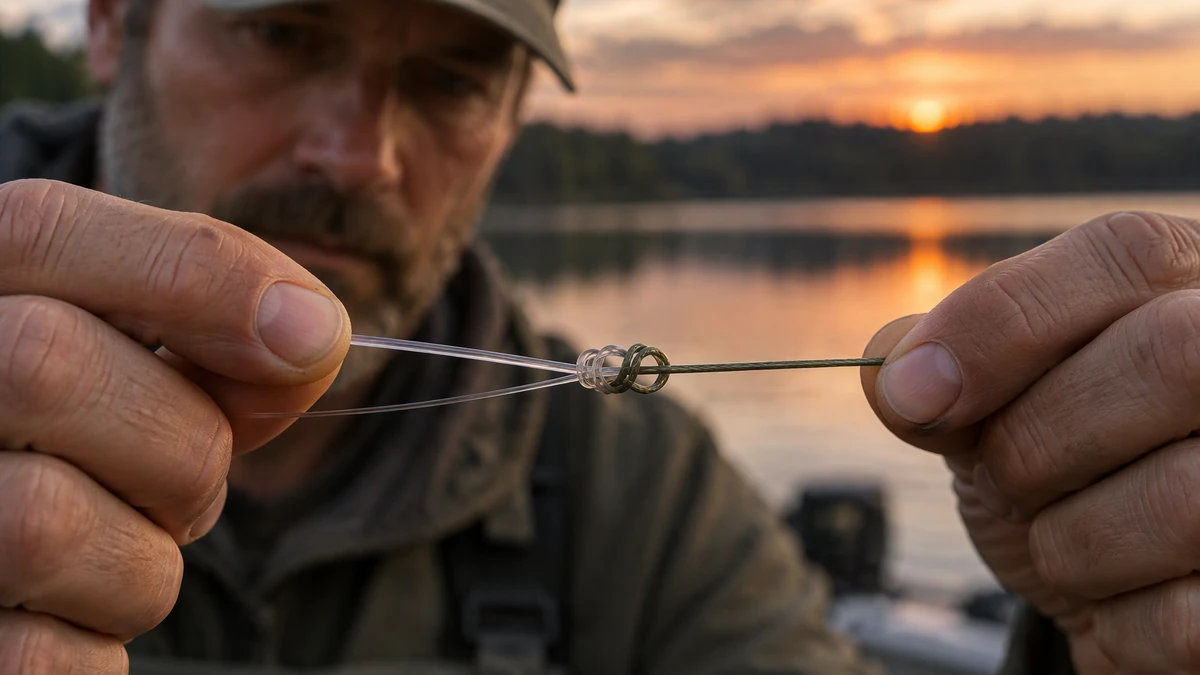
Surgeon's Knot: Fast Line Joiner
The surgeon's knot joins two lines with a doubled overhand knot. Both lines are held together and treated as one, passed through the loop twice, and pulled tight, so the finished join is a compact barrel of parallel wraps. It is the fastest of the common line joins, which is why it shows up on fly leaders and on the water when a connection has to be remade quickly. This guide covers what the surgeon's knot is used for, how strong it is, the exact steps, how it compares with other line joins, and the mistakes that weaken it.
What the Surgeon's Knot Is Used For
The surgeon's knot connects two lines end to end. Its most common use is attaching tippet to a fly leader. A tippet is the last, lightest section of a leader, and it wears out faster than the rest, so it gets replaced often. The surgeon's knot makes that replacement a one-minute job.
Outside fly fishing, the knot is used to join monofilament and fluorocarbon sections, to add a length of lighter line to a heavier main line, and to make an emergency join after a break. It handles lines of unequal diameter better than the blood knot, which is the main reason it stays popular despite its bulk.
It is a line-to-line knot only. It does not attach line to a hook, lure, or swivel, and it is not used to anchor line to a reel spool. The related surgeon's loop, tied in a single line, makes a fixed loop at the end of a leader; the surgeon's knot described here joins two separate lines.
How Strong and Reliable the Surgeon's Knot Is
In monofilament of similar diameter, the surgeon's knot is commonly cited as retaining roughly 75 to 85 percent of line strength. The number moves with line stiffness, diameter difference, and how carefully the knot is seated. Stiff fluorocarbon and lines of very different size tend to test at the lower end.
The knot gains its hold from two parallel passes through the loop. Both lines bend together, and the wraps lock against each other when the four ends are pulled. This is also its weakness: the doubled line and the doubled wraps make a bulky knot, and bulk is what limits it. In a fly leader, a surgeon's knot is a noticeable bump in the guides compared with a blood knot.
Reliability comes down to execution. A knot with two clean passes, wetted and drawn down evenly, is dependable for its class. A knot with one pass is an ordinary overhand knot, which is much weaker and should be retied.
How to Tie a Surgeon's Knot Step by Step
- Overlap the ends of the two lines by about six to eight inches.
- Hold the two lines together and form a loop by crossing the tag ends over the standing parts.
- Pass both tag ends through the loop twice, so the knot has two complete wraps. Use three passes for slick or very stiff line.
- Moisten the knot, then pull all four ends, both standing lines and both tags, until the wraps gather evenly.
- Pull the two standing lines apart to seat the knot, and trim both tags close.
Keep the two lines parallel through every step. If one line crosses over the other inside the wraps, the knot seats lopsided and the crossing becomes the failure point. Pulling only the standing lines, without taking up the tags, lets the wraps roll over themselves instead of locking.
Surgeon's Knot vs Blood Knot and Double Uni
The three knots solve the same problem with different trade-offs.
The surgeon's knot is the fastest to tie and the most tolerant of unequal diameters. It is also the bulkiest and generally tests a little lower than the blood knot in matched monofilament.
The blood knot is slimmer and lies straighter, which matters when a join has to run through guides. It needs the two lines to be close in diameter, and it takes more steps: wraps on each side, two tag ends threaded through the center, and a careful draw.
The double uni knot is the generalist. It joins lines of different materials and sizes, including braid, and it is more compact than a surgeon's knot but slower to tie than either the blood or the surgeon's.
A practical division of labor: matched mono or fluoro where slimness matters points to the blood knot; a fast tippet change or a mismatched pair points to the surgeon's; braid, or braid to leader, points to the double uni or the FG knot.
Line Types and Diameter Differences
Monofilament. The easiest material for this knot. Mono compresses well, the wraps lock cleanly, and the knot can be tied quickly with cold hands.
Fluorocarbon. Works, but wet it thoroughly and draw it down slowly. Stiff fluoro in heavy sizes makes a bulky, hard knot, and the wraps need firm pressure to seat.
Tippet and leader sections. The classic use. The knot tolerates the step down from a heavier leader to a lighter tippet without the precise diameter matching a blood knot requires.
Diameter difference. The surgeon's knot handles a moderate mismatch, roughly a couple of line sizes. It is not a solution for extreme differences; the wraps cannot lock evenly when one line is much thinner.
Braid. Not a suitable material. Braid is slick and the doubled overhand can slip. Braid-to-leader joins use the double uni or the FG knot, and the blood knot has the same limitation.
Common Mistakes
- One pass instead of two. A single pass makes an overhand knot, not a surgeon's knot. The second pass is the knot.
- Crossed lines. The two lines must stay parallel inside the wraps. A crossover creates a high spot that fails first.
- Tightening dry. Friction heat damages mono and especially fluorocarbon. Wet the knot before drawing it down.
- Pulling only the standing lines. The wraps roll instead of locking. Take up all four ends evenly.
- Trimming the tags too short. Leave a short tag until the knot has been pulled hard and inspected.
- Using it where a slim join is needed. In fly leaders that pass through guides constantly, the bulk is a real drawback compared with a blood knot.
- Using it in braid. The knot relies on friction between wraps, and slick braid defeats it.
FAQ
Is a surgeon's knot the same as a double surgeon's knot? In fishing, the names are used interchangeably for the two-pass version. The "double" refers to the two passes through the loop, not to two separate knots.
Can a surgeon's knot join lines of different sizes? Yes, within limits. It tolerates a moderate diameter difference better than a blood knot. For a large difference, use the double uni.
How many turns does a surgeon's knot need? Two passes is standard. A third pass adds security in slick or stiff line at the cost of more bulk.
Is the surgeon's knot good for tippet? Yes. It is one of the standard tippet-to-leader connections because it is fast and handles the diameter step-down.
Does a surgeon's knot work in braid? It is not reliable in braid. The doubled overhand depends on friction, and braid slips. Use the double uni or FG knot instead.
Surgeon's knot or blood knot for a fly leader? The blood knot is slimmer and straighter; the surgeon's is faster and more forgiving of diameter differences. Many anglers use both, choosing by the job.
For the other line joins, see the blood knot, the double uni, and the FG knot, or start with the Fishing Knots guide and the Fishing Knots category.
About the author and how this was tested
About the author
FishermanGuy
Bank, boat and kayak angler · fishing, crabbing and shrimping since 2021
I buy the gear, fish it for a season and write down what failed. No sponsored verdicts, no free-sample flattery. Every rig on this page has landed fish in water I can point at on a map.
How this was tested
- Every rig gets at least six trips on the same water before it is published.
- Gear is bought at retail. Free samples are labelled in the first paragraph.
- Dates show first publication and the last time the page was updated.