Field notes
Tiger Shark: Identification, Habitat & Diet
Tiger Shark: Identification, Habitat & Diet
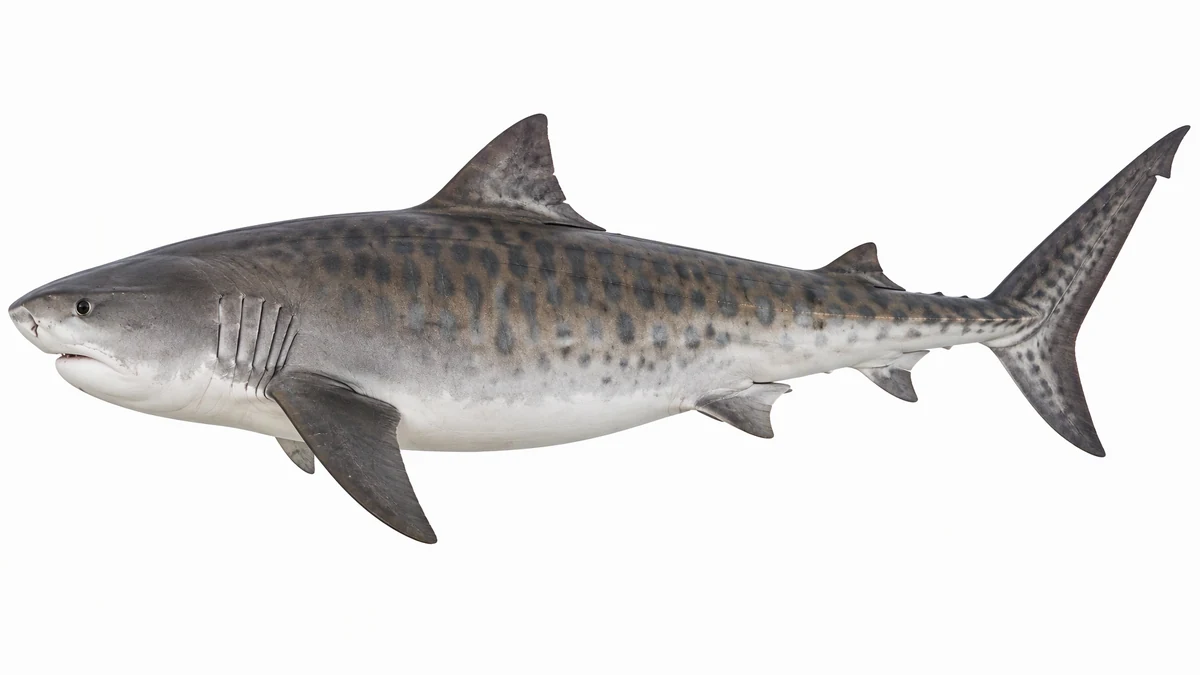
The tiger shark (Galeocerdo cuvier) is the ocean's great generalist: a broad-headed, blunt-snouted predator that will eat fish, turtles, birds, rays, other sharks, and — more than once — the contents of a garbage can. It is one of the largest sharks in warm water, one of the three species most often implicated in bites on people, and the only living member of its genus. Tiger sharks are also nomadic, moving between reefs, estuaries, and open ocean, which puts them in front of anglers from Florida to Australia. This guide covers tiger shark identification, habitat, diet, size, teeth, the world record, how it differs from a great white, and the release practices that keep a slow-breeding predator in the water.
Quick ID Card
| Field | Details |
|---|---|
| Scientific name | Galeocerdo cuvier |
| Common names | Tiger shark, tiger, sea tiger |
| Family | Carcharhinidae (requiem sharks) |
| Typical size | 10–14 feet; 400–1,000 pounds |
| Maximum size | About 18 feet (5.5 m); 600+ kg (1,300+ lb) |
| Water type | Coastal and oceanic warm water |
| Depth range | Surface to roughly 1,000 feet (300 m) |
| Range | Tropical and subtropical oceans worldwide |
| Difficulty | Heavy tackle only; release is standard |
| Best season | Summer and fall in subtropical latitudes |
How to Identify a Tiger Shark
Tiger shark identification begins with the head. The snout is short and blunt, almost squared off, and the head is wide — wider than any other common requiem shark of similar size. The eye is small, and behind it sits a tiny spiracle, a throwback feature that most requiem sharks have lost. The body is heavy through the shoulders, the first dorsal fin is tall, the upper lobe of the tail is long and swept back, and a low keel runs along the tail base.
Then there are the markings. Young tiger sharks carry dark bars and spots across the back and upper flanks, the pattern that gave the species its name. The bars fade with age, and large adults can look almost plain grey-brown above with a pale belly. Do not expect every tiger shark to look striped; expect a big-headed, short-snouted shark with a long tail and, usually, at least a hint of barring.
The teeth are the backup field mark. Tiger shark teeth are unlike those of any other requiem shark: broad, curved, coarsely serrated, and cut with a deep notch on the outer edge. They look custom-made for sawing, which is exactly what they are.
Tiger Shark Teeth and Lookalikes
A tiger shark's dental gear explains a lot about the animal. Each tooth is a hooked blade with heavy serrations and that distinctive notch, and the upper and lower teeth are similar in shape. The arrangement works like a reciprocating saw, and it lets a tiger shark open a sea turtle's shell or carve chunks from a whale carcass. It is also why a hooked tiger should never be brought aboard for a photo. A single shake near a hand or a leader can do serious damage.
Tiger shark vs great white is the comparison that matters most, because both are large, grey, and capable of eating almost anything. The tiger has a blunt, wide head and a short snout; the white has a pointed, conical snout and a much heavier, torpedo-shaped body. The tiger carries faint bars and a long upper tail lobe; the white is plain grey above and white below, with a black eye and a crescent tail. Tiger teeth are notched and saw-like; white teeth are broad triangles with finer serrations. Behavior differs too: white sharks are ambush hunters of seals and large fish, while tiger sharks are scavengers and generalists that will investigate almost anything.
Tiger shark vs bull shark is easier. Bull sharks are shorter and thicker, with small eyes and no bars, and they are the ones that push into rivers. A tiger shark's bars, long tail, and much larger head settle the question in seconds. The sand tiger shark — a different family entirely, common on the U.S. East Coast — is slimmer, has a pointed snout and protruding ragged teeth, and is not a close relative despite the shared name.
Is the Tiger Shark Dangerous?
Tiger sharks are dangerous, and the honest reason is not that they hunt people. It is that they are large, curious, bold, and willing to test unfamiliar objects with their mouths. A tiger shark can be 14 feet long and weigh over 1,000 pounds, and it spends time in shallow reefs, channels, and harbors where people swim and dive. Add a scavenger's willingness to investigate splashing, speared fish, or a dangling chum bag, and the risk becomes obvious. The species is consistently ranked among the three sharks most often implicated in unprovoked bites on humans.
The good news is that bites remain rare, and most incidents are avoidable. Do not swim at night in tiger shark country — this is a nocturnal hunter. Keep speared fish out of the water and away from your body; a struggling fish on a stringer is a dinner bell. Avoid swimming near turtle cleaning stations, fish cleaning docks, and any boat releasing chum. Do not corner a tiger shark against a reef, and do not try to touch one while diving. Divers in places like Tiger Beach in the Bahamas interact with these animals under strict protocols; that is not a model for casual behavior.
Handling a hooked tiger is the highest-risk moment for an angler. Keep the fish in the water, use a heavy leader and a long dehooker, and cut the leader if the hook is deep. Never gaff a tiger shark you intend to release, never drag one onto a beach, and never put your hands near the mouth to pose it. If you are not equipped to release a big shark safely, do not fish for them.
Where Do Tiger Sharks Live?
Where do tiger sharks live? In warm water almost everywhere. The species ranges through tropical and subtropical seas worldwide — the western and eastern Atlantic, the Indian Ocean, the Pacific, the Mediterranean (rarely), and the Gulf of Mexico. In Asia it is caught from the South China Sea and the East China Sea southward, and it turns up around coral reefs, estuaries, harbors, and offshore banks.
Tiger shark habitat spans both shallow and deep water. They are common over reefs and sea grass beds in 10 to 100 feet, and they also move offshore and dive to roughly 1,000 feet. Tagging studies show long-distance travel: sharks tagged in Hawaii have crossed thousands of miles of open ocean, and individuals move seasonally toward cooler latitudes in summer. Some populations show strong site fidelity, returning to the same reefs year after year, which makes local management possible — and local depletion dangerous.
Water temperature shapes the range. Tiger sharks are most active in water above roughly 21°C (70°F), and their seasonal push into higher latitudes follows warming seas. Pups are born in shallow coastal nurseries, including bays and reef flats, where they feed on small fish and invertebrates before ranging wider.
Habits and Diet: What Do Tiger Sharks Eat?
What do tiger sharks eat? The list is almost embarrassing. Fish, rays, sea turtles, sea snakes, dolphins, dugongs, seabirds, squid, crabs, lobsters, other sharks, carrion, and human garbage all appear in tiger shark stomachs. License plates, tires, bottles, and pieces of net have been documented. The species is a true scavenger as well as a predator, and it is one of the few sharks that regularly eats sea turtles, crunching through shells with those notched teeth.
That diet matters ecologically. Research in Shark Bay, Australia, showed that tiger sharks influence where sea turtles and dugongs graze; remove the sharks and the grazing patterns change, which in turn affects sea grass beds. Tiger sharks are not just consumers — they are architects of shallow marine ecosystems.
Tiger sharks are nocturnal. They hunt most actively at dusk and through the night, often in shallow water, and rest or cruise in deeper water during the day. They are mostly solitary, though several may gather around a food source such as a whale carcass. When do tiger sharks spawn? They do not spawn; they give birth to live young. Females are ovoviviparous, carrying litters variously reported at 10 to 80 pups for a gestation of roughly 12 to 16 months, and they likely reproduce only every other year. Females mature slowly — several years old and well over 10 feet — which makes the species slow to recover from heavy fishing.
Size, World Record and Regulations
How big do tiger sharks get? Most adults measure 10 to 14 feet and weigh 400 to 1,000 pounds, with females larger than males. The largest verified animals reach about 18 feet (5.5 m) and more than 1,300 pounds (600 kg), and unconfirmed reports of bigger fish persist. A 14-foot tiger is a genuinely enormous animal, and a 5.5-meter one is rare.
The world record tiger shark on rod and reel is roughly 1,780 pounds, taken off New South Wales, Australia, in 2004. Check the current IGFA record book for the certified all-tackle weight and line-class records, because record listings are revised.
The species is listed as Near Threatened on the IUCN Red List, with fishing pressure, bycatch, and the fin trade as the main threats. Regulations vary widely and change often. In U.S. Atlantic federal waters, tiger sharks are managed under NOAA's Highly Migratory Species rules, which set gear requirements, reporting obligations, and tight retention limits; finning is prohibited. Florida requires a free shore-based shark fishing permit after an online course and restricts chumming and gear from beaches. Hawaii has closed its state waters to shark fishing. Australia, South Africa, and many island nations limit or prohibit large-shark retention, and the Bahamas has protected all sharks since 2011.
The practical rule is catch-and-release unless you have confirmed that retention is legal where you are fishing — and even then, consider releasing. Use 80- to 130-pound class tackle, a heavy wire or 400-pound mono leader, and non-offset circle hooks. Fight the fish hard to shorten the battle, keep it in the water at the boat, and never lift a large tiger aboard. Support the body if you must measure it, revive it alongside the hull, and let it swim off under its own power. Check current NOAA, state, and local rules before every trip. Last verified: November 2025.
How to catch tiger shark, where it is legal, is a night game. Anchor or drift over a reef edge, channel, or drop-off and lay a chum slick. Fresh bait matters: a bonito flake, a tuna head, a whole mackerel, or a big chunk of jack all work. Fish a circle hook on a wire leader, set the drag heavy enough to keep the shark out of the reef, and expect a long, stubborn fight rather than a screaming run. Shore-based anglers in Florida use similar tactics with heavy surf rods and kayak-deployed baits, under the state's shore-based shark fishing rules.
FAQ
How big do tiger sharks get? Most adults are 10–14 feet and 400–1,000 pounds. The largest verified fish reach about 18 feet (5.5 m) and over 1,300 pounds.
What is the world record tiger shark? Roughly 1,780 pounds, caught off New South Wales, Australia, in 2004. Confirm the current figure in the IGFA record book.
Where do tiger sharks live? Warm coastal and oceanic waters worldwide, from reefs and estuaries to open ocean, generally in water above about 70°F.
What do tiger sharks eat? Fish, rays, turtles, sea snakes, dolphins, dugongs, seabirds, other sharks, carrion, and garbage — one of the broadest diets of any shark.
Tiger shark vs great white: how do you tell them apart? Tiger sharks have blunt, wide heads, faint bars, notched saw-like teeth, and long upper tail lobes. Great whites have pointed snouts, black eyes, plain two-tone bodies, and broad triangular teeth.
Tiger shark teeth: what makes them special? They are broad, hooked, heavily serrated, and notched on the outer edge, built for sawing through turtle shells and large prey.
When do tiger sharks spawn? They do not spawn; females give birth to live pups, roughly 10–80 per litter after a 12- to 16-month gestation, likely every other year.
How to catch tiger shark? Night drift or anchor with a chum slick, fresh tuna or bonito bait, circle hooks, wire leader, and 80–130-pound tackle. Keep the fish in the water for release.
Can you keep a tiger shark? Retention is tightly limited or prohibited in many jurisdictions. Release unless local rules clearly allow otherwise.
Related Articles
- Bull Shark — the stocky, freshwater-tolerant member of the dangerous-shark trio.
- Lemon Shark — a smaller warm-water shark of the same shallow coastal zone.
- Nurse Shark — a bottom-dwelling contrast in temperament and feeding style.
- All species profiles
The tiger shark is a scavenger, a turtle-shell crusher, and a long-distance traveler that happens to share the shallows with people. Treat it as the large, curious predator it is: give it space, fish for it only where it is legal, and release it in the water. A tiger shark returned alive is worth far more than a photograph of one on a deck.
Ready to catch one? Read our step-by-step guide: How to Catch Tiger Shark.
About the author and how this was tested
About the author
FishermanGuy
Bank, boat and kayak angler · fishing, crabbing and shrimping since 2021
I buy the gear, fish it for a season and write down what failed. No sponsored verdicts, no free-sample flattery. Every rig on this page has landed fish in water I can point at on a map.
How this was tested
- Every rig gets at least six trips on the same water before it is published.
- Gear is bought at retail. Free samples are labelled in the first paragraph.
- Dates show first publication and the last time the page was updated.