Field notes
Lemon Shark: Identification, Habitat & Diet
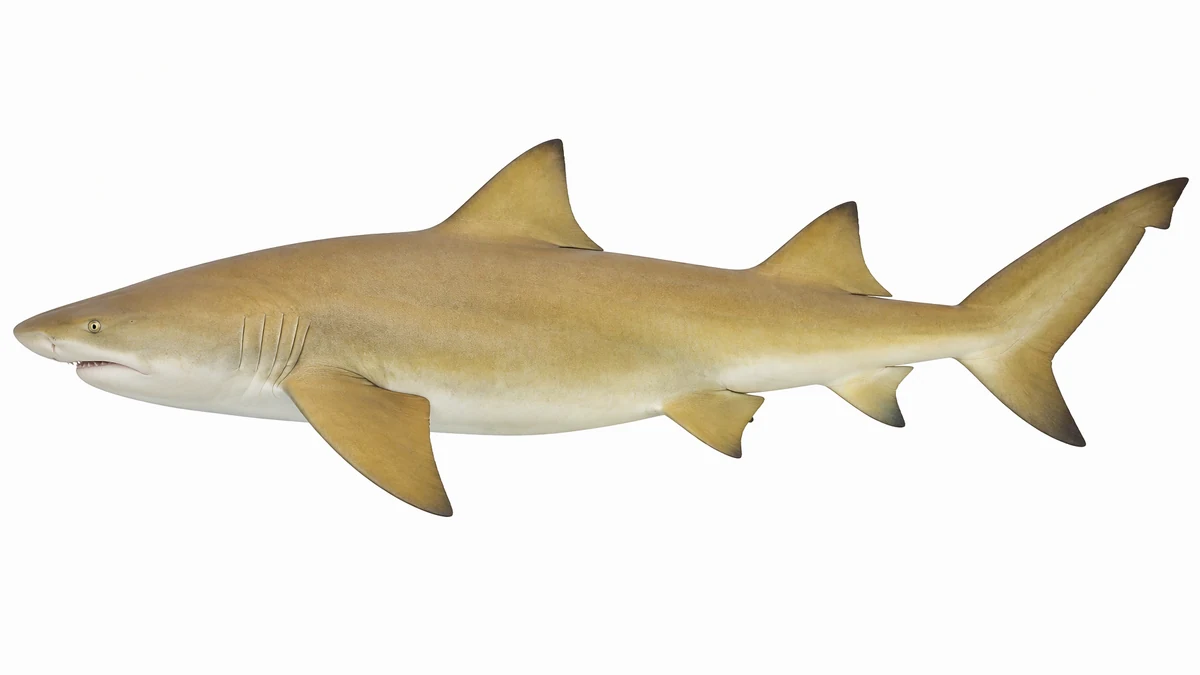
Lemon Shark: Identification, Habitat & Diet
The lemon shark (Negaprion brevirostris) is a warm-water requiem shark named for its color: a yellowish brown back that fades to a pale, lemon-tinged belly. It is a stocky, blunt-faced animal of mangroves, bays, and shallow reefs, and it is arguably the most studied shark in the world, thanks to decades of research at Bimini in the Bahamas. Lemon sharks are also one of the most accessible large sharks for anglers, which makes knowing the rules — and releasing them properly — more important than ever. This guide covers lemon shark identification, habitat, diet, size, facts, how it differs from a bull shark, its breeding cycle, and how to fish for lemon sharks without harming them.
Quick ID Card
| Field | Details |
|---|---|
| Scientific name | Negaprion brevirostris |
| Common names | Lemon shark, lemon, yellow shark |
| Family | Carcharhinidae (requiem sharks) |
| Typical size | 6.5–8 feet; 150–250 pounds |
| Maximum size | About 11 feet (3.4 m); 180 kg (400 lb) |
| Water type | Shallow coastal salt and brackish water |
| Depth range | Surface to roughly 300 feet (90 m) |
| Range | Western Atlantic, eastern Atlantic, eastern Pacific |
| Difficulty | Moderate; light-to-medium shark tackle works |
| Best season | Spring through fall in subtropical latitudes |
How to Identify a Lemon Shark
Lemon shark identification rests on color and fins. The back is a yellow-brown or olive-brown that looks almost lemon-colored in bright sun, and the belly is pale yellow-white. The snout is short, broad, and bluntly rounded, and the eyes are small. There are no spots, bars, or fin markings — the whole fish is a smooth, even two-tone.
The fin arrangement is the giveaway. A lemon shark has two dorsal fins of nearly equal size. The first is tall and triangular; the second is unusually large for a requiem shark and sits well back toward the tail. In most similar sharks the second dorsal is a small afterthought, so a big second dorsal on a yellowish shark is close to diagnostic. The pectoral fins are broad and curved, there is no interdorsal ridge, and the upper tail lobe is long.
Teeth confirm it. Lemon shark teeth are narrow and pointed, with smooth edges rather than the heavy serrations of a bull or tiger shark. The lower teeth are especially fine and needle-like. Up close, the mouth looks less like a saw and more like a picket fence.
Lemon Shark vs Bull Shark and Other Lookalikes
Lemon shark vs bull shark is a fair question because both are stocky, blunt-snouted requiem sharks of similar maximum size. Color separates them first: the lemon is yellow-brown with a pale yellow belly, the bull is grey-brown with a white belly. The fins separate them second: the lemon's second dorsal is nearly as large as its first, while the bull's second dorsal is small. The lemon's teeth are narrow and smooth-edged; the bull's are broad, triangular, and serrated.
Range and habits seal it. Bull sharks are found worldwide and routinely enter rivers and lakes. Lemon sharks are an Atlantic and eastern Pacific species, and while they tolerate brackish estuaries, they do not make the bull's long freshwater runs. Bull sharks are also quicker to aggression; lemon sharks are calmer, though neither should be handled casually.
The other common mix-up is the nurse shark, which also lives in shallow warm water. Nurse sharks are tan and bottom-hugging, with rounded fins set far back, barbels under the snout, and a totally different, sluggish posture. If the shark is cruising mid-water with two big dorsal fins and a yellow cast, it is a lemon.
Is the Lemon Shark Dangerous?
Lemon sharks are not among the three species most often implicated in bites on humans, and unprovoked attacks are genuinely rare. They are generally described as placid, even curious, and they are a staple of supervised shark dives in the Bahamas. That reputation is deserved — up to a point. A lemon shark can exceed 10 feet and carries a heavy jaw with a strong bite, and it will defend itself if grabbed, cornered, or deprived of a speared fish.
Most lemon shark bites happen during feeding interactions: hand-feeding dives, spearfishing, or a fish on a stringer. The rules are the same as for any large shark. Do not grab a lemon shark, do not pull its tail, and do not swim with speared fish. If one approaches while you are diving, stay vertical, keep it in view, and do not corner it against the bottom or a reef. If you hook one, keep your hands clear of the mouth and use a long dehooker or cut the leader.
There is one more consideration: lemon sharks and people use the same shallow water. Wading anglers and swimmers in Florida, the Bahamas, and the Gulf should be aware that a large shark may be cruising the same flat. That is not a reason to stay home; it is a reason to avoid swimming at night, to avoid splashing like injured prey, and to keep fish out of the water.
Where Do Lemon Sharks Live?
Where do lemon sharks live? Along warm western Atlantic coasts, mostly. The species ranges from New Jersey south through Florida, the Gulf of Mexico, and the Caribbean to southern Brazil. There is a separate eastern Atlantic population off West Africa, and another in the eastern Pacific from Mexico to Ecuador. It is not an Indo-Pacific shark, which is one reason it is less familiar to anglers in Australia and Asia.
Lemon shark habitat is defined by shallows. They favor bays, lagoons, estuaries, mangrove fringes, sea grass beds, and shallow coral reefs, and they are most common in water less than 100 feet deep, though they occasionally descend to about 300 feet. Juveniles use water so shallow that their dorsal fins break the surface — mangrove-lined nurseries where a pup can hide from bigger predators among the roots.
Those nurseries are the heart of the species' life cycle, and they are why lemon sharks are so well studied. Female lemon sharks return to the same nursery areas to give birth, and young sharks stay close for years. At Bimini, researchers have followed individual lemon sharks from birth into adulthood, documenting social behavior, site fidelity, and learning. Mangrove loss is therefore a direct threat: destroy the nursery and you remove the next generation, no matter how healthy the adult population looks.
Habits and Diet: What Do Lemon Sharks Eat?
What do lemon sharks eat? Mostly fish, plus crustaceans and cephalopods. Mullet, mojarra, jacks, snappers, and other small to medium fish dominate the diet, along with crabs, shrimp, lobster, octopus, and the occasional ray. Lemon sharks feed most actively at dusk and through the night, when small fish move across the flats and through mangrove edges. They use electroreception to find prey buried in sand or hidden in sea grass, and they can suction food out of crevices.
Lemon sharks are social by shark standards. Juveniles gather in groups, and researchers have documented individuals learning from one another and returning to familiar resting spots. They can also rest motionless on the bottom, pumping water over their gills instead of ram-ventilating — a useful trick in the still, shallow water they prefer. When do lemon sharks spawn? They do not spawn; they give birth to live young. Females carry 4 to 17 pups for roughly 10 to 12 months and typically reproduce only every other year. Pupping happens in shallow nurseries in spring and summer, and the pups are born fully formed, around 2 feet long.
Growth is slow. Lemon sharks take many years to mature — well over a decade in some populations — and can live for decades. That life history, combined with a small litter and a biennial cycle, makes the species far less productive than its abundance in some nurseries suggests.
Size, Records and Regulations
How big do lemon sharks get? Most adults run 6.5 to 8 feet and 150 to 250 pounds. Large females reach about 11 feet (3.4 m) and roughly 400 pounds (180 kg), which is a serious animal on light tackle. Pups are about 2 feet at birth.
A few lemon shark facts are worth keeping straight. They are one of the few sharks known to rest on the bottom and pump water over their gills. They return to natal nurseries to give birth. They are among the most intensively studied sharks in the world, with individual animals known by name and followed for decades at Bimini. And their yellow color is camouflage over sand and sea grass, not a warning.
The IUCN Red List assesses the lemon shark as Vulnerable, reflecting slow reproduction, nursery habitat loss, and fishing pressure. Regulations differ by country and state. In the Bahamas, all sharks have been protected since 2011, and lemon sharks there are effectively off-limits to fishing. In U.S. waters, lemon sharks are managed under federal Highly Migratory Species rules and state shark regulations, with size and bag limits where retention is permitted; finning is prohibited, and release is encouraged. Florida requires a free shore-based shark fishing permit after an online course and restricts chumming and gear from beaches.
For anglers, the default should be catch-and-release. If you fish for lemon sharks, use 20- to 50-pound class tackle — enough to land the fish quickly without exhausting it — with a wire or heavy mono leader and a non-offset circle hook. Keep the shark in the water, support it if you need to measure it, and revive it until it swims off. Do not lift a large lemon shark by the tail or gills, and do not beach it. Check current NOAA, state, and local rules before you fish, because lemon shark management is tightening in several jurisdictions. Last verified: November 2025.
How to fish for lemon sharks is straightforward where they are legal to target. Fish the edges: mangrove shorelines, channel mouths, sea grass flats, and the drop-offs beside shallow bays. Fresh cut bait — mullet, ladyfish, jack, or bonito — outfishes everything, with crab and lobster a close second. Fish the last hours of daylight into the night, when lemon sharks move onto the flats. From shore, cast beyond the bar and wait; from a boat, drift or anchor along a channel edge. Expect a strong, steady pull rather than acrobatics. Keep the fight short, keep the fish wet, and send it back.
FAQ
How big do lemon sharks get? Most adults are 6.5–8 feet and 150–250 pounds. Large females reach about 11 feet (3.4 m) and roughly 400 pounds (180 kg).
What are some key lemon shark facts? They are named for their yellow-brown color, have two nearly equal dorsal fins, can rest on the bottom and pump water over their gills, and return to mangrove nurseries to give birth.
Where do lemon sharks live? Shallow coastal waters of the western Atlantic from New Jersey to Brazil, plus West Africa and the eastern Pacific from Mexico to Ecuador. Juveniles use mangrove nurseries.
What do lemon sharks eat? Fish such as mullet and jacks, plus crabs, shrimp, lobster, octopus, and rays, hunted mostly at dusk and at night.
Lemon shark vs bull shark: how do you tell them apart? Lemon sharks are yellowish with two large dorsal fins and narrow, smooth-edged teeth. Bull sharks are grey, have a small second dorsal, serrated triangular teeth, and enter fresh water.
When do lemon sharks spawn? They do not spawn. Females give birth to 4–17 live pups after about 10–12 months, usually every other year, in shallow nurseries.
How to fish for lemon sharks? Fish mangrove edges, flats, and channel mouths at dusk or night with fresh cut bait, a circle hook, a wire leader, and 20–50-pound tackle. Release the fish in the water.
Are lemon sharks dangerous? Unprovoked attacks are rare, but they are large, powerful animals that can bite when grabbed, cornered, or fed. Give them space, especially around speared fish.
Related Articles
- Bull Shark — the grey, freshwater-capable shark most often confused with a lemon.
- Tiger Shark — a larger warm-water predator of the same coastal zone.
- Nurse Shark — another shallow-water shark with a very different build and temperament.
- All species profiles
The lemon shark is a shallow-water specialist with a yellow coat, a big second dorsal fin, and a life cycle tied to mangroves. It is calm enough to watch and strong enough to demand respect. Fish for it where it is legal, keep it in the water, and release it quickly — the nursery sharks of today are the breeding adults of the next decade.
Ready to catch one? Read our step-by-step guide: How to Catch Lemon Shark.
About the author and how this was tested
About the author
FishermanGuy
Bank, boat and kayak angler · fishing, crabbing and shrimping since 2021
I buy the gear, fish it for a season and write down what failed. No sponsored verdicts, no free-sample flattery. Every rig on this page has landed fish in water I can point at on a map.
How this was tested
- Every rig gets at least six trips on the same water before it is published.
- Gear is bought at retail. Free samples are labelled in the first paragraph.
- Dates show first publication and the last time the page was updated.