Field notes
Carp: Identification, Habitat & Diet
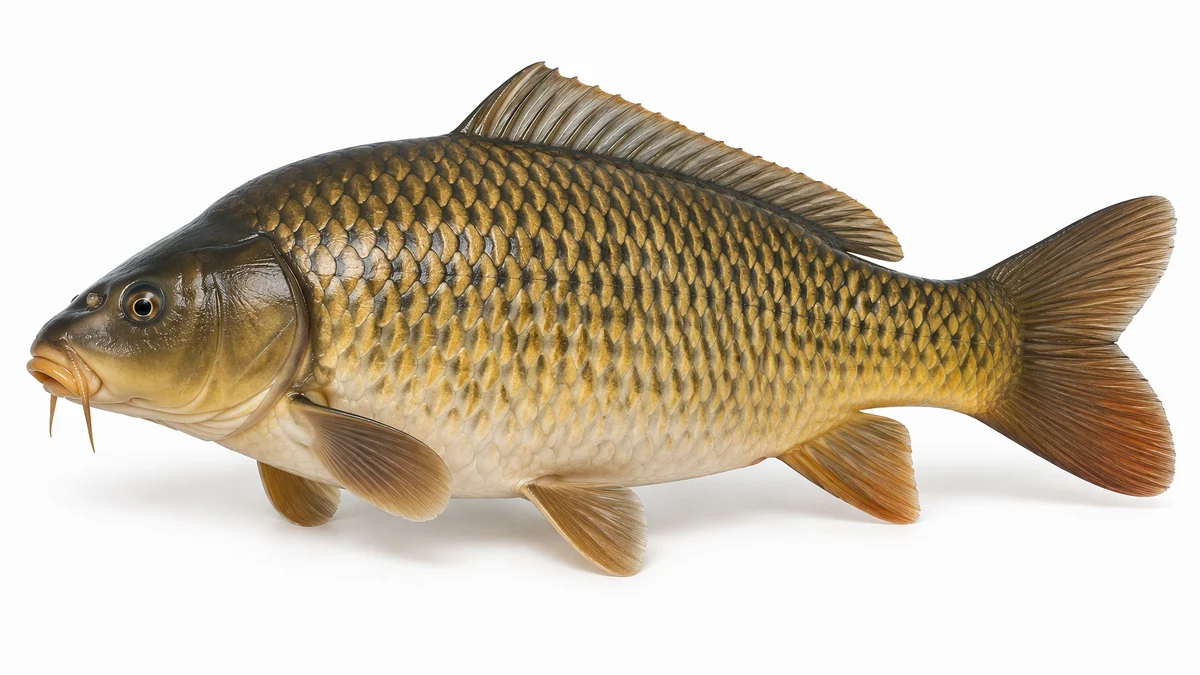
Carp: Identification, Habitat & Diet
The carp (Cyprinus carpio) is one of the most familiar freshwater fish in Europe, and one of the hardest to fool. Heavy-bodied and golden-brown, with a high arched back and a pair of barbels hanging from the mouth, it thrives in muddy ponds, slow rivers, and gravel pits alike. Carp are wary, light-shy, and clever around bait, which is exactly why anglers spend whole seasons chasing them. This profile covers carp identification, habitat, what carp eat, how big they get, the difference between common and mirror carp, and how to catch them.
Quick ID Card
| Field | Details |
|---|---|
| Scientific name | Cyprinus carpio |
| Common names | Common carp, European carp, king carp |
| Family | Cyprinidae (carps and minnows) |
| Typical size | 16–28 in (40–70 cm); 4–15 lb (2–7 kg) |
| Trophy size | 30 lb plus; fish over 40 lb are exceptional |
| Water type | Lakes, ponds, slow rivers, canals, gravel pits |
| Depth range | Mostly on the bottom, to about 5 m, deeper in big lakes |
| Active water temperature | About 59–82°F (15–28°C); feeding slows sharply below 46°F (8°C) |
| Preferred temperature | 64–77°F (18–25°C) |
| Best season | Spring before spawning and autumn; dawn, dusk, and night in summer |
| Difficulty | High; carp are wary and learn from pressure |
How to Identify a Carp
Carp identification starts with the mouth and the barbels. A common carp has two pairs of barbels at the corners of the mouth: a short pair on the upper lip and a longer pair at the corners. Those barbels carry taste buds, and they are the single best feature separating carp from goldfish and crucian carp, which have none. The mouth is small, fleshy, and built for sucking food off the bottom.
The body is thick and deep, with a high back that peaks just ahead of the dorsal fin. The dorsal fin is long, running along more than half the back, with a strong, serrated leading spine. The flanks are bronze to olive-brown, the belly is paler, and the scales are large and clearly outlined, giving the fish its tiled look. The head is broad and slopes down to a blunt snout. The eye sits fairly high and small for the size of the fish.
Colour varies with water and age. Fish from muddy water look dark and olive; fish from clear gravel pits look paler and more golden. Older specimens grow a thick, leathery look, and some carry a patchy pattern of scales.
Common Carp vs Mirror Carp
Carp come in a few scale patterns, and the names confuse a lot of anglers. They are not different species. The common carp, the mirror carp, and the leather carp are all Cyprinus carpio, shaped by centuries of selective breeding.
| Feature | Common carp | Mirror carp |
|---|---|---|
| Scale cover | Fully scaled, even rows | Few large, irregular scales |
| Body shape | Slightly slimmer | Often deeper and heavier-bodied |
| Look | Even, tiled bronze | Patchy, with bare skin between scales |
| Origin | The wild form | Bred for the table and for angling |
A mirror carp might carry only a scattering of big plates along the back and flanks, with smooth skin elsewhere. A leather carp is almost scaleless, often with just a line of scales along the dorsal ridge. In many European fisheries, mirror carp grow bigger than commons, which is why they dominate specimen waters. For identification, the barbels still settle it: a scaleless fish with barbels is a leather carp, not a goldfish.
Crucian carp (Carassius carassius) are the other common mix-up. They are rounder and deeper, usually lack barbels, and have a convex dorsal fin edge instead of the carp's straight, spiny one. If in doubt, look at the mouth.
Are Carp Dangerous?
Carp are not venomous and have no sting. The risks are mechanical and practical, not toxic.
The throat holds pharyngeal teeth, a set of grinding plates deep in the throat used to crush shells and seeds. They are not for biting, but a finger pushed far enough into a carp's mouth can be pinched hard. Keep fingers clear of the throat when unhooking.
The bigger hazard is weight. A 30 lb carp lifted badly can hurt your back, and a fish dropped on hard ground can be injured. Use a padded unhooking mat, wet your hands or the mat before touching the fish, and support the body with two hands. Never lift a carp by the jaw or hold it vertically by the gill cover; support the belly and keep the fish low over the mat. For photos, crouch down and keep the fish close to the ground.
Carp have a thick slime coat that protects them from infection. Dry hands, dry mats, and hot, dry gravel strip that coat away. Wet everything first, and return the fish head-first into the water, holding it upright until it kicks away.
Where Do Carp Live?
Carp habitat is warm, slow, and often shallow. The species is native to central and eastern Europe around the Danube basin and to parts of Asia, and it has been spread by people for more than a thousand years. Today carp live across most of Europe, and they have been introduced to North America, Africa, Australia, and much of Asia, where they are sometimes treated as an invasive problem.
They prefer still or slow-moving water with a soft bottom: ponds, lakes, reservoirs, canals, gravel pits, and the lower reaches of rivers. Carp root through mud and silt for food, so a muddy or weedy bottom suits them. They tolerate low oxygen and warm, coloured water better than most fish, which is why they dominate ponds where other species struggle.
Where do carp live in the water column? Mostly on the bottom, but not always glued to it. In warm weather carp cruise just under the surface, and on hot, still days they can be seen basking with their backs and tails breaking the surface. They are wary of bright light and open shallows, so they hold in shade, under overhanging trees, along steep banks, in deep holes, and beside snags and weed beds. On rivers, look for eddies, inlets, and the slack water behind bends.
Temperature rules their behaviour. Carp feed best from about 15 to 28°C, with a sweet spot of 18 to 25°C. Below roughly 8°C they mostly shut down, and winter fishing becomes a game of patience for the occasional slow fish.
Habits and Diet: What Do Carp Eat?
What do carp eat? Almost anything, which is part of why they are so successful. Carp are omnivores that grub through the bottom for insect larvae, worms, snails, freshwater shrimp, and small crustaceans, and they also eat plant matter, seeds, and detritus. Big carp will take crayfish and the occasional small fish. They feed by sucking up mouthfuls of bottom and blowing out the debris, a habit that clouds the water and leaves a trail of bubbles and stirred mud.
Carp are cautious. Before committing to a bait, they often test it, mouthing and rejecting it, which is the "false bite" that leaves anglers striking at nothing. They have an excellent sense of smell and taste, and they learn fast: a bait that fools a fish once may be ignored the next week on a pressured water. That wariness, plus a powerful first run when hooked, is what makes them a cult target across Europe.
When do carp spawn? Spawning happens in late spring and early summer, when the water warms to roughly 18–20°C. Fish move into shallow, weedy margins in groups, and females scatter sticky eggs over plants and roots. There is no parental care; the eggs are left to hatch on their own. The weeks just before spawning are a classic feeding window, when carp pile on weight, and the period right after can be slower as fish recover.
Carp can live a long time. Fish of 20 to 30 years are not unusual, and a few famous specimens have been caught, named, and released for decades.
Size, Records and Regulations
How big do carp get? Most adult carp run 40 to 70 cm and 2 to 7 kg. A 20 lb fish is a good one anywhere, and fish over 30 lb are trophies. True giants are rare but real: European specimen waters regularly produce carp of 25 to 35 kg (55–77 lb), and a handful have crossed 40 kg.
The world record carp is disputed, because most big carp are weighed, photographed, and released without being submitted to record bodies. The most widely reported fish is a Hungarian mirror carp nicknamed "Two Tone", caught at about 51 kg (112 lb) in 2018. Official all-tackle lists, such as those kept by the IGFA, sit lower because they require stricter verification, so treat "world record carp" figures with care and check which list a number comes from.
Regulations vary widely across Europe. In England and Wales, carp are treated as coarse fish; rivers have a closed season from mid-March to mid-June, many stillwaters do not, and most carp fisheries are catch-and-release only. In parts of central and eastern Europe, carp are also a food fish, and a minimum size and daily bag limit usually apply. In Germany and Austria, anglers often need a licence and a permit that lists the rules for the specific water.
As of 2025, check the current rules for the exact water you plan to fish. The Environment Agency in England and Natural Resources Wales publish the legal framework, but the fishery owner usually adds stricter conditions. On the coast, CEFAS and ICES handle marine stocks; for inland carp, the relevant national fisheries authority is the place to start. Last verified: November 2025.
How to Catch Carp
The best bait for carp depends on the water and the season, but a few approaches work almost everywhere. Sweet, starchy baits shine in warm water: sweetcorn, boilies, and paste made from steamed sweet potato and flour. Fermented or "sour" baits, such as boiled corn left to ferment, are classic big-fish baits. In cold water, fishmeal and shellfish-flavoured baits, and plain worms, often out-fish the sweet stuff.
How to catch carp: find them first, then feed them, then be patient. Carp respond to baiting. Spread a bed of particles, corn, or boilies and let the fish find it, then fish a hookbait among it. On pressured waters, use a hair rig or a bolt rig so the fish hooks itself against the weight. Fish dawn, dusk, and into the night in summer, when carp move into the shallows. On rivers, fish the creases, inlets, and deep holes.
Watch the float or the bite alarm. A classic carp bite starts with small taps as the fish tests the bait, then a steady pull or a "screaming" run as it takes. Strike on the run, keep the rod bent, and let the fish tire before you net it. Land carp on a soft mesh, unhook on a wet mat, and release them carefully so they can be caught again.
FAQ
How big do carp get? Most are 40–70 cm and 2–7 kg. A 30 lb fish is a trophy, and the largest recorded carp reach about 40–51 kg, though record claims vary by source.
What is the world record carp? It depends on the list. The most cited rod-caught fish is a Hungarian mirror carp of about 51 kg (112 lb) from 2018; official IGFA records are lower because they demand stricter verification.
Where do carp live? In warm, slow fresh water across Europe and much of the world: ponds, lakes, canals, gravel pits, and slow rivers, usually over a soft, weedy bottom.
What do carp eat? Almost anything: insect larvae, worms, snails, shrimp, plant matter, seeds, and detritus. They feed by rooting through the bottom.
Common carp vs mirror carp: what is the difference? They are the same species. A common carp is fully scaled; a mirror carp has only a few large, irregular scales. Both have barbels.
When do carp spawn? In late spring and early summer, when the water reaches about 18–20°C, in shallow weedy margins.
What is the best bait for carp? Sweetcorn, boilies, and sweet potato paste in warm water; fishmeal baits and worms in the cold. Baiting the spot matters as much as the bait.
How do you catch carp? Find feeding fish, bait the area, fish dawn to dark with a hair or bolt rig, and strike on the run. Patience beats fancy tackle.
Related Articles
- Perch — a spiny, striped predator that shares carp lakes but hunts very differently.
- Wels Catfish — Europe's largest freshwater fish, often found in the same big waters.
- All species profiles
Carp are a study in patience. Learn the barbels and the high back, find the warm, weedy corners where they feed, and bait the spot before you cast. The reward is a slow, deliberate take and a powerful first run that has kept European anglers coming back for centuries.
Ready to catch one? Read our step-by-step guide: How to Catch Carp.
About the author and how this was tested
About the author
FishermanGuy
Bank, boat and kayak angler · fishing, crabbing and shrimping since 2021
I buy the gear, fish it for a season and write down what failed. No sponsored verdicts, no free-sample flattery. Every rig on this page has landed fish in water I can point at on a map.
How this was tested
- Every rig gets at least six trips on the same water before it is published.
- Gear is bought at retail. Free samples are labelled in the first paragraph.
- Dates show first publication and the last time the page was updated.