Field notes
Perch: Identification, Habitat & Diet
Perch: Identification, Habitat & Diet
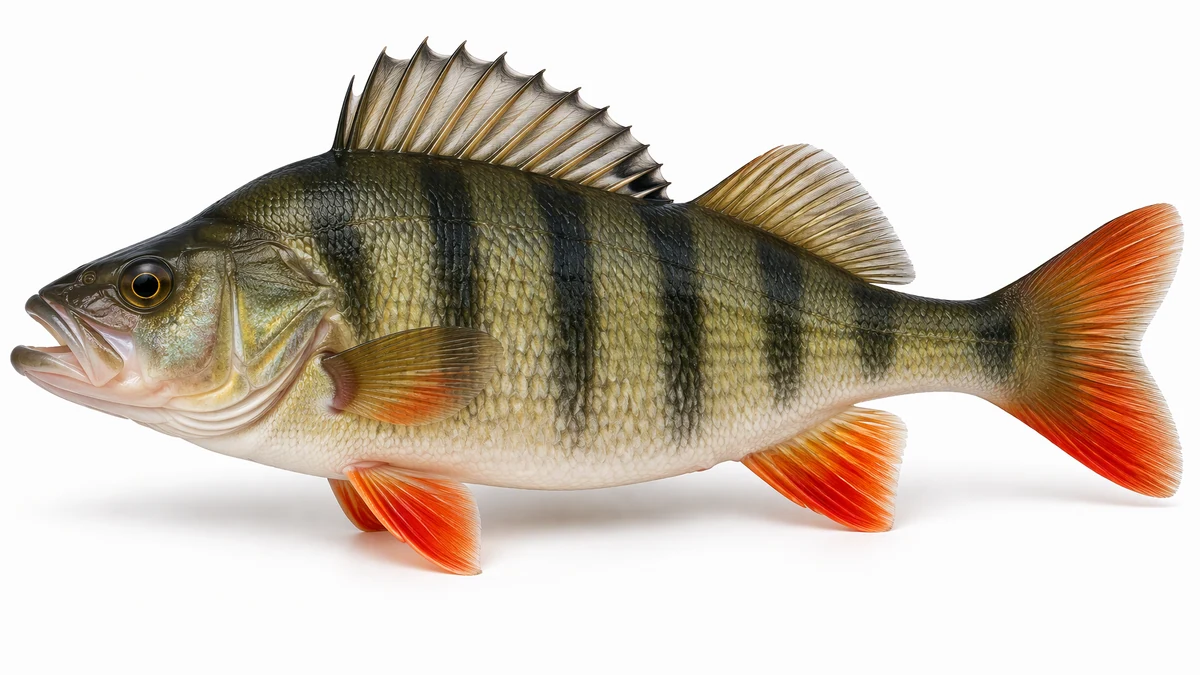
The perch (Perca fluviatilis) is the fish that teaches Europe to fish. Bold, striped, and greedy, it lives in almost every lake, canal, and slow river on the continent, and it will take a bait or a lure when little else will. The bird-like dark bars along its flanks and the red lower fins make it unmistakable, and its willingness to bite makes it a favourite first quarry for new anglers and a lifelong target for specialists. This profile covers perch identification, habitat, what perch eat, how big they get, how they differ from walleye, and how to catch them.
Quick ID Card
| Field | Details |
|---|---|
| Scientific name | Perca fluviatilis |
| Common names | Perch, European perch, Eurasian perch, redfin perch |
| Family | Percidae (perches) |
| Typical size | 6–12 in (15–30 cm); 4 oz–1 lb (100–500 g) |
| Trophy size | 16 in (40 cm) and 3 lb (1.4 kg) plus |
| Water type | Lakes, ponds, canals, slow rivers, reservoirs |
| Depth range | Shallows to about 15 m; big fish deeper in summer |
| Active water temperature | About 54–75°F (12–24°C) |
| Preferred temperature | 60–70°F (15–21°C) |
| Best season | Autumn and early spring; dawn and dusk in summer |
| Difficulty | Easy to catch, hard to catch big |
How to Identify a Perch
Perch identification is simple once you know the stripes. A European perch has five to nine bold, dark vertical bars running down olive-green flanks. The stripes are strongest in young fish and in clear water, and they fade in big, old fish and in muddy water. The back is darker than the flanks, and the belly is pale yellow-white.
The fins do most of the rest of the work. The first dorsal fin is spiny and tall, with sharp rays and a dark spot at the back. Behind it sits a softer second dorsal. The lower fins are the giveaway: the pelvic, anal, and lower pectoral fins are a vivid red to orange, which no other common European freshwater fish matches so clearly. The tail is lightly forked. The scales are small and rough to the touch, and the gill cover ends in a sharp point.
The head is large, the mouth is wide, and the eye is yellow. Big perch grow a pronounced hump behind the head, which gives old specimen fish a hunched, thuggish look.
Perch vs Walleye
Perch are sometimes confused with walleye (Sander vitreus), a larger North American cousin in the same family. The two are related but easy to separate if you check the fins and the bars.
| Feature | Perch | Walleye |
|---|---|---|
| Flank pattern | Bold dark vertical bars | Mottled, golden, faint bars |
| Lower fins | Bright red-orange | Plain, pale, no red |
| Maximum size | Rarely over 4 lb (1.8 kg) | Commonly 3–10 lb (1.4–4.5 kg) |
| Tail tip | No white tip | White tip on the lower lobe |
| Eyes | Yellow, normal | Glassy, reflective (low-light hunter) |
| Range | Europe and northern Asia | North America |
The red fins are the fastest test. A perch has them; a walleye never does. Walleye also grow much larger and have a milky-white tip on the lower tail lobe, which a perch lacks. The European zander, a close relative, looks like a stretched, duller perch with no red fins and a glassy eye, and it grows far bigger than any perch.
The perch family also includes the North American yellow perch (Perca flavescens), which looks almost identical to the European fish but lives on the other side of the Atlantic. For anglers in Europe, if it has red lower fins and bold bars, it is a perch.
Are Perch Dangerous?
Perch are not venomous, but they are spiny, and the spines are the hazard. The first dorsal fin stands up when the fish is alarmed, and every ray ends in a sharp point. The gill covers also finish in a hard spine, and the edge of the preopercle is serrated.
A perch that flips in the hand can drive a dorsal spine into a palm or a finger, and the wound can be sore and slow to heal. The safe grip is across the back with the spiny dorsal folded flat, fingers behind the gill cover and away from the spines, or a light hold under the belly for small fish. A wet cloth helps with bigger fish, and forceps make short work of the hook.
Small perch are often swallowed deep by greedy fish, so carry long-nosed forceps or a disgorger. If you are unhooking a lot of fish, barbless hooks speed things up and do less damage. Beyond the spines, perch are harmless to people, and they are excellent eating when taken from clean water.
Where Do Perch Live?
Perch habitat is almost every kind of fresh water in Europe and northern Asia. The native range runs from Britain and Ireland across the continent to Siberia, and perch have been introduced to Australia, New Zealand, and South Africa, where they are sometimes a problem for native fish. They tolerate a wide range of conditions, from small ponds to huge lakes, and from clear rivers to coloured canals.
Where do perch live in a lake? Structure is everything. Young perch shoal in the shallows around weed beds, lily pads, and reed edges. Bigger fish drop into deeper water, especially in summer when the surface warms, and gather around drop-offs, sunken trees, rock piles, and the deeper edge of weed. On rivers, perch hold in slack water behind bends, around bridge pilings, and in the lee of structures where small fish gather. In canals, they cluster around moored boats, lock walls, and bridge holes.
Temperature shapes their year. Perch are most active from about 12 to 24°C, and they feed hard in autumn as they put on weight for winter. In summer, the biggest fish often feed at dawn and dusk and sit deep during the heat of the day. In winter they slow but rarely stop completely, which is why perch are a dependable cold-weather target.
Habits and Diet: What Do Perch Eat?
What do perch eat? Perch are aggressive predators, but small ones are not fussy. Young perch eat aquatic insect larvae, worms, and tiny crustaceans. As they grow they switch to fish: minnows, young roach, smelt, ruffe, and the fry of other species, along with shrimp, crayfish, and large insects. Big perch are almost entirely fish-eaters and will happily eat their own young.
Perch hunt in packs when small, herding baitfish into the shallows and cutting them off. The shoaling habit makes small perch easy to catch once you find one, because there are usually more. Big perch become more solitary and more cautious, holding near structure and ambushing prey that comes too close. That shift from shoal to loner is why big perch are a genuine challenge on waters where small ones are everywhere.
When do perch spawn? Spawning happens in early spring, usually March to May, when the water reaches about 7–12°C. Females lay long, gelatinous ribbons of eggs that drape over weed, branches, and roots in shallow water. The ribbons can be startling to find, strung through the margins like clear tape full of dots. There is no parental care, and the young hatch within a couple of weeks. The weeks before spawning are a good feeding window, and autumn is the other peak as fish feed up.
Perch grow slowly compared with pike or zander. A 2 lb fish is a good one and may be several years old, and a 4 lb perch is a fish of a lifetime on most waters.
Size, Records and Regulations
How big do perch get? Most adult perch run 15 to 30 cm and 100 to 500 g. A 1 lb fish is respectable, a 2 lb fish is a good specimen, and anything over 3 lb (1.4 kg) is exceptional. The largest authenticated European perch approach 3 to 4 kg, and such fish are rare and usually old females from big, rich waters.
The world record perch depends on the list you read. National records across Europe sit in the 2 to 4 kg range, and the biggest fish are often reported from large lakes and reservoirs rather than small ponds. Because records are kept separately by each country and many big perch are released without formal weighing, figures vary. Check the current national record for the country you fish rather than trusting a single number.
Regulations are local. In England and Wales, perch are coarse fish: rivers have a closed season from mid-March to mid-June, most stillwaters do not, and many specimen fisheries practise catch-and-release. In much of continental Europe, perch are both a sport fish and a food fish, with minimum sizes and daily limits set by national or regional rules, and anglers often need a licence and a water-specific permit. Some waters protect large perch to keep the breeding stock.
As of 2025, check the current rules for the water in front of you. The Environment Agency in England and Natural Resources Wales publish the legal framework, but individual fisheries usually add stricter conditions. For marine species, ICES and CEFAS advise on stocks; perch are freshwater, so the relevant national fisheries authority is the place to start. Last verified: November 2025.
How to Catch Perch
The best bait for perch is simple: worms, maggots, prawns, and small fish. A lobworm or a bunch of maggots on a light float rig catches perch almost anywhere. A small dead or live fish, or a strip of prawn, selects for bigger fish. Perch are greedy and not leader-shy, so light line and a small hook are all you need to get bites.
On the artificial side, perch are the classic lure target. Small spinners, tiny crankbaits, soft plastic shads on light jig heads, and drop-shot rigs all work. Red, orange, and chartreuse are popular colours because they echo the perch's own fins and prey. Fish lures slowly around structure: along weed edges, past sunken trees, and through the shadow of a bridge. When you catch one small perch, keep fishing the same spot; where there is one, there are usually more.
How to catch perch: find structure and baitfish, fish light, and slow down. In summer, fish dawn and dusk and look for big fish deep during the day; drop-shot a soft plastic near the bottom. In autumn, perch feed hard and spread out, so cover water with a spinner or a small swimbait. In winter, fish deep and slow, and be ready for gentle bites.
Handle perch with care because of the spines, unhook over a wet mat or in the water, and release fish that you do not intend to eat. Perch are resilient, but repeated handling of big specimens does them no favours.
FAQ
How big do perch get? Most are 15–30 cm and 100–500 g. A 2 lb fish is a specimen, and fish over 3 lb (1.4 kg) are exceptional, with the largest approaching 3–4 kg.
What is the world record perch? National records across Europe sit in the 2–4 kg range and vary by country. Check the current record for the country you fish.
Where do perch live? In lakes, ponds, canals, and slow rivers across Europe and northern Asia, usually around weed, structure, and baitfish.
What do perch eat? Insects, worms, and crustaceans when small; fish such as minnows and young roach as they grow. Big perch are almost pure fish-eaters.
Perch vs walleye: how do you tell them apart? A perch has bright red-orange lower fins and bold vertical bars. A walleye has plain fins, a glassy eye, a white tail tip, and grows much larger.
When do perch spawn? In early spring, roughly March to May, when the water reaches about 7–12°C, laying egg ribbons over weed and roots.
What is the best bait for perch? Worms, maggots, prawns, and small fish, or small spinners, soft plastics, and drop-shot lures on the artificial side.
How do you catch perch? Find structure and baitfish, fish light and slow, and target dawn and dusk in summer and deeper water in winter.
Related Articles
- Carp — the cautious bottom-feeder that shares many perch lakes but needs a very different approach.
- Wels Catfish — a giant predator from the same big European waters.
- All species profiles
The perch is where most European anglers learn to read water, find structure, and handle a spiny fish without getting hurt. Master the red fins and the bold bars, fish the weed edges and bridge shadows, and you will never be short of bites.
Ready to catch one? Read our step-by-step guide: How to Catch Perch.
About the author and how this was tested
About the author
FishermanGuy
Bank, boat and kayak angler · fishing, crabbing and shrimping since 2021
I buy the gear, fish it for a season and write down what failed. No sponsored verdicts, no free-sample flattery. Every rig on this page has landed fish in water I can point at on a map.
How this was tested
- Every rig gets at least six trips on the same water before it is published.
- Gear is bought at retail. Free samples are labelled in the first paragraph.
- Dates show first publication and the last time the page was updated.