Field notes
Walleye: Identification, Habitat & Diet
Walleye: Identification, Habitat & Diet
Ask a hundred Upper Midwest anglers to name the fish they'd drive all night for, and walleye tops the list more often than anything else. The walleye fills coolers on Lake Erie, pulls night fishermen onto rocky shorelines in July, and fuels more spring road trips than any bass or trout ever will. It belongs to the perch family (Percidae) alongside yellow perch and sauger, and it has no relation to northern pike despite sharing half a nickname. Catching one consistently comes down to understanding a single truth first: a walleye is a low-light predator, and everything about it — the milky eyes, the habits, the favorite haunts — is built around that.
Walleye at a Glance
| Field | Details |
|---|---|
| Scientific name | Sander vitreus |
| Common names | Walleye, walleyed pike, yellow pike, pike-perch; called "pickerel" in parts of Canada |
| Typical size | 14–22 in and 2–4 lb; a 24–27 in, 5–7 lb fish is a good catch; 28–30 in and 8–10 lb pushes trophy range |
| Water | Freshwater; large, cool, well-oxygenated lakes and rivers; poorly suited to warm ponds |
| Difficulty | Often called an ambitious but rewarding early target for beginners; jigging and trolling are the core techniques |
| Best season | Spring spawning run (April, water at 40–55°F) and the fall feeding binge; dawn, dusk, and night produce best day to day |
Walleye Identification
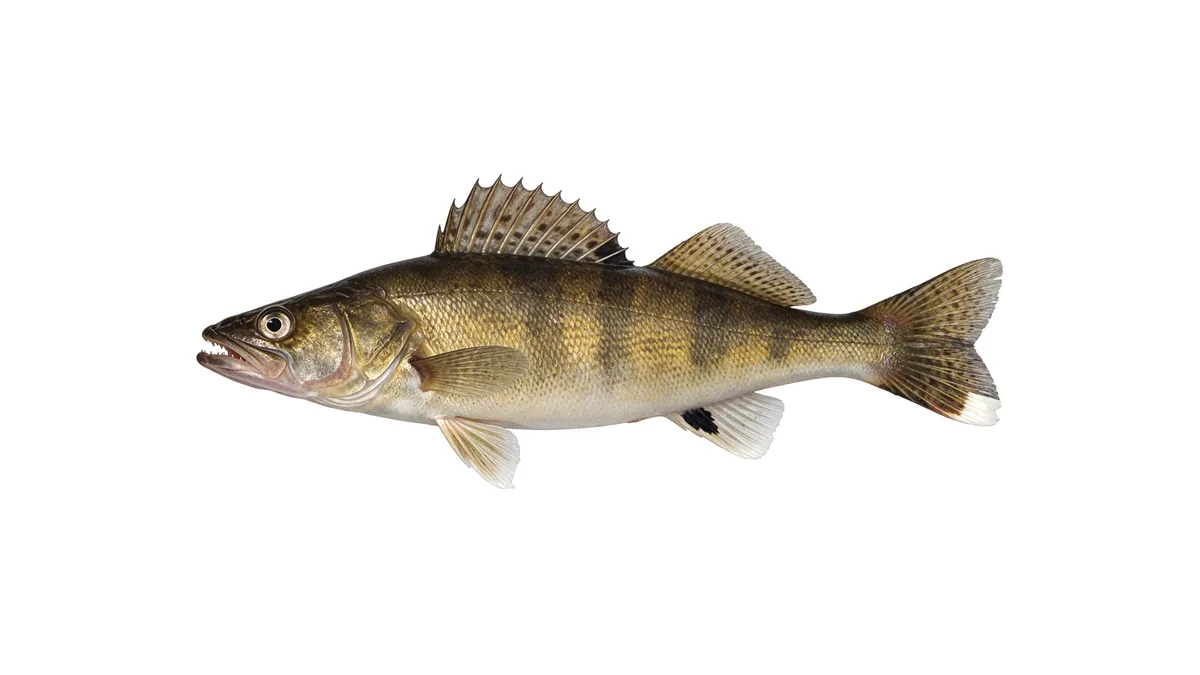
The first thing most people notice about a walleye is the eye. It's large, glassy, and pale — almost white — because of a reflective layer behind the retina called the tapetum lucidum. That layer bounces light back through the eye, giving the walleye exceptional vision in dim water and letting it hunt at dusk, at night, and at dawn when most prey fish can barely see a thing. The name "walleye" comes straight from that milky stare.
Beyond the eye, the fins do most of the identifying work. The walleye's first dorsal fin carries no dark spots and its membranes are opaque. A large dark blotch sits at the rear of that first dorsal fin. The body runs olive, gray, or silver-gray. And the lower lobe of the tail fin carries a white tip — a small detail that separates the walleye from its closest look-alike in seconds.
One more note on identity: every walleye swimming today is a yellow walleye. The blue walleye, also called blue pike, was a Great Lakes variant that disappeared from Lake Erie in the 1960s and no longer exists.
Walleye vs Sauger: How to Tell Them Apart
Anglers mix these two up constantly, and for good reason — they're close relatives in the same family. But walleye and sauger (Sander canadensis) differ in several ways you can check at the boat:
| Feature | Walleye | Sauger |
|---|---|---|
| First dorsal fin | No spots, opaque membranes | Dark spots, clear (transparent) membranes |
| Dark blotch behind dorsal fin | Present | Absent |
| Body color | Olive, gray, or silver-gray | Bronzy or brown |
| Tail | White tip on lower lobe | No white tip |
| Eyes | Large, strong reflection | Smaller, weaker reflection |
| Average size | Larger | Smaller on average |
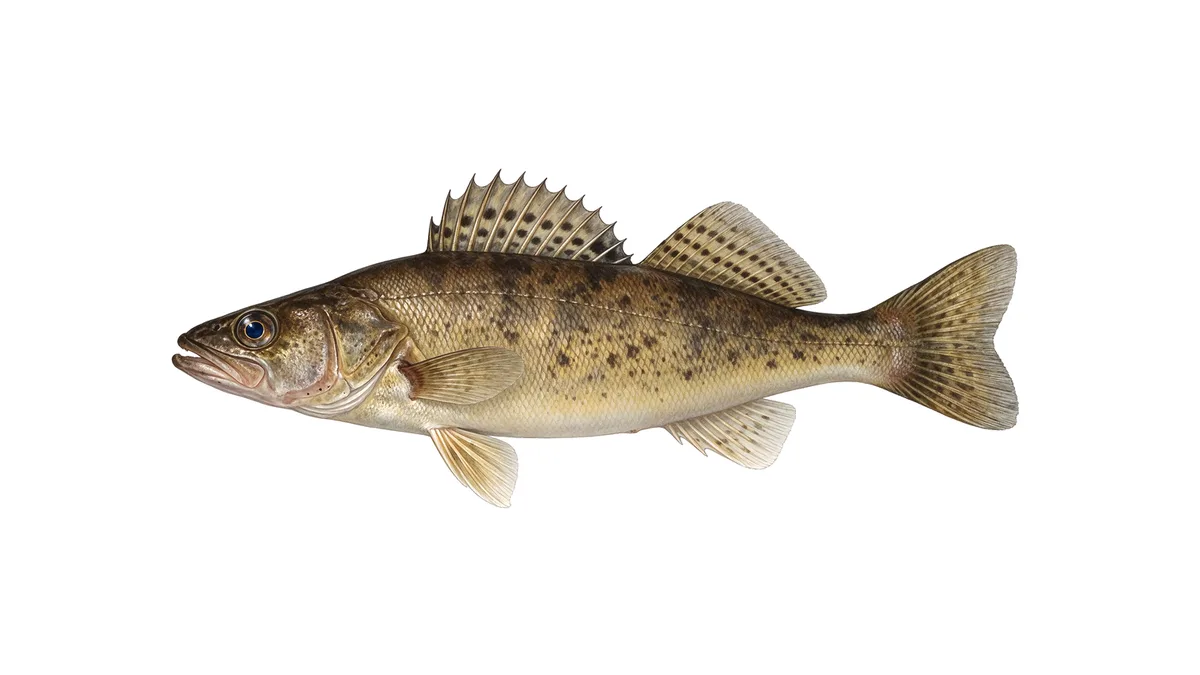
If you only remember one thing, check the tail and the dorsal fin: a white-tipped tail plus a dark blotch behind the fin says walleye.
Walleye Habitat: Where Do Walleye Live
Walleye are native to Canada and the northern United States — the Great Lakes, the Hudson Bay basin, and the Mississippi River basin. Through stocking they've been spread to nearly every state in the lower 48, from New York reservoirs down to Texas lakes. If you're asking where do walleye live, the short answer is cool, fertile, well-oxygenated water. The useful answer is more specific.
A walleye's holding spot usually checks three boxes at once: access to deep water, current or wind, and a firm bottom. That plays out as reefs, gravel shoals, and rocky humps; points and submerged islands; weed edges and drop-offs; slack water, river bends, and dam tailwaters; and windward shorelines in spring. Named walleye waters include Lake Erie (often called the most productive walleye lake in the world), Minnesota's Mille Lacs and Lake of the Woods, Wisconsin's Lake Winnebago, North Dakota's Devils Lake, and Lake Oahe on the Missouri River.
Depth shifts with the season. In summer, walleye hold during the day in cool water 15–35 ft down. In spring they spawn in rivers and on lake reefs in 3–12 ft of water.
Behavior
Walleye are low-light hunters through and through. Feeding peaks at dawn and dusk, through the night, and on heavily overcast days. Under a bright midday sun they slide deep or tuck tight to structure. They prefer water in the low-to-mid 60s°F and avoid the warm, shallow water that bass love. Night fishing shallow flats in summer is one of the most consistent patterns anywhere in the country.
They move with the seasons. In spring, at 40–55°F, they run up tributaries and onto gravel reefs to spawn. In summer they sit on deep structure 15–35 ft down during the day and move shallow to feed after dark. In fall they follow baitfish through mid-depths and binge ahead of winter. In winter they gather in deep basins, sluggish but still catchable — walleye are a common ice-fishing target across the north.
Walleye school loosely by size. Find one and there are usually more nearby, but the school keeps moving as baitfish and water temperature shift.
What Do Walleye Eat
Walleye are fish eaters first. Their diet centers on baitfish — gizzard shad, emerald shiners, spottail shiners, and fathead minnows. Big walleye in northern lakes readily eat yellow perch, and cold-water forage like cisco shows up in the mix too. In rivers they take crayfish and aquatic insects. And large walleye are known to eat smaller walleye.
The rule that matters for anglers: find the bait and you've found the walleye. Trollers hunt for baitfish balls and fish marks on the electronics at the same time.
When Do Walleye Spawn
Walleye are among the earliest freshwater spawners of the year. Once the water reaches 40–55°F — typically April across much of their range — they move into tributaries and onto gravel reefs in 3–12 ft of water. That spring run is one of the two big fishing windows of the year, the other being the fall feeding binge before ice-up.
Size and Regulations: How Big Do Walleye Get
A typical walleye runs 14–22 in and 2–4 lb. A 24–27 in fish weighing 5–7 lb is a legitimately good catch, and a 28–30 in walleye in the 8–10 lb range is widely considered a trophy — for most anglers, a 10-pounder is a once-in-a-lifetime fish.
The all-tackle world record walleye is 25 lb 0 oz, caught by Mabry Harper in August 1960 at Old Hickory Lake, Tennessee. Most state records in the Midwest and Great Lakes region fall in the 12–17 lb range, and walleye commonly live 10–15 years, with the longest on record reaching about 29 years.
Regulations vary by state, always check your local rules. Most states set a minimum size limit (often 14–18 in) and a daily bag limit (often 4–8 fish), so confirm both before you drop a line. The meat is white, firm, flaky, and mild with almost no small bones, and it handles frying, grilling, baking, or blackening well.
Walleye FAQ
What's the best bait for walleye?
Live minnows — shiners and chubs — are the classic choice, followed by nightcrawlers and leeches. On the artificial side, a 3–4 in soft plastic on a 1/4 oz jighead and shad-style crankbaits produce the most fish.
What's the best time to catch walleye?
Dawn, dusk, and after dark. Walleye use those reflective eyes to feed in low light, and they'll also bite on heavily overcast days. In summer, night fishing shallow flats is one of the steadiest patterns anywhere.
Why do walleye eyes look white?
A reflective layer behind the retina — the tapetum lucidum — acts like a mirror, bouncing light back through the eye. That's what gives the eye its milky look and lets the walleye see extremely well in dark water, hunting at dusk, night, and dawn.
Do walleye bite at night?
Yes, and night is one of the best times to target them, especially in summer. After dark they move onto flats, reefs, and weed edges to feed and will hit crankbaits, jigs, and live bait.
Is a walleye the same as a sauger?
No. They're close relatives, but a walleye has a white tip on the lower tail and a dark blotch behind the dorsal fin, while a sauger has spotted dorsal fins, a bronzy-brown body, no white tail tip, and a smaller average size.
How big is the world record walleye?
25 lb 0 oz, caught by Mabry Harper in August 1960 at Old Hickory Lake, Tennessee. Most Midwest and Great Lakes state records run 12–17 lb.
Related Articles
- [Northern Pike Species Profile — placeholder]
- [Sauger Species Profile — placeholder]
- [Yellow Perch Species Profile — placeholder]
Ready to catch one? Read our step-by-step guide: How to Catch Walleye.
About the author and how this was tested
About the author
FishermanGuy
Bank, boat and kayak angler · fishing, crabbing and shrimping since 2021
I buy the gear, fish it for a season and write down what failed. No sponsored verdicts, no free-sample flattery. Every rig on this page has landed fish in water I can point at on a map.
How this was tested
- Every rig gets at least six trips on the same water before it is published.
- Gear is bought at retail. Free samples are labelled in the first paragraph.
- Dates show first publication and the last time the page was updated.