Field notes
Northern Pike: Identification, Habitat & Diet
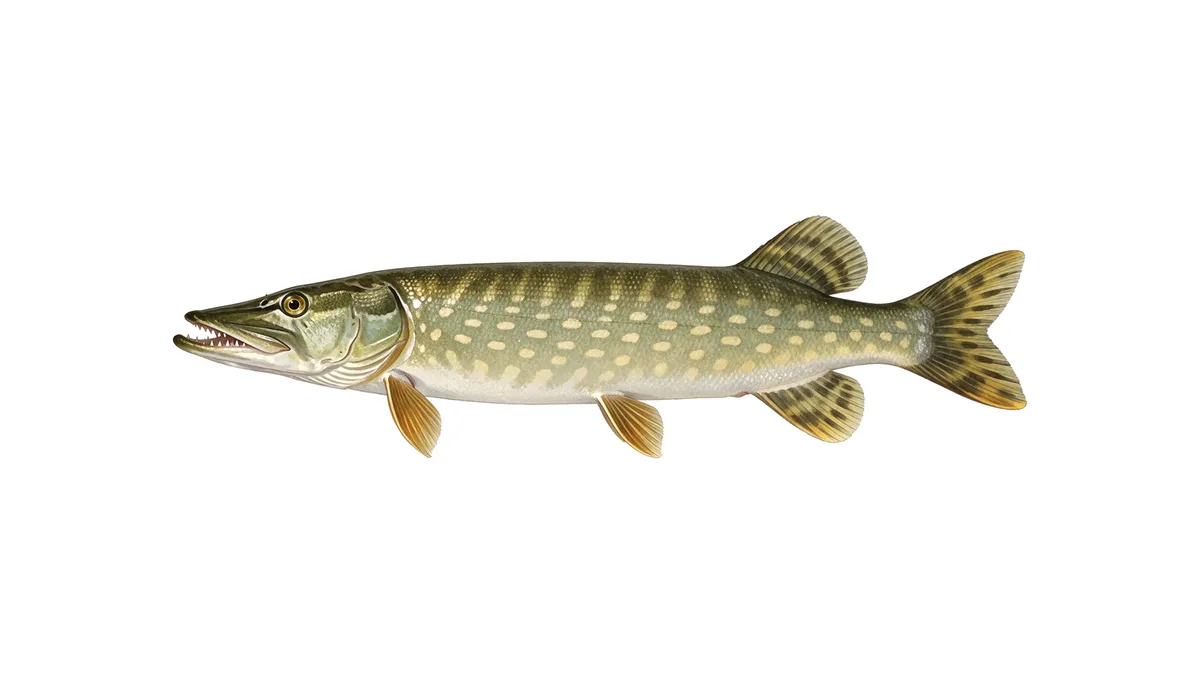
Northern Pike: Identification, Habitat & Diet
Few freshwater fish attack a lure with the violence of a northern pike. The "water wolf" sits motionless in a weed bed for hours, then explodes on anything that wanders past. Pike are aggressive and relatively easy to catch once you solve two problems — their teeth and their turf — and with the right gear they're a surprisingly forgiving first trophy for a beginner. If you fish cool, weedy lakes anywhere north of the Ohio River, understanding the northern pike should sit near the top of your list.
Northern Pike at a Glance
| Field | Details |
|---|---|
| Scientific name | Esox lucius |
| Common names | Northern pike, water wolf, gator; "common pike" in Europe |
| Typical size | 24–36 in and 3–10 lb; a 30 in, 10 lb fish is a good catch anywhere; 40 in and roughly 15–20 lb is a trophy |
| Water | Freshwater; cool, weedy lakes and slow rivers, especially backwaters, bays, and marshy shorelines |
| Difficulty | Aggressive and relatively easy to catch once you solve two problems — teeth and home turf; surprisingly forgiving as a first trophy for beginners with the right gear |
| Best season | The post-spawn spring period and the fall feeding binge |
Northern Pike Identification
A northern pike is built like a torpedo. The body is long and slender, the snout is long, flat, and duck-billed, and a single dorsal fin sits far back near the tail, which is forked. That lone dorsal fin separates it instantly from the two-finned walleye and perch you'd find in the same lake.
The mouth is the next giveaway — hundreds of needle-sharp, backward-curving teeth line the jaws, with more tooth rows on the roof of the mouth and the tongue. As for color, a northern pike wears light, bean-shaped spots scattered over a dark green-olive base, fading to a cream or white belly. Those light spots run in rows along the flanks, not in the vertical bars of a muskellunge. Fish from clear, dark-bottomed lakes run darker; fish from murky, weedy water run brighter.
Northern Pike vs Muskie (and Chain Pickerel)
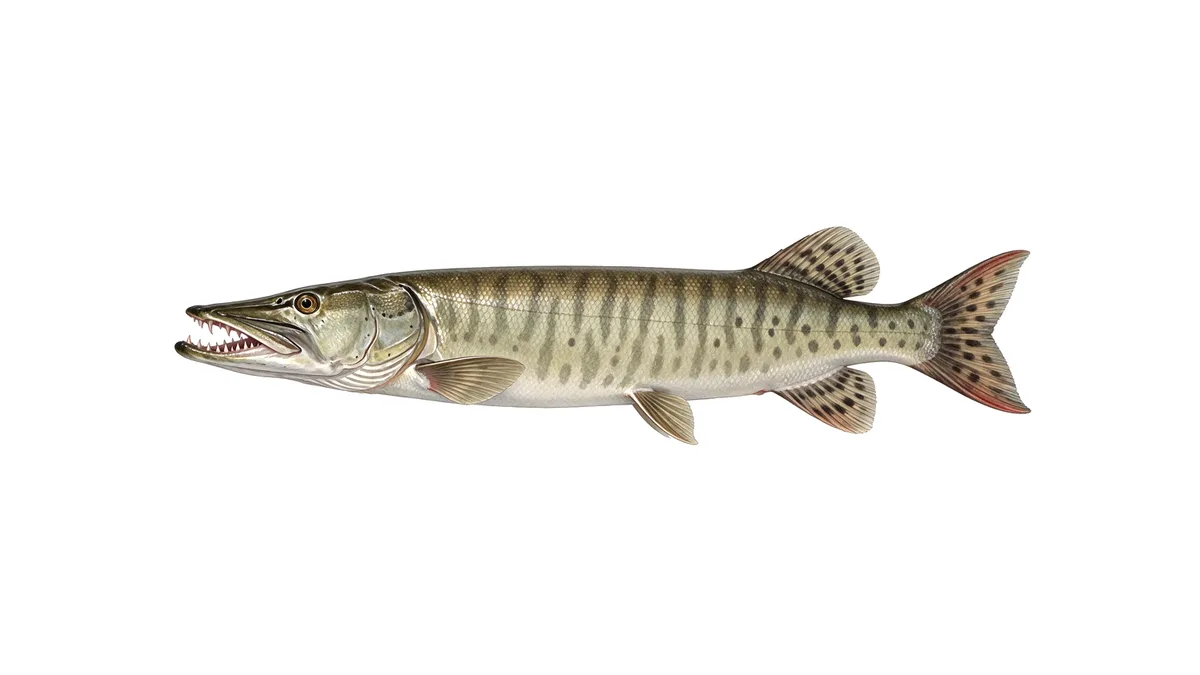
The muskellunge is the fish most often confused with a northern pike. Put the two side by side and the differences are clear:
| Feature | Northern Pike | Muskellunge |
|---|---|---|
| Markings | Light spots on a dark body | Dark bars or spots on a light body |
| Tail fin | Rounded tips | Pointed tips |
| Cheek scales | Full cheek | Upper half of cheek only |
| Sensory pores under jaw | 5 or fewer per side | 6 or more per side |
| Typical size | 24–36 in | 30–50 in |
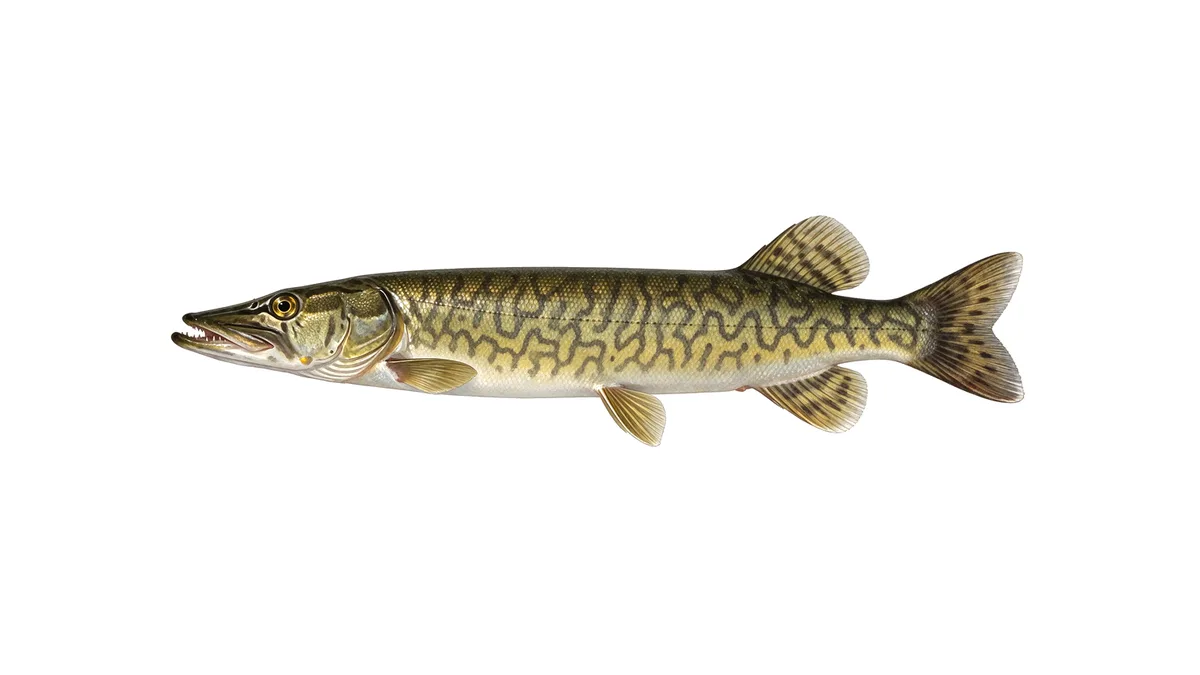
Chain pickerel, the third Esox cousin, shows a chain-link pattern, pointed tail tips, a fully scaled cheek, fewer than 5 pores under the jaw, and a typical size of 15–24 in.
Is a Northern Pike Dangerous?
Not venomous, but respect the teeth. They're sharp enough to slice through line and skin. The good news: a northern pike won't go after a person. Bites almost always happen when someone grabs a live fish around the head and slides a finger into the tooth zone. Hold a pike by the head behind the gill covers, keep your fingers away from the mouth, and take hooks out with pliers.
Northern Pike Habitat: Where Do Northern Pike Live
In the United States, northern pike are native to the northern tier: New England, New York, the Great Lakes states (Michigan, Wisconsin, Minnesota, Ohio, Pennsylvania), the upper Midwest, the northern plains, the Rockies, parts of the Pacific Northwest, and Alaska. The southern edge of the native range runs roughly along the latitude of the Ohio and Missouri rivers — most southern waters are simply too warm, so pike aren't found there.
The habitat formula is two words: cool plus weedy. Backwaters, bays, and marshy shorelines are home; weed beds, lily pads, and submerged timber provide the ambush cover they rarely stray far from. Water around 50–72°F is their comfort zone. They can tolerate near-freezing water, which is why they're an ice-fishing favorite, but once summer pushes past the mid-70s°F they move deeper and go off the feed during the day. Most fish hold in 2–10 ft near cover, with summer fish often on weed edges and drop-offs in 8–20 ft of cooler water.
A few western populations came from stocking or escapes and aren't native. A handful — California's Lake Davis is the famous example — are managed as invasive and have even been targeted for eradication. In those waters, regulations may encourage keeping every fish, so check your state's rules before you go.
Behavior
Northern pike are solitary ambush predators. Each fish claims a stretch of cover and can sit nearly motionless for hours before one explosive burst at passing prey. It strikes from the side, then turns the prey and swallows it headfirst.
Feeding peaks in low light — dawn and dusk and overcast days are classic, and clear-water lakes see noticeably more activity at night. In spring, when the water is cold and murky, pike can feed all day. They spawn among the earliest of any freshwater fish, entering flooded marshes, weed bays, and shallow backwaters just days after ice-out, when the water is in the low-to-mid 40s°F. They scatter eggs over vegetation and build no nest and guard no young.
The seasons move like this: spring in 2–6 ft of flooded grass right after the spawn, when they feed hard; summer on weed edges and 8–20 ft of cool water, sluggish by day and active at dawn, dusk, and night; fall back shallow chasing baitfish — the year's best window for big fish; and winter still feeding under the ice on weed flats and edges.
Pike are also cannibals. A big pike won't hesitate to eat a smaller one and can swallow prey about a third of its own body length.
What Do Northern Pike Eat
Fish dominate the menu — perch, suckers, cisco, whitefish, shad, minnows, and other pike. But a northern pike isn't picky: frogs and salamanders, crayfish and leeches, and even mice, voles, ducklings, and small muskrats all turn up in their stomachs. Most pike spend their lives within a few hundred yards of a favorite weed bed, so the old rule holds — find the baitfish and you'll find the pike.
When Do Northern Pike Spawn
Northern pike are among the very first freshwater fish to spawn each year. Just days after ice-out, once the water reaches the low-to-mid 40s°F, they push into flooded marshes, weed bays, and shallow backwaters and scatter eggs over the vegetation. There's no nest and no parental care — the adults leave and feed hard in the same shallows right after.
How to Catch Northern Pike
Pike hit hard and pull hard, but you have to rig for the teeth. Use a 6–12 in steel or titanium leader, throw big baits 4–7 in long, and work the 2–10 ft zone along weed edges, lily pads, and submerged timber with a slow retrieve. That's the whole game: heavy leader, big bait, slow and steady.
Size and Regulations: How Big Do Northern Pike Get
A typical northern pike runs 24–36 in and 3–10 lb. A 30 in, 10 lb fish is a good catch in any state, and a 40 in pike in the 15–20 lb range is a trophy. The IGFA all-tackle world record northern pike is 55 lb 1 oz, caught by Lothar Louis in 1986 at Lake of Grefeern, Germany. Among U.S. state records, New York's 46 lb 2 oz fish from Great Sacandaga Lake (1940) and Minnesota's 45 lb 12 oz from Lake of the Woods (1929) are the most famous, and most northern state records run 25–40 lb.
Pike commonly live 10–15 years, often exceed 20 in cold northern lakes, and have been recorded past 25. Cold water means slow growth, so a truly big pike is usually an old fish. In non-native waters there may be no size or possession limits, and keeping fish may even be encouraged; native waters carry the usual length limits, bag limits, seasons, and license requirements. Regulations vary by state, always check your local rules. The meat is white, firm, and mild — a delicacy in Europe — though the Y-shaped bones take some work: the five-fillet method removes them, or pickling softens them. On big fish, skin them and trim the dark lateral-line meat to avoid any muddy taste.
Northern Pike FAQ
How big do northern pike get?
Most run 24–36 in and 3–10 lb. A 40 in fish around 15–20 lb is a trophy, and the all-tackle world record is 55 lb 1 oz.
What's the world record northern pike?
55 lb 1 oz, caught by Lothar Louis in 1986 at Lake of Grefeern, Germany. The most famous U.S. fish are New York's 46 lb 2 oz (1940) and Minnesota's 45 lb 12 oz (1929).
Do northern pike bite people?
Their teeth can slice skin, but pike don't attack people. Bites come from mishandling a live fish — grabbing the head and putting fingers near the mouth. Hold a pike behind the gill covers and use pliers.
Are northern pike invasive in some states?
Yes, in a few stocked or escaped western populations they're managed as invasive. California's Lake Davis was treated with rotenone in 1997 and 2007 to remove illegally introduced pike. In non-native waters there may be no size or possession limits — check your local rules.
What's the best bait for northern pike?
Big bait for big teeth: large spoons, spinnerbaits, and 4–7 in jerkbaits or swimbaits worked slowly along weed edges, plus a 6–12 in steel or titanium leader so the line survives the bite.
Do northern pike bite in summer?
They do, but the timing shifts. By day they hold on weed edges and drop-off deep water; at dawn, dusk, and night they feed. Hit the same weed edge early and late, fish deeper at midday, and slow the retrieve.
How long do northern pike live?
Most live 10–15 years, often 20-plus in cold northern lakes, with records past 25. Cold water slows growth, so big pike tend to be old fish.
Related Articles
- [Walleye Species Profile — placeholder]
- [Muskellunge Species Profile — placeholder]
- [Chain Pickerel Species Profile — placeholder]
Ready to catch one? Read our step-by-step guide: How to Catch Northern Pike.
About the author and how this was tested
About the author
FishermanGuy
Bank, boat and kayak angler · fishing, crabbing and shrimping since 2021
I buy the gear, fish it for a season and write down what failed. No sponsored verdicts, no free-sample flattery. Every rig on this page has landed fish in water I can point at on a map.
How this was tested
- Every rig gets at least six trips on the same water before it is published.
- Gear is bought at retail. Free samples are labelled in the first paragraph.
- Dates show first publication and the last time the page was updated.