Field notes
Redfish: Identification, Habitat & Diet
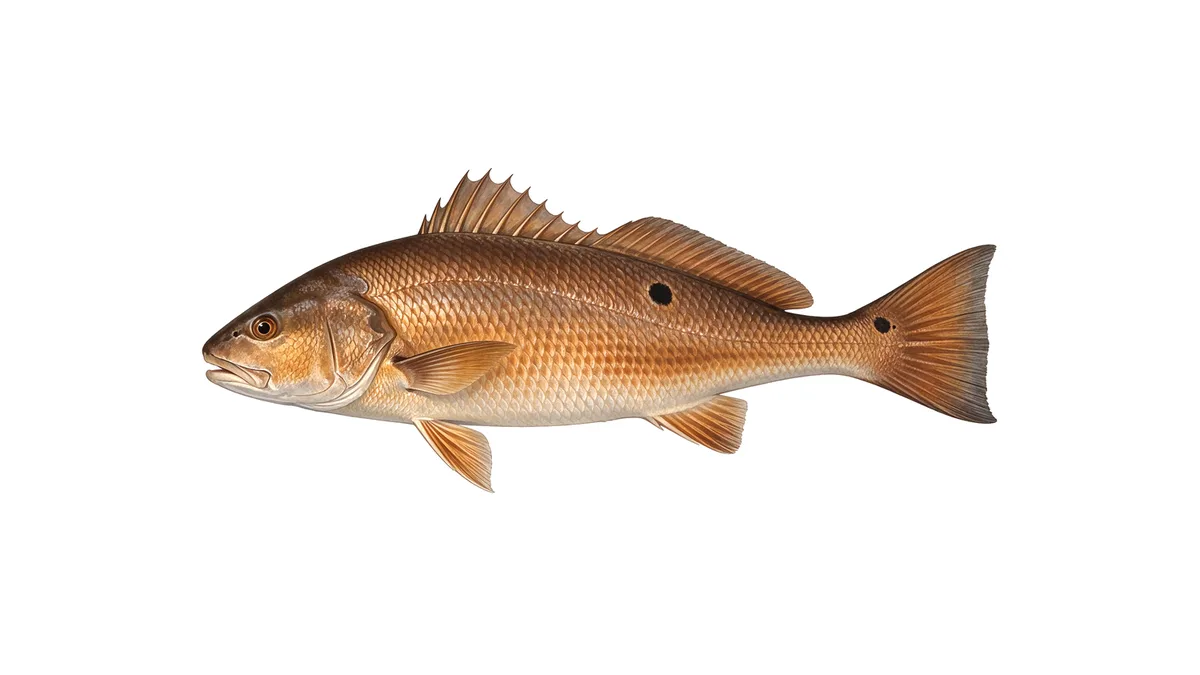
Redfish: Identification, Habitat & Diet
The redfish is the fish Gulf Coast anglers plan whole trips around. Depending on where you are and how big it is, the same Sciaenops ocellatus goes by redfish, red drum, channel bass, spottail bass, puppy drum, rat red, or bull red. It's a bronze-bodied inshore drum with a hard strike and a long first run, and it turns up everywhere from Texas marsh flats to Carolina surf zones. It also handles water from tidal freshwater to full-strength salt, which is a big part of why it's one of the most popular inshore gamefish in the country.
Redfish at a Glance
| Field | Detail |
|---|---|
| Scientific name | Sciaenops ocellatus |
| Common names | Redfish, red drum, channel bass, spottail bass, puppy drum, rat red (small), bull red (oversized) |
| Typical size | 18–27 in slot keepers (roughly 3–8 lb); age 1 ≈ 11 in/1 lb, age 2 17–22 in, age 3 22–24 in |
| Water | Inshore saltwater — juveniles in estuaries and bays, adults along surf, bay mouths, and reefs |
| Difficulty | Medium to high — strong pull and hard runs, but it bites readily |
| Best season | Fall, especially stormy weather during the Bull Redfish Run (mid-August through October); many states stay open year-round — check your state's season |
Redfish vs Red Drum: Same Fish, Many Names
The shortest answer to "redfish vs red drum" is that there's no contest. Redfish and red drum are the same species. "Red drum" is the more formal common name used in regulations and scientific writing; "redfish" is what most anglers actually say. The other names are size- and region-based. Small fish are rat reds or puppy drum. A redfish that tops the slot limit — the big one that has to go back in most states — is a bull red. Channel bass and spottail bass are older East Coast names you'll still hear in Virginia and the Carolinas.
How to Identify a Redfish
The one mark that gives a redfish away is the black spot on the upper part of the tail, near the base of the tail fin. It's an eye-like ocellated spot, and most redfish carry exactly one, though two or more isn't unusual. A redfish with no spot at all is rare.
From there, look at the body. Color runs from dark blackish-brown to bronze to almost silver, with reddish-bronze being the classic. The belly fades toward white. The shape is torpedo-like — streamlined, not deep and hump-backed. The tail fin is slightly lunate, the pectoral fins are rounded, the scales are large, and the mouth sits low in an underslung jaw.
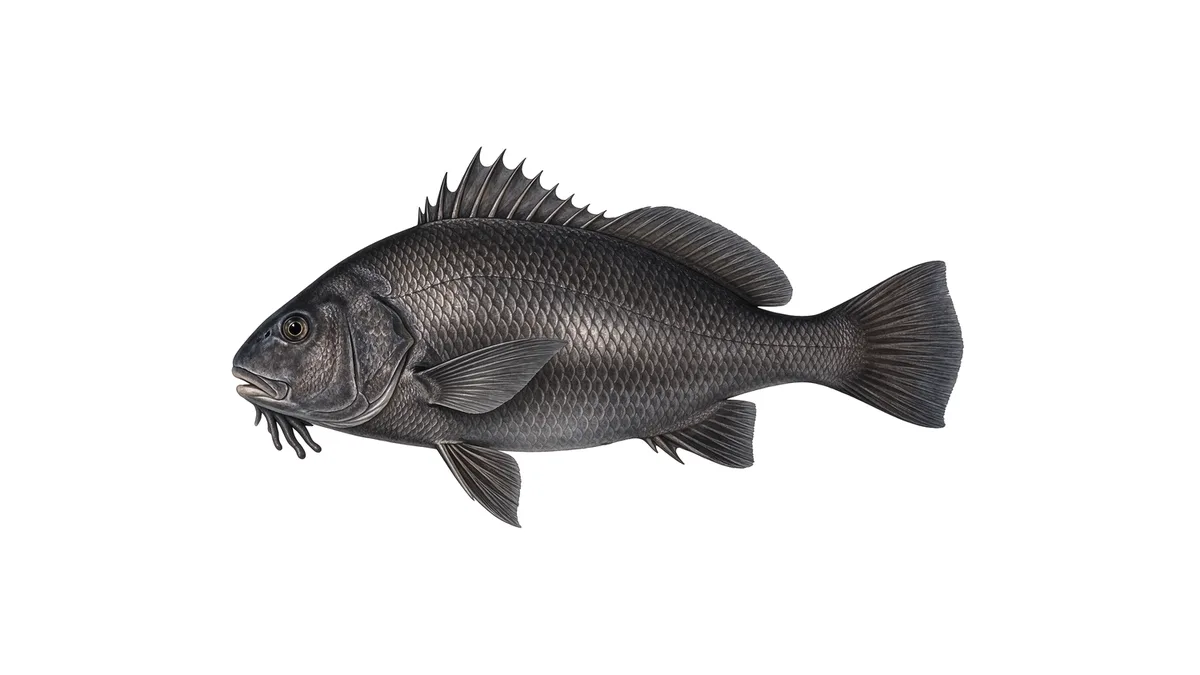
The fastest field mark that separates a redfish from its look-alikes is what's missing: no barbels on the chin. Black drum have them; redfish don't. Scientists think the tail spot is there to fool predators into striking the tail instead of the head.
Similar Species: Redfish vs Black Drum
The redfish vs black drum question comes up constantly, because the two share the same flats, the same oyster reefs, and the same drum family (Sciaenidae).
- Black drum (Pogonias cromis) have short chin barbels; redfish have none.
- Black drum lack the tail spot that redfish carry.
- Black drum run gray-black and get deep-bodied with a high, humped back as adults; redfish are reddish-bronze and streamlined.
- Juvenile black drum show four to six dark vertical bars; juvenile redfish don't.
- Black drum crush clams and oysters with throat teeth and can grow larger than redfish.
Spotted seatrout (Cynoscion nebulosus) is a same-family cousin and the other common source of confusion. It has spots scattered all over its body plus canine teeth, where a redfish keeps its spots concentrated at the tail.
Is a Redfish Dangerous?
No. A redfish has no venom and no venomous spines, and it's safe to eat — the meat is white and firm. The two cautions worth knowing are practical, not scary. First, redfish are long-lived; the oldest on record reached 37 years, so very large individuals carry the usual mercury concerns that come with big, old marine fish. Check your state's fish consumption advisories. Second, a redfish fights hard and has large, hard scales, so a fish that size at the end of the line can give you a cut or a bruised thumb if you aren't careful.
Redfish Habitat: Where Do Redfish Live?
Redfish are native to the U.S. Gulf Coast from Texas to Florida and up the Atlantic coast from northern Mexico (Tamaulipas) to Massachusetts — Cape Cod and Long Island mark the practical northern edge, and fish are now rare north of Chesapeake Bay. The core states are Texas, Louisiana, Mississippi, Alabama, Florida, Georgia, South Carolina, North Carolina, and Virginia.
Where do redfish live depends on how old they are. Juveniles stay in shallow estuarine water — marshes, oyster reefs, seagrass beds, and small creeks. Adults move out to the coastal surf zone, bay mouths, and natural or artificial reefs.
Depth and salinity both shift with the season. Most redfish stay inside about 72 ft of water near shore, with a practical offshore maximum around 141 ft. Spring and fall favor water shallower than 33 ft; summer pushes them deeper than 98 ft. On salinity, a redfish survives the full spread from tidal freshwater to high-salinity seawater, and juveniles actually get more freshwater-tolerant as they grow.
What Do Redfish Eat and When Do They Spawn?
What do redfish eat changes as they grow. Juveniles work small crabs, shrimp, and marine worms. Adults move up to big crabs, shrimp, and small fish, and will occasionally eat their own Atlantic croaker cousins. They're primarily bottom feeders, but they'll chase prey up into the water column when it's worth it.
That bottom-feeding habit produces the signature redfish behavior: tailing. In shallow water a redfish tips head-down into the grass to feed, leaving its tail sticking out of the water. Spot a tail, and you've found a fish to cast to.
For the first three years redfish stick to bays and the surf near passes; tag returns show they usually stay within three miles of where they were released. Once mature, they move offshore to the Gulf or continental shelf for the rest of their lives, coming back to the bays only occasionally, and concentrating in rivers and tidal creeks in winter. Day-to-day movement follows the tide and water temperature.
When do redfish spawn? They reach sexual maturity in years three and four. In the Gulf, the spawn runs from about mid-August to mid-October, at bay mouths and nearshore flats, and the eggs hatch in roughly 24 hours. In fall — especially in stormy weather — big reds pour toward gulf beaches, which is the famous Bull Redfish Run that surf and pier anglers wait for all year. The males also live up to the drum name: they contract muscles around the swim bladder to make a drumming courtship sound, the same trick used by black drum, spotted seatrout, weakfish, and croaker.
Size and Regulations: How Big Do Redfish Get?
Growth is fast early, then slows. A one-year-old redfish runs about 11 in and 1 lb. At two years it's 17–22 in and about 3.5 lb, and at three years 22–24 in and 6–8 lb. The largest measured on the Gulf side was 980 mm (about 38.6 in); on the Atlantic side, 1110 mm (about 43.7 in). The oldest on record lived 37 years.
The world record redfish is the one every Gulf angler can quote. David Deuel caught a 94 lb 2 oz (42.69 kg) fish on November 7, 1984, surf fishing at Avon, North Carolina, on a chunk of cut mullet. The fight ran about 45 minutes. It still stands as the IGFA all-tackle record and the men's 24 kg line-class record more than 40 years later.
State records give you a sense of the spread. Texas lists a 59.50 lb, 54.25 in fish taken January 30, 2000, in the Gulf. Florida lists 52 lb 5 oz from Cocoa in Brevard County, caught in February 1996, plus a 43 lb fly record. Louisiana lists 61 lb from 1992, and North Carolina's mark is the same 94 lb 2 oz fish as the world record. Check your state's fish and wildlife agency for the official record it currently recognizes.
Regulations vary by state, always check your local rules. Most redfish are managed with a slot limit — you can keep a fish only if it falls between a minimum and a maximum length — plus a daily bag limit. Florida uses an 18–27 in slot with one fish per person per day (zone-dependent, with vessel limits of two to eight) and is open year-round; the Indian River Lagoon is catch-and-release only. Texas uses 20–28 in with three per person per day, plus a Red Drum Tag and Bonus Tag that each let you keep one oversize fish. Louisiana moved to 18–27 in with four per person per day in July 2024 and prohibits keeping anything over 27 in. Alabama runs 16–26 in with three per person, one of which may exceed 26 in. Mississippi runs 18–30 in with three per person, one of which may exceed 30 in. Georgia is currently 14–23 in, with a proposal to move to 15–24 in. In federal Gulf waters, redfish harvest is closed entirely under a moratorium, and the species is managed as a game fish in state waters. You'll need a saltwater fishing license, and the requirements and fees differ by state.
Best Bait for Redfish and Best Time to Catch Redfish
The best bait for redfish tracks what they already eat. For live or cut bait, shrimp and fish chunks on the bottom do the job, and cut mullet is the classic surf choice — it's what caught the world record. On artificials, soft plastics, minnow-style lures, and spoons worked around mangroves, oyster bars, and artificial reefs produce, with shallow-running minnows doing well on the flats.
The best time to catch redfish is fall. The Bull Redfish Run, from mid-August through October, puts big fish on the gulf beaches — especially in stormy weather — and most states keep the season open year-round. Early mornings moving with the tide is how most inshore anglers put it together.
Frequently Asked Questions
Is redfish the same as red drum?
Yes. Redfish is just the most common name for the red drum (Sciaenops ocellatus); channel bass, spottail bass, puppy drum, and bull red are all the same species.
How big do redfish get?
The world record is 94 lb 2 oz. Slot keepers run 18–27 in and about 3–8 lb, while bull reds over the slot can reach 20–50+ lb.
What's the fastest way to identify a redfish?
Look at the upper tail for the black eye spot (sometimes more than one, rarely none), then check the chin — redfish have no barbels, black drum do.
Can redfish live in freshwater?
Yes. They tolerate everything from tidal freshwater to full-strength seawater, and juveniles get more freshwater-tolerant as they age.
Why do redfish "drum"?
Males contract swim bladder muscles to make a drumming courtship sound during the spawn, the same behavior as black drum, spotted seatrout, weakfish, and croaker.
Is redfish good to eat?
Yes — the meat is white and firm, and it's a popular food fish. Large, old fish carry the usual mercury cautions, so check your state's consumption advisories.
Related Articles
- [Placeholder: Redfish vs Black Drum — How to Tell Them Apart]
- [Placeholder: Spotted Seatrout Species Profile]
- [Placeholder: Best Surf Fishing Rigs for the Gulf Coast]
- [Placeholder: How to Read a Tidal Flat for Tailing Redfish]
Ready to catch one? Read our step-by-step guide: How to Catch Redfish.
About the author and how this was tested
About the author
FishermanGuy
Bank, boat and kayak angler · fishing, crabbing and shrimping since 2021
I buy the gear, fish it for a season and write down what failed. No sponsored verdicts, no free-sample flattery. Every rig on this page has landed fish in water I can point at on a map.
How this was tested
- Every rig gets at least six trips on the same water before it is published.
- Gear is bought at retail. Free samples are labelled in the first paragraph.
- Dates show first publication and the last time the page was updated.