Field notes
Mantis Shrimp: Identification, Habitat & Diet
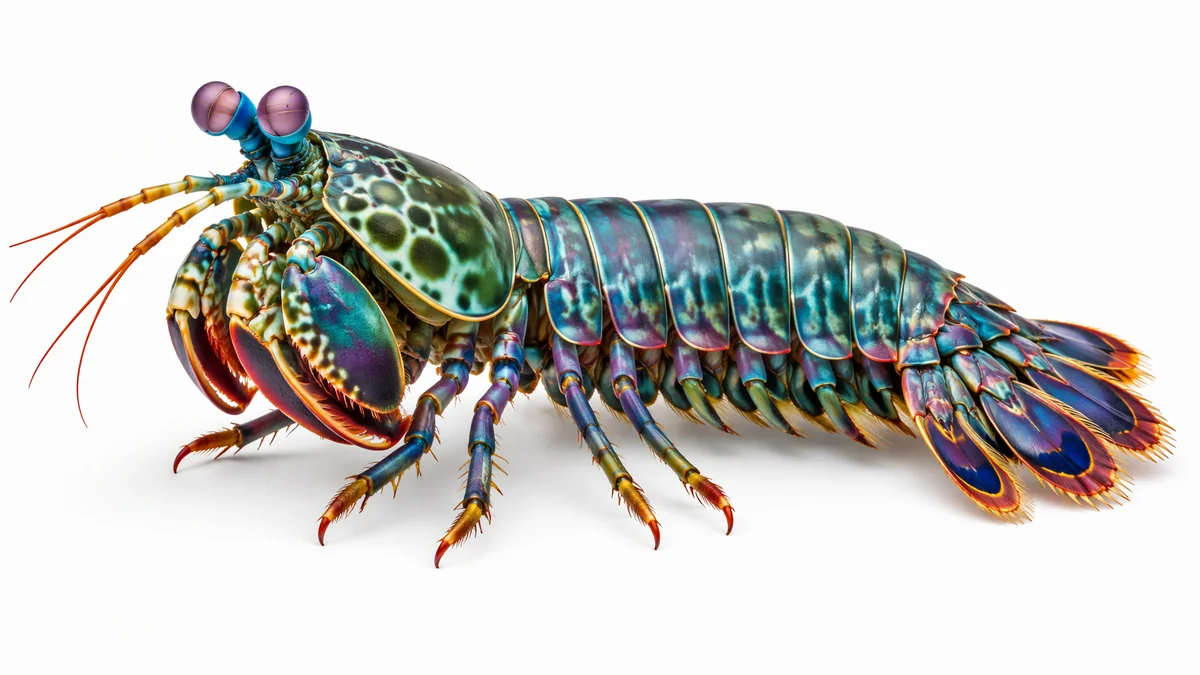
Mantis Shrimp: Identification, Habitat & Diet
The mantis shrimp is the ocean's hardest-hitting crustacean — a stocky, armored animal that isn't a true shrimp and isn't a praying mantis, but borrows the best of both names. Its folded forelimbs fire faster than the blink of an eye, cracking crab shells, snail shells, and occasionally a careless finger. On U.S. coasts, two species matter most to anglers: the Atlantic mantis shrimp (Squilla empusa), sold in Gulf bait shops as "sea lice," and the California mantis shrimp (Hemisquilla californiensis), which can top 12 inches. Both make outstanding bait for flounder, sheepshead, tautog, and striped bass — if you can get one off the hook without splitting your thumb.
Mantis Shrimp Quick ID Card
| Field | Details |
|---|---|
| Scientific name | Squilla empusa (Atlantic/Gulf), Hemisquilla californiensis (Pacific) |
| Aliases | thumb splitter, sea lice, sea mantis, blueleg mantis shrimp |
| Typical size | 6–10 in (15–25 cm); Pacific giants to 12.6 in (32 cm) |
| Water | Saltwater — bays, tidal creeks, nearshore mud and sand flats |
| Difficulty | Easy to catch, tricky to handle |
| Best season | Year-round; most inshore spring through fall |
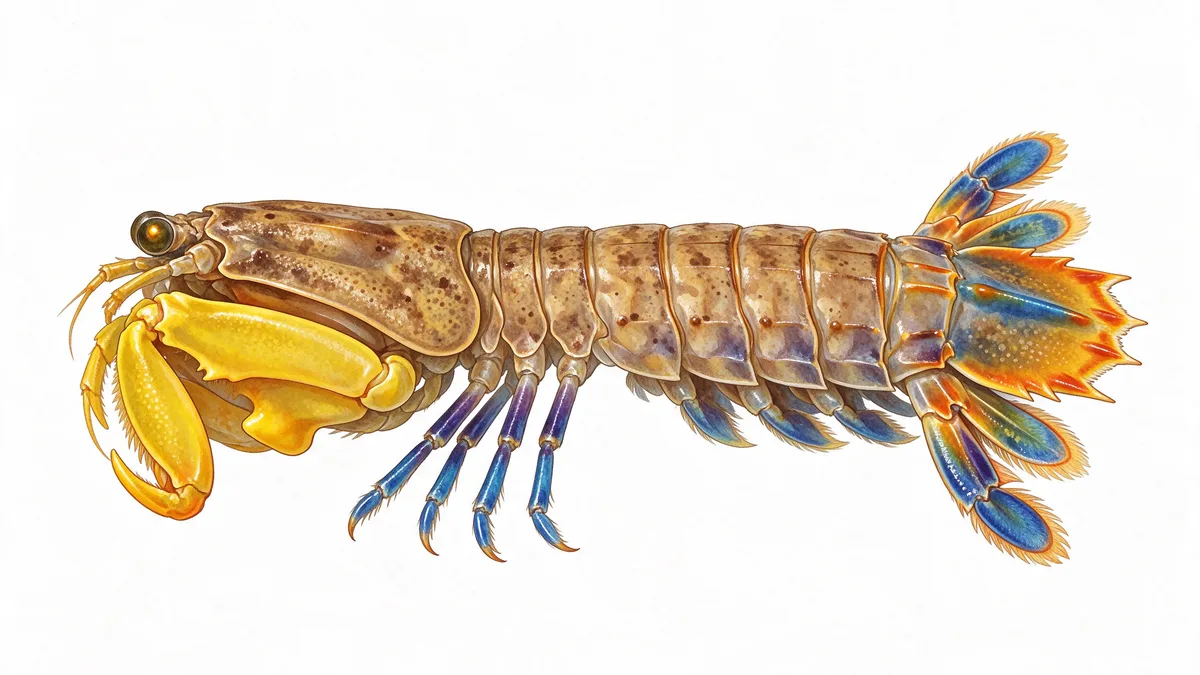
Mantis Shrimp Identification
Mantis shrimp identification starts with the eyes: two big, stalked, independently swiveling eyes on movable stalks at the front of a flattened body. No true shrimp has eyes like that. Behind the eyes, the giveaway is the pair of folded forelimbs tucked under the head like a boxer's fists — the "raptorial appendages" that give the animal its mantis look.
The body runs long and flattened, with a short carapace that leaves part of the back exposed, and a segmented, armored tail ending in a wide fan called the telson. On the California species, that tail fan is the flashy part: bright blue, orange, and yellow uropods with a pair of eyespots underneath, flashed at predators to startle them.
Color varies by species. Squilla empusa is drab — a muddy tan, greenish-brown, or gray that blends into soft bottom. Hemisquilla californiensis is the show-off, with blue-to-purple legs, yellow raptorial claws, and sometimes a pinkish-red wash across the carapace. Both look nothing like the thin-legged, translucent penaeid shrimp (white, brown, and pink shrimp) most people know, which is the first clue that a mantis shrimp is not a true shrimp at all.
Mantis Shrimp Species and Look-Alikes
Mantis shrimp belong to the order Stomatopoda — roughly 450 species worldwide, almost all in tropical or subtropical water. Only a handful show up on U.S. coasts, and two dominate.
- Atlantic mantis shrimp (Squilla empusa) — ranges from Maine and Cape Cod down through Chesapeake Bay, the Carolinas, Florida, and the Gulf of Mexico to Texas. This is a "spearer," built with barbed, spine-tipped forelimbs that stab soft prey rather than crush shells. It grows to 6–10 inches, occasionally 12, and lives in U-shaped burrows in mud.
- California mantis shrimp (Hemisquilla californiensis) — from Point Conception, California, south to Panama, including the Sea of Cortez. This is a "smasher," with club-like forelimbs it uses to crack shells against rock. It reaches 10–12.6 inches and is one of the largest mantis shrimp species in the world.
- Rock-dwelling smashers (Neogonodactylus spp.) — smaller, 2–4 inch species that live in holes in coral and rock around Florida and the Caribbean. Rarely caught by anglers but common under dock pilings.
What anglers usually confuse them with:
- True shrimp (white, brown, pink shrimp) — thin, translucent bodies, long antennae, no folded clubs, order Decapoda. Mantis shrimp are chunkier and hold their claws folded.
- Pistol shrimp — tiny burrow-dwellers with one oversized snapping claw that makes a loud "pop." No mantis fold, no striking power.
- Ghost shrimp — soft, pale, burrowing shrimp used as live bait. No raptorial arms and harmless to handle.
- Mole crabs (sand fleas) — barrel-shaped, clawless, found in the surf zone. Easy to tell apart once you see the mantis shrimp's eyes and folded limbs.
Are Mantis Shrimp Dangerous?
Yes — to your fingers, though not in a venomous way. A mantis shrimp won't poison you, but a "smasher" species can ruin your day. The club-shaped forelimbs accelerate faster than most rifle bullets leave the muzzle — up to about 50 mph, in about 3 milliseconds — and the strike lands with enough force to shatter a crab or snail shell, or crack quarter-inch aquarium glass. That's where the nickname "thumb splitter" comes from, and it isn't hyperbole: the blow can split skin and break a finger.
Spearers like Squilla empusa are less dramatic but still sharp. Their forelimbs carry barbed spines that can stab and puncture if you grab the animal wrong.
Safety rules are simple. Don't put a bare finger into a burrow hole. Handle them with thick gloves or a lip-grip tool, and grab behind the head where the claws can't reach. If you're catching them in a cast net, dump the net carefully — a mantis shrimp in a pile of bycatch will flail, and it doesn't care what it hits.
Where Do Mantis Shrimp Live?
On the Atlantic and Gulf coasts, Squilla empusa turns up from Maine to Texas in soft mud and sandy-mud bottom, from the intertidal zone down to about 500 feet. Chesapeake Bay's muddy lower intertidal is a classic stronghold, and the species is one of the most common crustaceans on the northern Gulf shelf. On the Pacific side, Hemisquilla californiensis lives from Point Conception, California, to Panama, from the shallows down to roughly 295 feet.
The real answer to "where do mantis shrimp live" is in a burrow. Both species dig U-shaped tunnels in soft sediment, with two openings on the surface. Atlantic mantis shrimp space their burrow mouths 2–3 feet apart; in winter, northern populations dig a vertical shaft up to 13 feet deep. Around Florida and the Caribbean, the smaller smashers tuck into rock and coral holes instead.
For anglers, that means bay flats, tidal creeks, dock lines, and the bycatch of a shrimp trawl or cast net are all places you'll meet one.
Mantis Shrimp Behavior: What Do Mantis Shrimp Eat?
Mantis shrimp are ambush predators, and they're mostly nocturnal. They sit inside their burrow and strike prey that wanders past the entrance. Smashers crush hard prey — crabs, snails, clams, and other crustaceans — while spearers stab soft-bodied targets like small fish, shrimp, worms, and krill. Both are happy to cannibalize, and a big Squilla empusa will take down a small flounder given the chance.
That diet is exactly why they work as bait. A mantis shrimp is a natural meal for flounder, sheepshead, tautog, striped bass, and red drum — the same bottom feeders that patrol the mud flats where the shrimp live. Rigged whole on a bottom rig, a 6-inch mantis shrimp is one of the toughest, fishiest baits you can put in front of a sheepshead.
Activity peaks at night and around tide changes, when the shrimp leave the burrow to hunt. Numbers inshore are strongest spring through fall; in the northern part of the Atlantic range they hold deeper in winter.
Mantis Shrimp Size and Regulations
The typical mantis shrimp size an angler sees is 6–10 inches on the Atlantic coast, with Gulf specimens running smaller (often around 5 inches) and northern Atlantic fish occasionally reaching a foot. The California smasher is the heavyweight, topping out around 12.6 inches (32 cm). Atlantic mantis shrimp weigh 40–110 grams on average. There is no IGFA all-tackle record for mantis shrimp — they aren't a game fish — so "record" here means the biggest one you can dig out of a net.
Regulations are the short version of this story: in nearly every coastal state, the mantis shrimp is not a managed recreational species. There is no dedicated bag limit, size limit, or closed season for it in Texas, Louisiana, Florida, the Carolinas, or California. What you do need:
- A saltwater fishing license. All coastal states require one for any recreational take in state waters (0–3 miles offshore). A state license or registration also covers you under the NOAA saltwater angler registry for federal waters.
- Legal gear. Mantis shrimp are typically kept as bycatch from a cast net, seine, or recreational shrimp trawl, all of which are regulated by gear type and season in each state. Check your state's net rules before you throw.
- Bait rules. Texas, for example, only allows Gulf-native shrimp as bait — mantis shrimp ("sea lice") are on the approved list, and bait shrimp may be possessed year-round. South Carolina caps recreational shrimp harvest at 48 quarts (heads-on) per boat per day, which applies if you're netting shrimp and keep mantis shrimp as part of the take.
State-by-state limits and seasons change, so verify before you go:
- NOAA Fisheries recreational fishing: https://www.fisheries.noaa.gov/topic/resources-fishing/recreational-fishing
- Texas Parks & Wildlife: https://tpwd.texas.gov/
- South Carolina DNR: https://www.dnr.sc.gov/
- Florida FWC: https://myfwc.com/
- California DFW: https://wildlife.ca.gov/
Last verified: November 2026.
How to Catch Mantis Shrimp
Most anglers don't target mantis shrimp on purpose — they show up in the cast net while you're after bait shrimp, or in a minnow trap left overnight in a tidal creek. If you want them on demand, three methods work.
The easiest is a funnel trap on the bottom. A small box or funnel trap baited with cut menhaden, squid, or shrimp heads, set on a mud bottom at night and checked the next morning, will load up with mantis shrimp in good areas.
On sand flats, the salt trick works at low tide. Find the burrow opening, pour a small amount of table salt down the hole, and wait. The shrimp backs out within a minute or so to escape the salt. Have a gloved hand or a net ready, because it comes out fast and swinging.
If you're netting anyway, a cast net or seine over a mud flat at dusk pulls mantis shrimp up as bycatch. Sort them into a separate bucket — they'll tear up any other shrimp or baitfish you're keeping.
Handle every one behind the head, or with heavy gloves, and rig them whole on a Carolina or fish-finder bottom rig. That's mantis shrimp fishing at its simplest: put the bait where the flounder and sheepshead are, and let the shrimp do the rest.
Mantis Shrimp FAQ
Are mantis shrimp dangerous? To a finger, yes. Smashers can split skin and crack bone; spearers can puncture. They're not venomous and don't attack unprovoked, but handle with gloves and never reach into a burrow barehanded.
Where do mantis shrimp live? In U-shaped burrows in soft mud and sand, from the intertidal zone to about 500 feet. On U.S. coasts: Maine to Texas in the Atlantic and Gulf, and Point Conception, California, to Panama in the Pacific.
How big do mantis shrimp get? Atlantic mantis shrimp typically run 6–10 inches and occasionally reach a foot; the California mantis shrimp is the largest U.S. species at up to 12.6 inches.
What do mantis shrimp eat? Fish, shrimp, crabs, worms, krill, clams, and snails. Smashers crush shelled prey; spearers stab soft-bodied prey.
Can you eat mantis shrimp? You can — they're edible and popular in parts of Asia — but U.S. sources rate the meat yield low for the work involved. South Carolina's DNR calls the meat "little, of poor quality." Most American anglers use them as bait instead.
Do I need a license to catch mantis shrimp? Yes, a state saltwater fishing license is required in every coastal state. There is no dedicated bag or size limit for mantis shrimp, but gear rules and general shrimp limits (like South Carolina's 48-quart cap) still apply.
Why are they called thumb splitters? Because a smasher's club-like forelimbs strike with enough force to crack shells and aquarium glass — and a finger caught in the way doesn't win that exchange.
Can a mantis shrimp break glass? Yes. Smashers are documented cracking aquarium glass, which is why aquarists keep them in acrylic tanks.
Related Articles
- sheepshead
- flounder
- striped-bass
Ready to catch one? Read our step-by-step guide: How to Catch Mantis Shrimp.
About the author and how this was tested
About the author
FishermanGuy
Bank, boat and kayak angler · fishing, crabbing and shrimping since 2021
I buy the gear, fish it for a season and write down what failed. No sponsored verdicts, no free-sample flattery. Every rig on this page has landed fish in water I can point at on a map.
How this was tested
- Every rig gets at least six trips on the same water before it is published.
- Gear is bought at retail. Free samples are labelled in the first paragraph.
- Dates show first publication and the last time the page was updated.