Field notes
Types of Shrimp in the US: Species & What to Eat
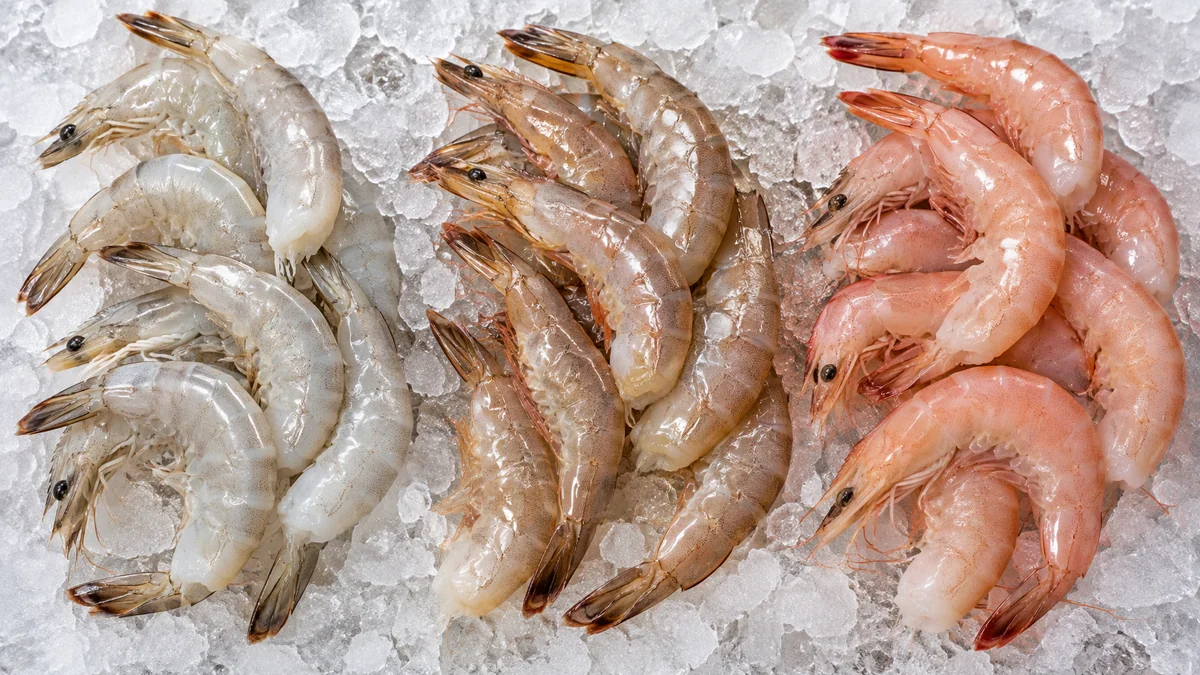
The types of shrimp sold in the US are fewer than the names on the ice suggest. Most of the volume comes from three penaeid shrimp — white, brown and pink — that are sold under the collective label "Gulf shrimp" . Beyond those come a deepwater species, a hard-shelled rock shrimp, a northern shrimp whose fishery is closed, and a large Pacific spot shrimp. This guide covers seven species plus the Gulf shrimp trade name, with the scientific name, range, meat, season, size and gear for each. Fields the sources leave blank are marked as not documented rather than guessed.
White Shrimp (Litopenaeus setiferus)
The white shrimp is Litopenaeus setiferus (Linnaeus, 1767) . The World Register of Marine Species now treats that name as a superseded combination and accepts Penaeus (Litopenaeus) setiferus, while GBIF still lists the older name as a synonym; both forms are in current use .
It ranges on the Atlantic coast from Fire Island, New York, to St. Lucie Inlet, Florida, and in the Gulf of Mexico from the Ochlockonee River, Florida, to Campeche, Mexico, living in estuaries and nearshore water out to about 100 feet . The meat is the tail, the abdominal muscle; raw meat is translucent pink to gray and turns pearl white with pink after cooking .
Spawning runs March to September in the Gulf and May to September off the Carolinas, commercial seasons are set by each state, and Texas federal waters close completely for about mid-May to mid-July each year . The shrimp reaches 7 to 8 inches and matures at about 5.5 inches . Gear is the bottom trawl, which must carry turtle excluder devices .
Brown Shrimp (Farfantepenaeus aztecus)
The brown shrimp is Farfantepenaeus aztecus (Ives, 1891), which WoRMS records as a superseded combination for Penaeus (Farfantepenaeus) aztecus . Its range runs from Martha's Vineyard, Massachusetts, to the Florida Keys and along the Gulf coast to northwestern Yucatan, mostly in water shallower than 180 feet and down to 360 feet . The edible part is the tail meat .
Spawning peaks in spring and summer and young shrimp enter the estuaries in February and March; Texas federal waters close for about mid-May to mid-July each year to protect the species . Brown shrimp reach 7 inches and mature at about 5.5 inches . Gear is the near-bottom trawl, wide at the mouth and tapering to the cod end, fitted with turtle excluder devices .
Almost all US brown shrimp landings come from the Gulf of Mexico, mainly Texas and Louisiana.
Pink Shrimp (Farfantepenaeus duorarum)
The pink shrimp is Farfantepenaeus duorarum (Burkenroad, 1939), unaccepted at WoRMS in favor of Penaeus (Farfantepenaeus) duorarum . It ranges from the southern Chesapeake Bay to the Florida Keys and around the Gulf to Cabo Catoche, Mexico, and is most abundant off southwest Florida and in the southeastern Bay of Campeche . The edible part is the tail meat, and the tail usually carries dark blue banding .
Spawning off North Carolina runs May to July and Florida fish spawn repeatedly from April to July; Texas federal waters close in the same mid-May to mid-July window . Pink shrimp can exceed 8 inches and mature at about 3.3 inches . Gear is the bottom trawl .
Gulf Shrimp: A Trade Name, Not a Species
"Gulf shrimp" is not a scientific name and should not be read as a single animal. It is the industry label for the three penaeid shrimp above — white, brown and pink — which together make up the great majority of shrimp landings in the southeastern US . The catch comes mainly from the Gulf of Mexico, led by Texas and Louisiana, plus the South Atlantic coast . The edible part is the tail meat , and Texas federal waters close for about mid-May to mid-July each year, with the rest of the fishery managed on rolling state and federal seasons . Sizes follow the individual species, in the 7-to-8-inch range . Gear is the otter trawl, with turtle excluder devices required .
Royal Red Shrimp (Pleoticus robustus)
The royal red shrimp is Pleoticus robustus (Smith, 1885), accepted by GBIF but recorded by WoRMS as a superseded combination for Faxonia robusta; the two databases disagree, so both names are worth knowing . It occurs in the western Atlantic and the Gulf of Mexico, with most GBIF records from the US and the rest from Colombia and Mexico; it is a deepwater shrimp, and the sources do not break down its depth range or subregions further . The meat is the tail . Season and size are not documented in the sources. Gear is the bottom trawl used across the Gulf shrimp fishery, though gear details specific to this species are not documented in the sources .
Rock Shrimp (Sicyonia brevirostris)
Sicyonia brevirostris Stimpson, 1871 is the rock shrimp, accepted by both WoRMS and GBIF . It ranges from Norfolk, Virginia, south through the Gulf to Yucatan, on sand bottom in 80 to 215 feet with a deepest record at 600 feet, and it is the largest of the six rock shrimp species in that area .
The shell is thick and hard to peel, so the catch is sold almost entirely as meat; the flavor is close to lobster and the trade nickname is "little shrimp with a big lobster taste" . It spawns year-round with a peak from November to January . It can reach 6 inches, though shallow-water individuals are mostly under 2 inches . Gear is the bottom trawl, and parts of Florida are closed to trawling to protect deepwater coral .
Northern Shrimp (Pandalus borealis), Sold as Maine Shrimp
Northern shrimp and Maine shrimp are the same animal, Pandalus borealis Krøyer, 1838; "Maine shrimp" is a market and place name, not a separate species. Its range covers the Gulf of Maine and inshore New England waters off Maine, New Hampshire and Massachusetts, and it also occurs off the West Coast, Alaska, Canada, Greenland, Iceland and Norway.
The meat is the tail . Live shrimp have a reddish tail and body under a translucent shell . The fishery has been closed in every season since 2014, after the stock was assessed as collapsed, and it has not reopened. Average size is 2 to 4 inches, with a maximum around 3 to 4 inches. The historical gear is the bottom trawl, with traps also used in the past; with the fishery closed, neither is in use.
Background: northern shrimp, how to catch northern shrimp.
Spot Shrimp (Pandalus platyceros)
Pandalus platyceros Brandt, 1851 is the spot shrimp, also called spot prawn . It ranges from southern California to the Aleutians and west to the Sea of Japan and Korea Strait; adults live around rock piles, crevices, coral and rubble, most concentrated at about 60 fathoms .
The meat is the tail . Specific season months are not documented in the sources; the shrimp carry eggs from October to March, and Southeast Alaska runs a pot fishery with a quota of about 800,000 lb . It is the largest shrimp in its range, with big females over 23 cm, about 9 inches . Gear is the baited pot, fished mainly in protected Southeast Alaska bays .
FAQ
Is Gulf shrimp one species? No. Gulf shrimp is a trade name for white, brown and pink shrimp together, and those three make up the great majority of southeastern US shrimp landings .
Is Maine shrimp the same as northern shrimp? Yes. Maine shrimp, northern shrimp and Pandalus borealis are three names for one species.
Why is Maine shrimp hard to find? The fishery has been closed in every season since 2014, when the stock was assessed as collapsed .
Why is rock shrimp usually sold as peeled meat? The shell is thick and hard to peel, so nearly all of the catch is sold as meat .
About the author and how this was tested
About the author
FishermanGuy
Bank, boat and kayak angler · fishing, crabbing and shrimping since 2021
I buy the gear, fish it for a season and write down what failed. No sponsored verdicts, no free-sample flattery. Every rig on this page has landed fish in water I can point at on a map.
How this was tested
- Every rig gets at least six trips on the same water before it is published.
- Gear is bought at retail. Free samples are labelled in the first paragraph.
- Dates show first publication and the last time the page was updated.