Field notes
Red Swamp Crawfish: Identification, Habitat & Diet
Red Swamp Crawfish: Identification, Habitat & Diet
Walk down any bayou town in south Louisiana between February and June and you'll see it: steaming piles of bright-red, spice-caked mudbugs heaped onto newspaper-covered tables. The red swamp crawfish (Procambarus clarkii) is the animal behind that scene. It's the most heavily farmed freshwater crustacean in North America, a beloved food animal, and — for anglers — one of the easiest "catches" in the country. A kid with a length of string, a chicken neck, and a roadside ditch can fill a bucket before lunch.
The red swamp crawfish goes by more names than almost any animal in the South. Call it crawfish, crayfish, crawdad, or mudbug and you're talking about the same species. What matters for anyone on the water is that it's everywhere, it's easy to catch, and it eats great.
Red Swamp Crawfish at a Glance
| Field | Detail |
|---|---|
| Scientific name | Procambarus clarkii |
| Common names | Crawfish, crayfish, crawdad, mudbug, Louisiana crawfish |
| Typical size | 2.2–4.7 in (5.5–12 cm); commercial "select" grade runs about 3 in |
| Habitat | Shallow freshwater — ponds, bayous, rice fields, slow creeks, ditches |
| Difficulty | Beginner — one of the easiest fisheries in the U.S. |
| Best season | February–June in Louisiana; peak March–May |
How to Identify a Red Swamp Crawfish
A crawfish is essentially a miniature freshwater lobster — a hard-shelled decapod built like a squat tank with a fan tail.
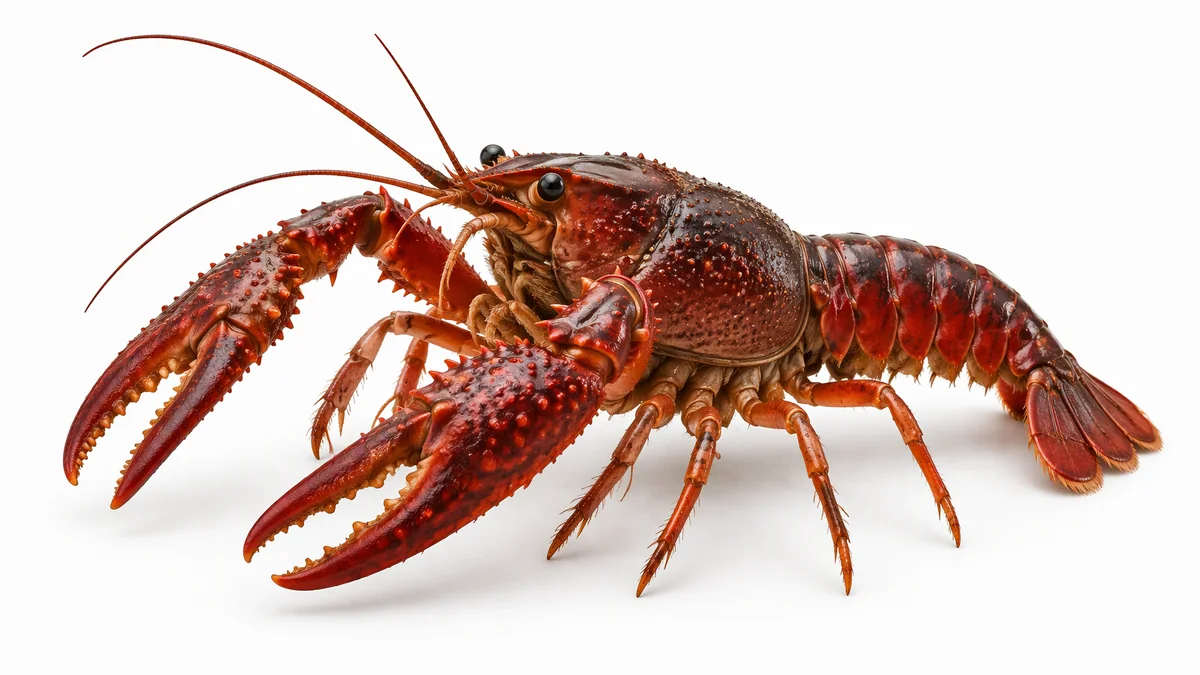
Color is the first giveaway. Adults run dark red to brick red, often with a brownish or olive cast across the back. The claws are the signature feature: long, slender, and studded with bright-red bumps (tubercles) that look like little warts. Young crawfish start out more olive or gray-brown and deepen to red as they mature. A rare blue color morph pops up now and then, and even rarer white ones show up occasionally — worth a photo if you ever find one.
The body splits into two parts. The front half is the cephalothorax, the fused head and thorax under a single shield of shell. The back half is the segmented abdomen — the "tail" that fans out at the end and holds most of the edible meat. Five pairs of legs line the underside: the first pair forms the claws (chelae), and the other four do the walking. A pointed, wedge-shaped rostrum juts out between the eyes.
The three tells to remember: dark red body, long slender claws covered in red wart-like bumps, and a wedge-shaped nose. That combination separates it from most other crawfish sharing its range.
Similar Species: Crawfish vs. Lookalikes
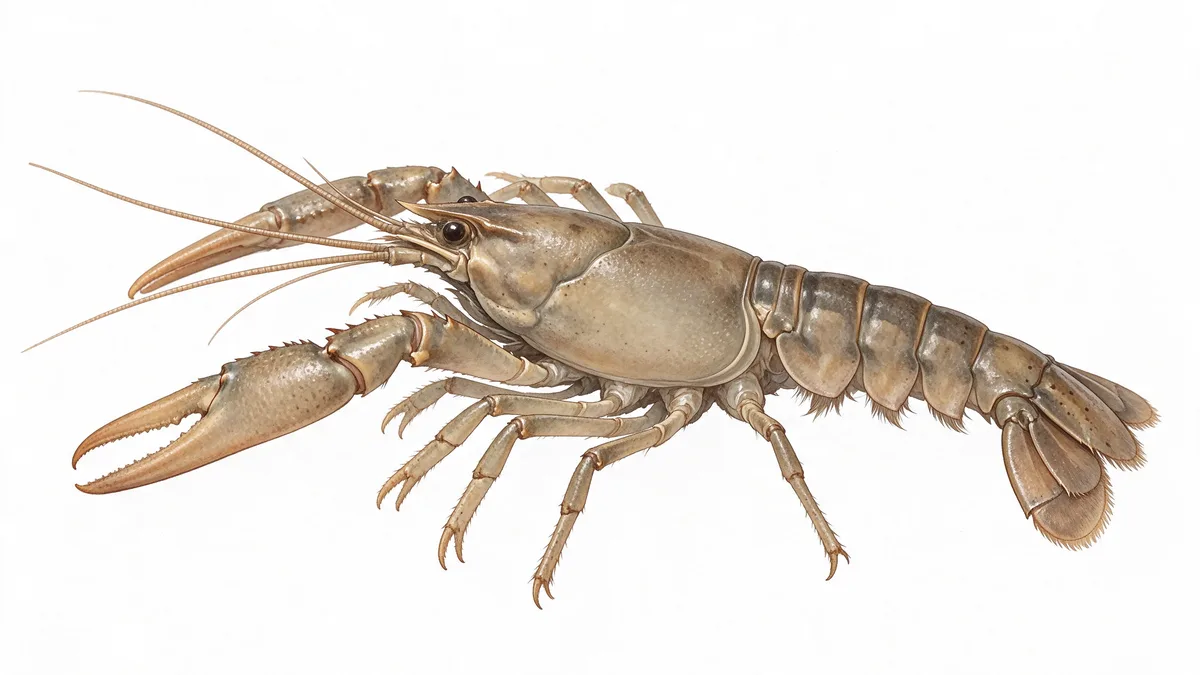
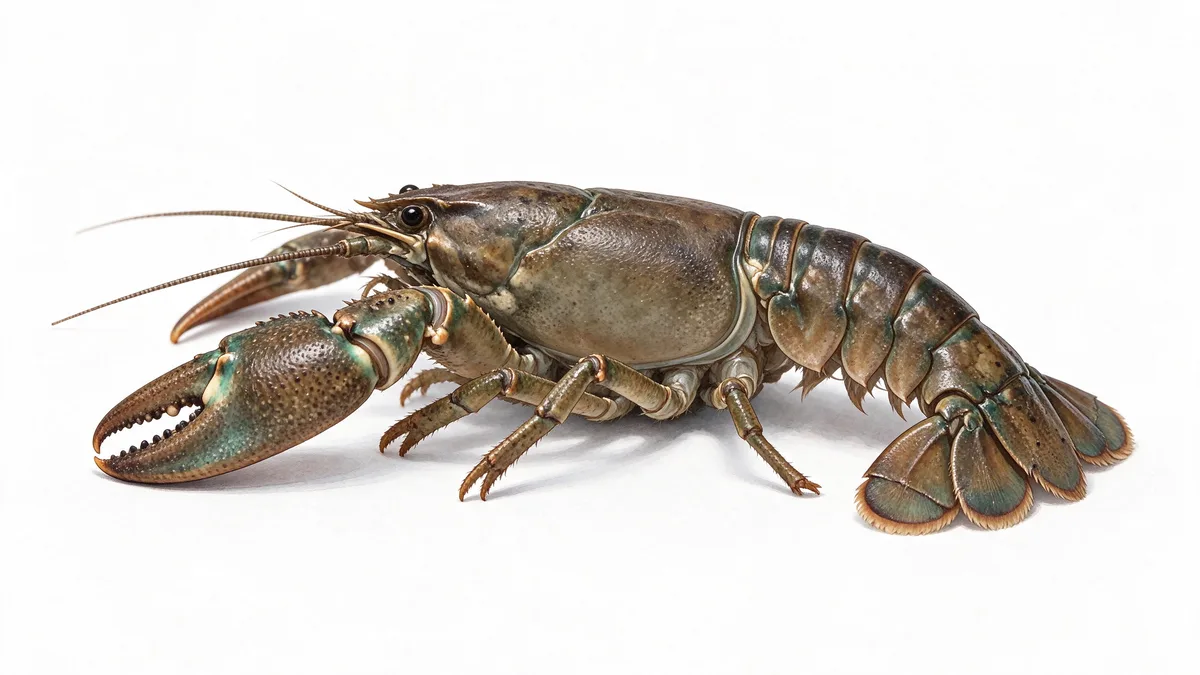
Sort through a bucket of mudbugs and two other species will trip you up. The white river crawfish (Procambarus zonangulus) shares the same bayous and, confusingly, the same aquaculture ponds — farmers often raise both together. It runs paler, more tan or gray, with longer, thinner claws and none of the bright red tubercles. Farther out West, the signal crayfish (Pacifastacus leniusculus) shows up as an invasive species; it grows bigger and flashes a white-to-turquoise patch right at the claw hinge.
And then there's the question everybody asks: crawfish vs. lobster. Short version — same body plan, different family, different water, and a very different size class. The full breakdown is in the FAQ below.
| Species | Color | Claws | Size | Where you'll see it |
|---|---|---|---|---|
| Red swamp crawfish (P. clarkii) | Dark red to brick red | Long, slender, red tubercles | 2.2–4.7 in | Gulf South, farm ponds, ditches |
| White river crawfish (P. zonangulus) | Tan to gray-brown | Longer, thinner, no red bumps | Similar, slightly larger | Louisiana and Texas bayous, ponds |
| Signal crayfish (P. leniusculus) | Brown to blue-green | White/turquoise patch at hinge | Larger, up to 6+ in | Pacific Northwest, invasive |
Are Crawfish Dangerous?
Short answer: no venom, no poison — just a pinch. The claws of a red swamp crawfish can draw blood when a big one clamps down, especially on a kid's finger or the web of your hand. It stings, but it's not medically serious. Clean the nick like any small cut and you're done.
Grab them safely by pinching the back of the carapace, right behind the claws — they can't reach you there. If one latches on, don't yank; dip your hand back in the water and it usually lets go.
The only real risk is eating one that was mishandled or undercooked. Boil them thoroughly (at least 10 minutes), purge and devein them, and never eat one that was already dead before it hit the pot.
Where Do Crawfish Live: Range & Habitat
The red swamp crawfish is a Gulf Coast native. Its natural range runs from the Florida panhandle west across Alabama, Mississippi, Louisiana, and Texas into northeastern Mexico, and north up the Mississippi River valley into southern Illinois. It's also native in pockets of Oklahoma, Tennessee, and New Mexico. Louisiana is its cultural home — Louisiana crawfish are a more than $150-million-a-year industry, and mudbugs are as tied to the state's identity as jazz or gumbo.
But this species travels. It's been introduced into at least 15 other states and is now established from the Chesapeake Bay to the Great Lakes (Ohio, Michigan, Wisconsin), out to California, Oregon, and Washington, and even in Hawaii. In those places it's a problem — a burrowing, fast-breeding omnivore that out-competes native crayfish and undermines levees and rice-field banks.
Crawfish Habitat: Mud, Grass, and Burrows
Crawfish want three things: shallow water, a soft muddy bottom, and cover. Think farm ponds, bayous, rice fields, slow-moving creeks, swamps, and — the classic — roadside ditches. Water a couple of feet deep or less is ideal. Aquatic plants provide both food and hiding spots.
Their burrows are the dead giveaway that crawfish are around. They tunnel into banks and levees, sometimes more than three feet deep, leaving a mud "chimney" at the entrance. That burrow is a survival bunker: it stays damp, so crawfish can ride out droughts and hot summers for months at a time.
How to Catch Crawfish: What They Eat and When to Fish
Catching crawfish barely counts as fishing, which is exactly why it's the classic gateway for kids in the South. But there are real tricks to filling a sack instead of a small bucket.
The string-and-bait method is the icon. Tie a chunk of chicken liver, a chicken neck, or even a hot dog to a length of string, lower it into a ditch or pond, and wait for the tug. Crawfish clamp on with their claws and won't let go, so you can lift them slowly out of the water and drop them straight into a bucket. For volume, a baited pillow-style wire trap set near cover and checked every few hours beats hand-lining by a wide margin.
What Do Crawfish Eat
Crawfish are omnivores, and they are not picky. They graze on aquatic plants and algae, scavenge dead fish and carrion, and hunt whatever they can catch — snails, insects, tadpoles, worms, and small fish. Juveniles lean heavier on animal protein; adults shift toward vegetation and detritus. For bait, the smellier the better: chicken necks, oily fish heads, canned cat food, or commercial crawfish bait all work.
When Is Crawfish Season
Timing matters more than technique. In Louisiana, wild and farmed crawfish hit their stride from late winter through early summer — roughly February to June, with the peak from March through May, once the water warms into the 60s and 70s. That's when the crayfish are actively feeding and molting and the ponds are full. Crawfish are most active around dusk and dawn and on overcast days; a bright, hot afternoon is the slowest time to chase them.
Crawfish Size, Crawfish Season, and Crawfish Regulations
Crawfish Size
Most crawfish you'll catch or buy run 2.2 to 4.7 inches long, with market "select" or "jumbo" mudbugs in the 3-inch-plus range. A red swamp crawfish can pack on more than 50 grams (about 1.8 ounces) in three to five months of good growing. The species record is a monster for its kind: the largest reported specimen measured about 160 millimeters (6.3 inches), though that outlier came from an introduced population abroad. There's no official rod-and-reel record for crawfish — nobody keeps one — so a 5-inch mudbug is bragging-rights territory.
Crawfish Regulations
Rules are state by state, and they're refreshingly simple compared to finfish.
Louisiana (the crawfish capital): - License: a Basic Fishing License (required at age 18 and up), which includes crawfish trap gear. Harvesting with just nets, dip nets, hand lines, or a bait seine requires only a Hook & Line License. A WMA Access Permit is required on LDWF wildlife management areas and refuges. - Season: open year-round in state waters — no closed season, except on some WMAs and refuges, where crawfishing runs March 15 through July 31. - Limits: no minimum size; 150 pounds per person per day in state waters (100 pounds per day on many WMAs and refuges). - Gear: up to 35 traps per person; traps must carry a waterproof tag with your gear license number, and trap mesh must be at least 3/4 by 11/16 inch.
Texas: - License: a freshwater fishing license with a freshwater endorsement to take crayfish from public fresh waters. - Limits: no bag or size limit on crawfish; harvest is open year-round. - Gear: minnow traps up to 24 inches are the standard legal crawfish trap.
Check your state before you set gear — invasive-crawfish rules in places like Washington, Oregon, and the Great Lakes states are stricter (some require permits or ban live transport outright) because red swamp crawfish damage native ecosystems there.
Sources: Louisiana Department of Wildlife and Fisheries (wlf.louisiana.gov); Texas Parks & Wildlife (tpwd.texas.gov). Last verified: November 2026.
FAQ: Common Crawfish Questions
What do crawfish eat? Just about everything. Aquatic plants, algae, snails, insects, tadpoles, worms, small fish, and any dead animal they can find. That broad diet is why they thrive everywhere from rice fields to drainage ditches.
Where do crawfish live? In shallow freshwater with soft, muddy bottoms — ponds, bayous, swamps, rice fields, slow creeks, and ditches. They also dig burrows into banks that stay moist enough to survive droughts.
Crawfish vs. lobster — what's the difference? They're cousins, not the same animal. Lobsters are marine, belong to a different family (Nephropidae), and grow 8 to 20-plus inches; crawfish are freshwater (Cambaridae) and rarely top 5 inches. The meat is the other flip: with lobster you prize the claws, with crawfish you peel the tail.
When is crawfish season? Roughly February through June in Louisiana, peaking March to May. The season follows water temperature — once ponds and bayous warm into the 60s and 70s, crawfish get active.
How big do crawfish get? Typically 2.2 to 4.7 inches. A 5-incher is big, and the largest red swamp crawfish on record hit about 6.3 inches.
Do you need a license to catch crawfish? Usually, yes. Louisiana requires a Basic or Hook & Line license, and Texas requires a freshwater license with a freshwater endorsement. Check state rules — especially outside the native range, where crawfish are regulated as invasive species.
What's the best bait for crawfish? Oily, smelly protein: chicken necks or livers, fish heads, canned cat food, or commercial crawfish bait. Crawfish find food by smell, and they'll hang on once they grab it.
Are crawfish safe to eat? Yes, when handled right. Boil at least 10 minutes, purge and devein, and throw out any that were dead before cooking.
Related Articles
Ready to catch one? Read our step-by-step guide: How to Catch Red Swamp Crawfish.
About the author and how this was tested
About the author
FishermanGuy
Bank, boat and kayak angler · fishing, crabbing and shrimping since 2021
I buy the gear, fish it for a season and write down what failed. No sponsored verdicts, no free-sample flattery. Every rig on this page has landed fish in water I can point at on a map.
How this was tested
- Every rig gets at least six trips on the same water before it is published.
- Gear is bought at retail. Free samples are labelled in the first paragraph.
- Dates show first publication and the last time the page was updated.